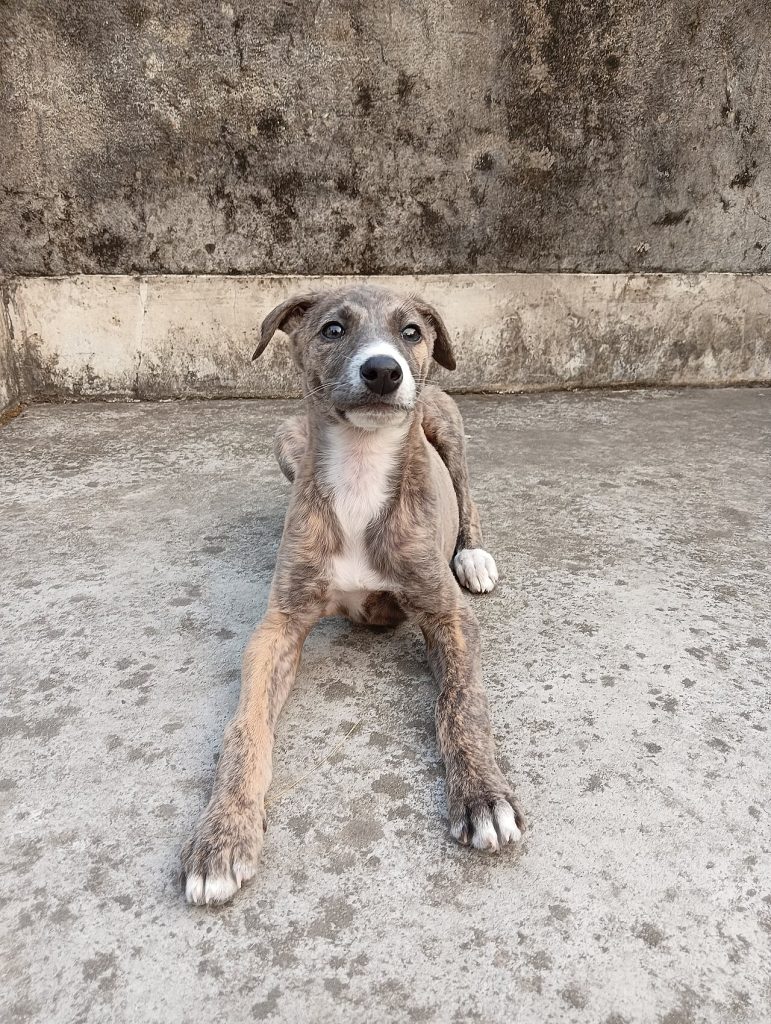
The Rampur Greyhound(Rampur Greyhound) is a large, agile, high-speed hare native to the Rampur region of northern India. bred for centuries by the nababs to hunt hares, jackals and even wild boars and panthers in the open ground, it is a pure sight dog: silent, independent and capable of detecting motion at enormous distances. Outside his homeland he is a rarity, and anyone looking for a Rampur Greyhound should know that he is up against a primitive athlete with intact hunting instincts, not a conventional companion dog.
Is the Greyhound of Rampur for you?
The Rampur Greyhound is a primitive type of hunting hare, far removed from the breeds designed for living in the living room. Before considering one, be honest about what it offers and what it requires. He’s a quiet, clean dog at home, but he needs space to run and very careful management of his chase instinct. It is not an easy dog for beginners or for those who live around cats, rabbits or chickens.
In favour .
- Exceptional speed and endurance – a dream companion for outdoor sports.
- At home he’s serene, quiet and surprisingly quiet when he’s spent his energy.
- Short coat that barely needs maintenance.
- Intense and loyal bond with his family; very sensitive to the treatment of his people.
- Rustic and healthy, with few documented hereditary problems compared to other breeds.
Against
- Very strong hunting instinct: difficult coexistence with cats and small animals.
- He needs to run at full speed in safe, fenced-in areas; just walking is not enough.
- Independent and reserved, he is not a “book” obedient dog.
- Very rare outside India: almost impossible to find and socialize with expert breeders.
- Its natural thinness and fine skin make it sensitive to cold and rubbing.

Character and temperament
The Rampur Greyhound combines two facets that at first glance seem contradictory. In the countryside it is an explosive, courageous and determined hunter, able to throw itself after a prey that it has seen move hundreds of meters away. At home, however, it is a quiet, almost contemplative dog, which enjoys lying in a comfortable corner and does not require constant attention.
It is a reserved and somewhat distant breed with strangers, inherited from its role as guardian and hunter in Rampur’s courts. It is not usually aggressive without motive, but neither does it distribute trust lightly: it observes, evaluates and decides. With its own family, however, it develops a deep bond and silent loyalty, and perceives with enormous finesse the mood of its people.
Its independence is that of all hares: it thinks for itself and is not programmed to obey orders mechanically. This does not mean that it is clumsy – on the contrary, it is very intelligent – but it cooperates when it understands why and trusts whoever asks it.
Coexistence: children, other pets, flat and loneliness
With children: The Rampur Greyhound is usually tolerant and gentle with the children in its family, although its reserved character and size advise supervision with the younger ones.
With other pets: has a very strong hunting instinct, and tends to see cats, rabbits and small animals as prey. Coexistence with cats is possible only if it grows with them from puppyhood and always with caution. With other dogs, especially of similar size, it usually gets along well if it is well socialized.
On the floor: As surprising as it may seem, an adult, well-exercised Rampur Greyhound can live in a flat, because indoors it is quiet and sleepy.
Soledad: reasonably tolerates being left alone if it has been progressively accustomed to it, but it is a dog that is very attached to its family and does not do well with prolonged isolation or lack of contact.
Education and training
Raising a Rampur Greyhound requires understanding that it is not an obedient working dog in the style of a shepherd or a retriever. It responds to positive reinforcement, short sessions and consistency, but shuts down to mechanical repetition and authoritarianism. The key is building trust and making collaboration enjoyable.
The early socialization is fundamental: the more it learns from puppy to people, environments, noises and other animals, the more balanced it will be as an adult.
The most difficult point is the called. Like any sight dog, when it starts after a moving stimulus it enters a state in which its owner’s voice ceases to exist. Therefore, in unfenced areas, safety rules: long leash or enclosed spaces.
Exercise and activity
This is a breed built for speed. The Rampur Greyhound needs something more than walks: it needs running at full gallop, and it needs to do so regularly.
The ideal are daily sessions that combine quiet walks with free-running explosions in a fenced and safe enclosure, where you can reach your top speed without the risk of going after a prey.
It is worth remembering that it is a sprinter, not a marathon runner: it prefers short bursts of maximum effort to long days of sustained jogging.
Care: fur and hygiene
The maintenance of the Rampur Greyhound is one of the simplest in existence. Its hair is short, thin and attached to the body., so a weekly brushing with a rubber glove or soft brush is enough to remove the dead hair and maintain the shine.
Bathing should be sporadic, only when it gets really dirty. It is advisable to pay attention to other details: checking the ears, taking care of the teeth and, above all, monitoring the cushions and skin, since its thin coat and its low body fat make it somewhat vulnerable to scratches, cuts and cold.
Foodstuffs
The Rampur Greyhound is a lean, muscular dog with very little body fat: this is its natural and healthy form, not a sign of being underweight.
You need a high-quality diet, rich in animal protein to maintain your muscle mass, and tailored to your activity level. Being a large, deep-chested dog, it is prudent to avoid strenuous exercise just before and after eating to reduce the risk of gastric dilation-torsion, a problem that affects deep-chested breeds. Fresh water should always be available, especially after races.
Health and life expectancy
The Rampur Greyhound is, as a whole, a rustic and resistant dog, the result of centuries of functional breeding without the flaws derived from extreme aesthetic selection.
Having said that, it shares with the rest of the hares some considerations of its morphology: Its deep thorax makes it theoretically susceptible to gastric dilation-torsion, and its low body fat requires caution with anesthesia (a trait common to greyhounds, which the vet should be aware of). Fine skin also demands attention in the face of cuts and cold. As with all hares, you should monitor your heart and dental health throughout your life.
Information about its longevity is scarce because of how rare the breed is, but, in line with other large-sized hares, one can expect a life expectancy around 10-12 years with good care.
Physical appearance
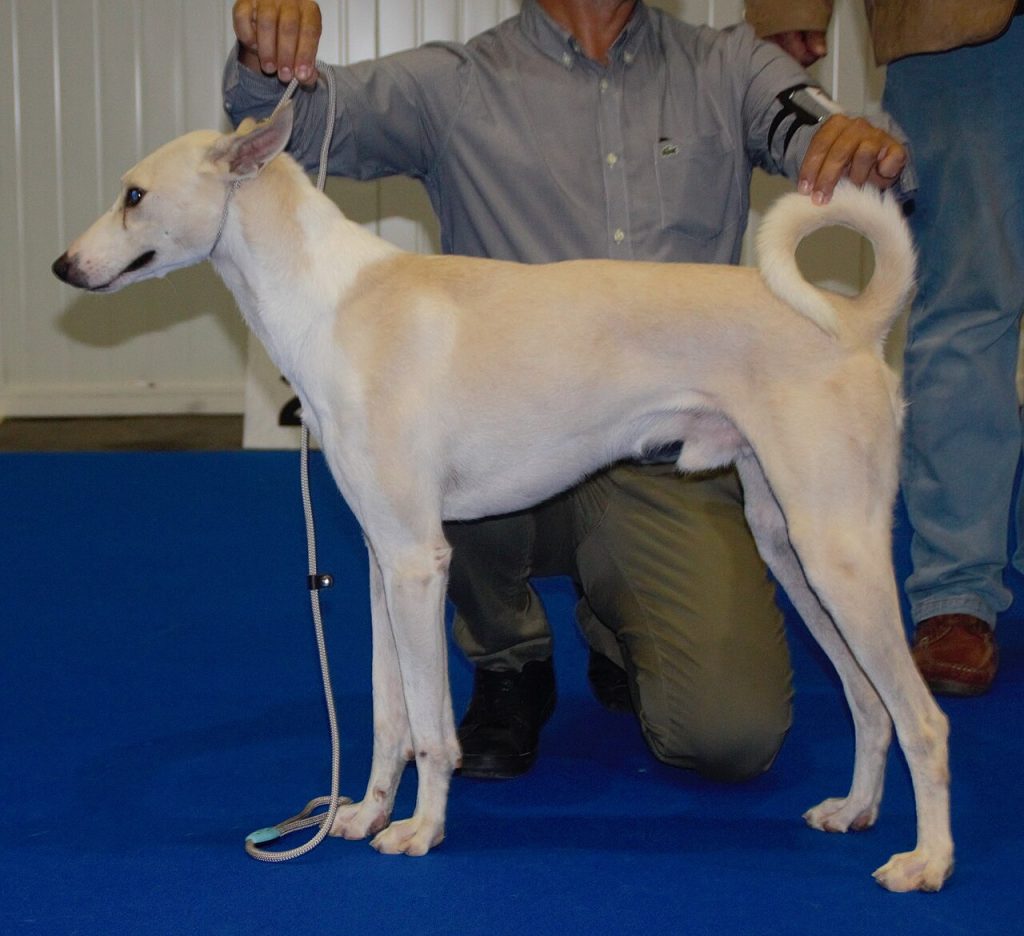
The Rampur Greyhound is a large and imposing hare that resembles a more robust English Greyhound or a larger Sloughi.
It is a sizeable dog. The height at the withers ranges from approximately 56 to 76 cm, and the weight around 23 to 32 kg, varying notably depending on the specimen and line. The head is long and narrow, with a flat skull and a sharp snout; the eyes, expressive, and ears, fine and mobile.
The the hair is short and thin, and supports a wide variety of colors: brindle, black, gray, fawn, brown and white, as well as their combinations.
Origin and history
The Rampur Greyhound takes its name from the Rampur region, in the present-day state of Uttar Pradesh, in northern India, between Delhi and Bareilly. It is believed to be descended from the ancient Tazy(Asian-type greyhounds related to the Afghan Greyhound and Saluki), brought to the region and adapted for hunting in the plains of northern India.
Its modern history is linked to the nabs of Rampur, which in the 19th century sought a dog capable of hunting in open ground hares, jackals and even larger prey such as wild boar and panther. To increase its speed, it was intensively crossed with the english Greyhound brought by the British during the colonial era. From that mixture came the Rampur Greyhound as we know it: a native hare, more stubborn and hardy than the European Greyhound, but equally fast.
It has traditionally been kept as a courses dog (hunting in sight) and rarely as a companion animal. Outside India it is hardly seen, and not even within the country enjoys the spread of other breeds today.
Curiosities
- Its name alternates with “Rampur Hound”, “North Indian Greyhound” or “Rampur dog”, depending on the source.
- It was said to be able to take on large prey, including jackals and even cats, an exceptional feat for a hare.
- Their resemblance to the North African Sloughi attracts the attention of many enthusiasts, although they are geographically very distant breeds.
- It is a breed mostly linked to private breeders and local communities in India, rather than to large international exhibition circuits.
- Like all sighthounds, it hunts with its eyes, not its nose.
If you are attracted to the Rampur Greyhound because of its elegance and speed, you will probably enjoy meeting other hares and athletic dogs of similar temperament. You can compare its character and needs with those of the Greyhound, its most direct relative; the agile Whippet, a smaller, more manageable version; the fast Vizsla, another high-endurance hunter; or the sleek Weimaraner, a sensitive-tempered hunting dog.
Frequently Asked Questions About the Rampur Greyhound
Is the Rampur Greyhound a good companion dog?
It may be for the right person. At home it is quiet, clean and affectionate with its family, but it retains a very strong hunting instinct and needs to run daily. It is not a dog for those looking for an obedient pet without exercise requirements, nor for those living with cats or other small animals.
How tall and how much does a Rampur Greyhound weigh?
It is a large hare: the height at the withers is approximately between 56 and 76 cm and the weight between 23 and 32 kg, with important variations depending on the specimen and the breeding line.
Do you get along with cats?
This is its most delicate point. Being a hunting hare with a very marked instinct of pursuit, it tends to see cats and small animals as prey.
How much exercise do you need?
A lot, and of a specific type: you need to run at full speed regularly, not just walk. Ideally, short, intense runs in fenced and safe spaces, in addition to your daily walks. Lure coursing is a perfect activity for the race.
How long does a Rampur Greyhound live?
Data are scarce for how rare the breed is, but, in line with other large hares, life expectancy is estimated to be around 10-12 years with good care.
Is it hard to find outside India?
The Rampur Greyhound is a rare breed even within India and practically does not exist outside its country of origin.
Is it easy to train?
It is intelligent but independent, like all hares. It responds well to positive reinforcement and patience, but is not a dog of mechanical obedience. Calling in the presence of moving stimuli is its greatest challenge and should never be taken for granted in open areas.
Where did the breed come from?
It is descended from ancient Tazy hares and acquired its present form in the 19th century through crosses with the English Greyhound encouraged by the Rampur nababs to improve their speed in hunting.