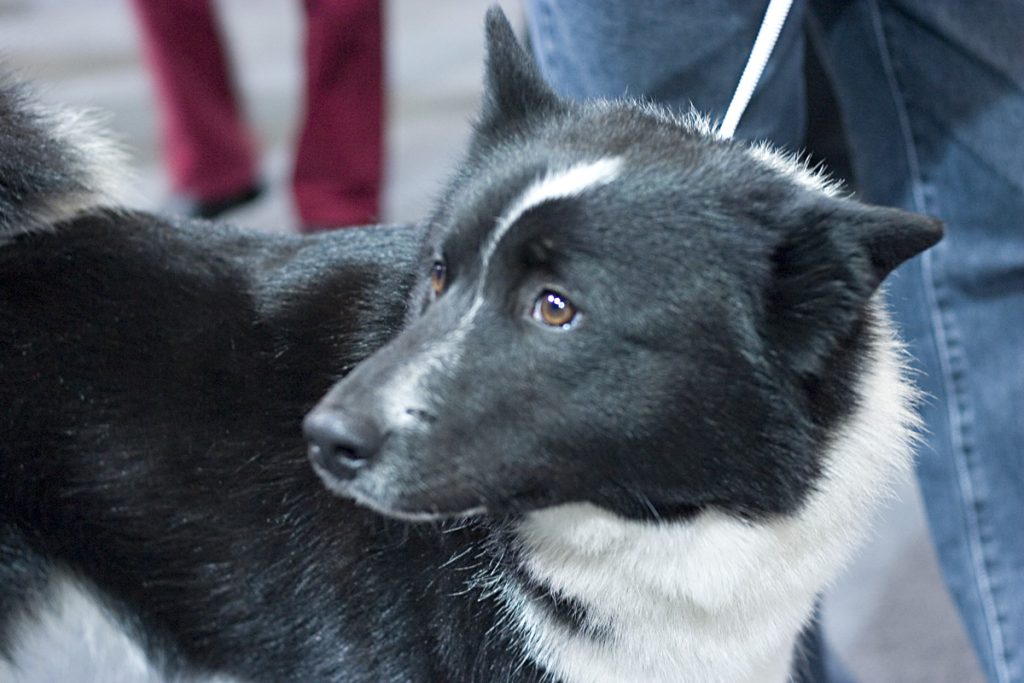
The Russian-European Laika(in Russian, Russko-Evropeïskaïa Laïka) is a Spitz-type hunting dog native to the forests of northern Russia, recognized for its vivacious temperament, exceptional smell and characteristic way of cornering and barking at prey. Medium in size, dense double coat and wolf-like appearance with erect ears and sickle tail on the back, it is a brave, territorial and deeply attached companion to its family, but demanding in exercise and unusual outside of its native Russia.
Is the Russian-European Laika for you?

Before you get carried away by its lovely wolf-like appearance, let’s be honest: the Russian-European Laika is a working dog to the bone. It fits wonderfully with hunters and with very active people who enjoy the mountains, and it fits fatally with anyone looking for a quiet couch dog. It’s not a breed that adapts to any home; it’s a breed that rewards those who give it a purpose.
In favour .
- Very close to his family and extraordinarily tolerant of the children at home.
- Excellent guard: territorial, alert and warns of everything.
- Rustic, hardy and healthy, adapted to cold and hard terrain.
- Excellent sense of smell and great work capacity.
- Simple maintenance coat off the seedlings.
To be taken into account
- He needs a lot of exercise; he gets bored and crushed if he doesn’t.
- He barks a lot, both at work and at home.
- Reserved with strangers and intolerant of other dogs.
- Strong hunting instinct: watch out for other small pets.
- Rare breed outside Russia: few breeders and little information.
Character and temperament
The breed standard describes a stable and temperamentally balanced dog, with a highly developed sense of smell and ability to detect prey.
On a day-to-day basis, the Russian-European Laika is a lively dog that loves to be outdoors. He is easily aroused by stimuli and expresses that emotion with his voice, barking both when locating a piece and when something draws attention to him at home. It’s a dog that he loves people deeply. from its core: Once you bond with someone, you become territorial and protective, which makes you an excellent guardian without the need to encourage aggression, which the standard itself considers a serious flaw.
It is not a submissive or overly self-indulgent dog: it is happy to cooperate when it understands that there is work to be done and trusts its guide. That is why it works so well with active owners who give it structure, and so badly with those who leave it without activity and clear leadership.
Coexistence: children, other pets, flat and loneliness

With the children of the family is remarkably tolerant and patient, always within the basic norms of coexistence between dogs and minors (supervision and respect by the child).
With strangers is reserved and suspicious, which reinforces its guardian aspect but requires socialization from a puppy so that caution does not lead to nervousness.
With other dogs and animals is where you have to be more careful: it is not tolerant of dogs you don’t know and its hunting instinct is strong, so coexistence with small pets (cats, rodents, birds) can be complicated.
On the floor is not in his element: his need for space, activity and his tendency to bark fit better in a house with land. The Loneliness is also not his thing: a dog so attached to his people and so energetic suffers if he spends many hours alone and with nothing to do, and pays for it with barking and wrecking.
Education and training
Here’s one of the keys to the breed. For its high energy and its willingness to please when there’s trust, the Russian-European Laika he benefits immensely from any kind of training.. Giving it a job, solid obedience or a task with which to feel useful gives it the sense of purpose and the exercise it needs, and channels its intensity.
Socialization should start as a puppy and continue throughout life: exposing him positively to people, dogs, environments and noises prevents his reserved nature and instinct from becoming a problem.
It works well with positive, consistent methods and clear boundaries. It is an intelligent and bond-sensitive dog: punishing or forcing breaks trust and brings out the worst in it. With patience and constancy, a well-educated Russian-European Laika becomes a remarkably balanced family dog.
Exercise and activity

If there is something non-negotiable about this breed, it is exercise. The Russian-European Laika is an energetic and tenacious dog, bred for long days of hunting in forests and demanding terrain. It needs daily physical activity: a short walk around the block is not enough for it.
The ideal is to offer him opportunities to run around freely, explore and use his sense of smell, which is how he really unloads and enjoys. Long walks in the mountains, hiking, canicross, trawling, hunting or dog sports are activities that go like rings on your finger. Without enough exercise, he gets bored, and a boring Russian-European Laika becomes destructive: It’s not a whim, it’s a direct consequence of his working dog nature.
The mental component is just as important as the physical: combining activity with olfactory and obedience challenges makes you truly satisfied.
Care: fur and hygiene
The Russian-European Laika has a typical two layers of the Nordic Spitz: a hard and straight covering hair, and a well-developed, dense, soft, abundant and woolly undercoat that protects it from the cold. The hair is longer on the neck and shoulders, where it forms a kind of collar, and on the cheeks it draws paddles; on the hind legs it forms panties. He even has a protective growth of hair between his fingers.
Maintenance is easy most of the year: A weekly brush is enough to keep the coat in order. The exception is the spring and autumn seedlings, when it loses a lot of undercoat and it is advisable to brush it daily to remove the dead hair and avoid appendages. She does not need a hairdresser or a haircut; her fur is of natural maintenance. Bathrooms, just the right ones so as not to damage the skin’s natural protection. As with any dog, he completes hygiene by checking and cleaning ears, checking nails, and taking care of dental hygiene.
Foodstuffs
As a rustic, active and medium-sized dog, the Russian-European Laika needs a complete and balanced diet, adjusted especially to its level of activity. An example that works or does a lot of exercise burns a lot of energy and requires a corresponding contribution; one with quieter seasons will need less to not gain weight.
It is advisable to divide the food into two servings a day, respecting the amounts according to age, weight and wear, and avoid intense exercise right after eating. The wisest thing to do is to choose a quality food or diet appropriate to your life stage and energy expenditure and adjust the ration according to your physical condition: It must remain muscular and lean, without being overweight, which is what its function as a working dog demands. If you have any questions about the diet or if you are considering home feeding or BARF, it is best to consult your veterinarian.
Health and life expectancy
The Russian-European Laika is a rustic and functional breed, selected for decades for its ability to work rather than for aesthetics, which generally translates into healthy and hardy dogs, well adapted to the cold.
As it is a small breed outside of Russia, there are no large specific health studies, but as a Spitz type dog and medium size it is advisable to maintain the usual preventive care: daily vaccination and deworming, regular veterinary checks, weight control and good dental hygiene. Watching the joints (hip and elbows) and caring for the pads and fur after field days are wise in such an active dog. As a guideline, a well-kept medium working dog usually places its life expectancy around 12 – 14 years, always based on genetics, exercise and care.
Physical appearance
The Russian-European Laika is a medium size dog, square-built, muscular and with a strong skeleton, with a clearly marked sexual dimorphism. According to the FCI standard, males measure between 52 and 58 cm to the cross and females between 48 and 54 cm. It gives an impression of compact, balanced and agile dog, rather than heavy.
The head is elongated and, viewed from above, triangular wedge-shaped, longer than wide. He wears the Spitz’s identification badges: ears erect, not large, mobile, high implantation and pointed V-shaped; oval brown eyes, with vivid and intelligent expression; and black nose in all coat colors. The tail is screwed or sickled, carried on the back, and touches the back, thigh or groin.
In terms of color, the most typical are the black with white or the white with black, although there are also solid black and solid white specimens.
Origin and history
The Russian-European Laika is a relatively young breed with very ancient roots. It is descended from the native northern time– Spitz-type dogs from the forest regions of Russia – a group of hunting dogs that for centuries accompanied hunters from areas such as Komi, Udmurtia, Arkhangelsk, Yaroslavl, Tver, Moscow and other Russian areas. The earliest references to these sharp-snouted Nordic dogs date back to descriptions of the types known as the cheremis and zyriansky.
The race as we know it is born of a directed effort of selection. Starting with 1944, E. I . Shereshevsky, of the Research Institute for the Hunting Industry of the Soviet Union in Kalinin Province (now Tver), promoted a breeding program with this type of dog. In 1947 the descendants of Laika from Arkhangelsk, Komi, Karelia, Votiatsk and other areas were unified into a single breed under the modern name Russian-European Laika, and in 1952 their standard as a purebred dog was approved. The correct type today was not achieved simply by crossing different lines, but by careful selection over a long period of time.
The Fédération Cynologique Internationale recognised the breed definitively in 1980 and ranks it at number 304 within the Group 5 (spitz type and primitive dogs), Section 2 (Nordic hunting dogs), subject to work-testing, alongside its relatives the East Siberian Laika and the West Siberian Laika.
Curiosities
- The word layka comes from Russian and is related to the verb barking: it describes precisely these dogs that hunt by warning with the voice.
- Its hunting technique is characteristic: corner it and “climb” the dam(for example, it makes an animal take refuge in a tree) and keeps it at bay by barking until the hunter arrives.
- In addition to smaller arboreal hunting such as squirrels or raccoons, it is a excellent dog for duck hunting, showing its versatility as a multipurpose hunter.
- It is a rare outside Russia and neighbouring countries breed, which makes it quite unknown in Western Europe despite its remarkable qualities.
- Red and spots (“ticking”) on the legs are considered undesirable in the standard, reinforcing the preference for clean patterns in black and white.
If you are attracted to the Russian-European Laika for its energy, instinct and Nordic demeanor, you may be interested in other sledding, guard or herding dog breeds with a strong character and need for activity. You can take a look at the Husky Siberiano, Samoyedo, Akita and Pastor Alemán, breeds that share with the Russian-European Laika the close bond with their family and the desire to always have a job on hand.
Frequently asked questions about the Russian-European Laika
Is the Russian-European Laika a good family dog?
Yes, as long as the family is active and can give it the exercise and work it needs. It is a dog very attached to its own, extraordinarily tolerant of the children of the house and protective. It is not, however, a dog to spend the day locked up without activity: it is a natural hunter who needs physical and mental stimulation to be balanced.
Does the Russian-European Laika bark a lot?
Barking is part of its nature. In the forest it warns the hunter with the voice when it locates a piece and corners it to the prey barking; that instinct brings it in series. At home it tends to bark when it gets excited or sees something that attracts its attention. With socialization and training it is modulated, but it is good to know that it is not a silent race.
Do you get along with other dogs and animals?
With the animals of his own house to which he is accustomed since puppyhood he can coexist, but he is reserved and intolerant of unfamiliar dogs and other animals, partly because of his strong hunting instinct.
How much exercise do you need a day?
It is an energetic and resilient dog designed for long days of hunting in difficult terrain. It needs at least several demanding daily outings, and does its best when it can run free, explore and use its sense of smell. Without enough activity it becomes bored and can become destructive.
Can he live in a flat?
It can adapt to a flat if it is guaranteed plenty of daily exercise and stimulation, but its tendency to bark and its need for space and activity fit much better in a house with land and in the hands of active people or hunters.
What care does your fur need?
Its double layer – hard outer hair and abundant woolly undercoat – is of reasonable maintenance the rest of the year, but it sheds a lot of hair in the spring and autumn mowing periods, when it is convenient to brush it daily.
Where did the Russian-European Laika come from?
It is a relatively young breed: it was created by unifying different lines of northern laiks (Arkhangelsk, Komi, Karelia and others) under one type from the forties, with a directed breeding program and a standard approved in 1952.
How big is the Russian-European Laika?
It is a medium-sized dog. According to the FCI standard, males measure between 52 and 58 cm at the withers and females between 48 and 54 cm, with a square, muscular build and strong bones.