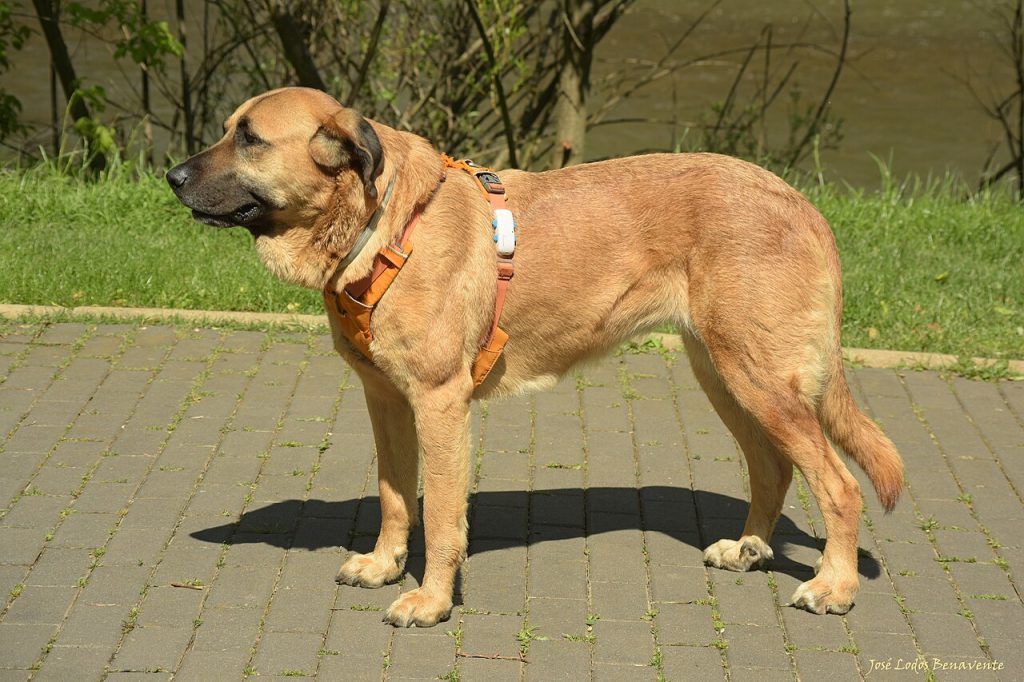
The Mastín Español is the quiet giant of Iberian cattle breeding: an enormous, serene and deeply loyal moloss that for centuries has stood up to the wolf to protect the trashing herds.
Is Spanish Mastin for you?

Before you fall in love with a photo, you should be realistic: the Spanish Mastiff is not a dog for any household. It is huge, independent and with a very strong guarding instinct. In the right place, it is an unbeatable companion; in the wrong, a problem of literal size. These two boxes summarize what you gain and what you should assume.
In favour .
- Exceptional guardian of home, farm and livestock, deterrent by sheer presence.
- Temperament balanced, serene and not nervous inside the house.
- Extremely loyal and affectionate to his family, especially the children.
- It needs less intense exercise than its size suggests.
- Easy-to-maintain fur, no haircuts or cuts.
To be taken into account
- Giant size and weight: not a dog for flat or city.
- Deep and powerful barking; territorial with strangers and other dogs.
- Independent character: obey out of respect, not submission.
- Prone to hip dysplasia and short life expectancy (10-11 years).
- He eats a lot and drools; he demands fenced space and early socialization.
Character and temperament
If I had to define the Spanish Mastiff in one word, it would be calm down. It is a dog that is rarely upset for no reason: it spends the day quietly, observing, and only changes the register when it perceives a real threat. That calmness is not laziness, it is the confidence of an animal that knows that it can solve almost any situation by its size and strength.
With his family he is noble, affectionate and devoted, though in his own way: He’s not a clingy dog or a buffoon, but a worthy companion who shows his affection by staying close and watching. With strangers he is reserved and suspicious by nature; he will politely accept visitors if he is well socialized, but always with an eye out. He was selected for centuries to act on his own instinct in front of the wolf, without waiting for orders from the shepherd, and that trait defines his entire personality: Think for yourself.
Coexistence: children, other pets, flat and loneliness

With children The Spanish Mastiff usually behaves wonderfully: it feels a special attraction for them and tends to be patient and protective. The only precaution, and not the least, is its size: a dog of 90 kg can accidentally pull or crush a small child, so coexistence must always be supervised.
With other pets is dependent. With cattle and animals of its family nucleus it is a natural protector: that is exactly what it does in the field. With other dogs, however, it can be tense, especially among males, so early socialization with non-threatening dogs is key to softening that tendency.
The floor is discarded. This dog needs terrain, preferably fenced, and a territory that feels its own. Its roaring voice and volume make it unviable in a dense urban environment. In the face of loneliness is more tolerant than other breeds: it is not dependent and knows how to be alone watching, but should not spend the day locked or isolated from its family.
Education and training
Here it is advisable to adjust expectations: the Spanish Mastiff is not a dog of sports obedience. It was selected to work with autonomy, so it does not obey to please but because it respects who leads. The good news is that it is intelligent and gluttonous, which helps a lot in training; the bad, which gets bored quickly with repetitions.
The recipe goes like this: start socializing and educating from a puppy, be firm but kind (never harsh), short and varied sessions, and earn their respect as a reference before you ask anything. A Spanish Mastiff who has accepted his guide is one of absolute loyalty. Exposing him as a puppy, in a controlled manner, to people, noises and other dogs is what makes the difference between a balanced keeper and a reactive one.
Exercise and activity
Contrary to popular belief, it is not an athletic dog that needs miles of running. It is made for the long, sustained stride of transhumance, not for sprinting. It moves more slowly than agile, although it can accelerate surprisingly quickly when the occasion demands it.
With a long daily walk and, above all, with access to a fenced area where you can patrol and exercise at your own pace, you have plenty.
Care: fur and hygiene
The mantle of the Spanish Mastiff is thick and smooth, with a woolly undercoat that loosens much of it in summer.
What you do need to watch out for is what a large mollusk does: checking and cleaning the folds and bellies, taking care of dropped ears, and assuming that it drools, especially after eating or drinking. Bathing only when really needed, so as not to dry its skin. Nails, teeth and pads complete a hygiene routine that, taken together, is one of the most bearable within the giant breeds.
Foodstuffs
Feeding a dog that can exceed 100 kg is neither cheap nor trivial. It needs a quality feed or diet formulated for large or giant breeds, with a protein and mineral contribution appropriate to its structure. The daily ration is considerable, but the goal is not that it eats a lot, but that it maintains a fit weight.
Overweight is your worst enemy: Every extra pound punishes an already vulnerable hip. In the giant puppy, too rapid growth from excess calories or calcium favors joint problems, so controlled growth is advisable. Splitting food into two servings and avoiding exercise right after eating helps reduce the risk of gastric torsion, common in deep-breasted dogs.
Health and life expectancy

The most important health point in this breed is the hypoplasia of the hip, to which it is especially prone due to its enormous wingspan and weight.
In addition to the hip, you have to pay attention to the usual in deep-chested giants: Gastric torsion, joint wear and heart problems with age. His life expectancy is around 10 to 11 years old, short as in almost all large breeds. Choosing breeders who perform hip testing on breeders, strict weight control and veterinary monitoring of joints are the best guarantees of a long and comfortable life.
Physical appearance
The Spanish Mastiff is a large, hypermetrical mollusk with a compact skeleton, very powerful and muscular, with a large head and a serious and vigilant expression. Males usually measure about 80 cm at the withers (the standard requires a minimum of 70) and usually weigh between 80 and 100 kg, with specimens reaching 120; females are around 70 cm and 65 to 80 kg. It is the largest breed in Spain and probably one of the highest height-to-weight ratio in the world.
It has small eyes, sloping, triangular ears, and a characteristic paw and skin folds on the neck. The coat supports a variety of colors: lobato, cervato, black, atigrado and pío are common.
Origin and history
The Spanish Mastiff has its roots in the nomadic herding of the Iberian Peninsula, and it is believed that its type has been in these lands for thousands of years: When the Romans arrived in Hispania, the Mastiffs were already working guarding the cattle. Their great historical setting was the trashumancia, those royal trenches that crossed Spain from north to south following the flocks of sheep, with the mastiff defending them from the wolves. To protect his neck in these fights, he wore the carlanca or carranca, a thick metal collar with spikes.
Its function was always protective, not conductive: unlike the bald dogs, which graze and guide the herd according to the shepherd’s indications, the mastiff simply watches and protects.
With the disappearance of the Mesta in the late 19th century and the decline of transhumance, the breed suffered a decline that worsened after the Civil War. The FCI drafted the first breed standard in 1946, and in 1981 the Spanish Mastiff Dog Association was founded, which launched a breeding program to recover the large and strong Mastiff of old, suitable both as a pet and as a guard and defense dog.
Curiosities
- A study of WWF from 1986 documented a 61% reduction in cattle predation when herds were guarded by mastiffs: numerical proof of their effectiveness as a guardian.
- The actor Viggo Mortensen received as a gift in León two dogs, a lion dog and a Spanish Mastiff, which he named “Aragorn” and “Alatriste”, names of two characters he played in the film.
- There are two varieties of the breed: the traditional, working french mustard, and the larger, more massive, modern standard Spanish Mastiff.
- Their role was not to fight the wolf for sport, but dissuade: often the mere presence of several mastiffs was enough to keep the wolf pack from even coming close to the herd.
If you’re attracted to the profile of the Spanish Mastiff but want to compare yourself to other giant, moldy guards, take a look at these related breeds: the imposing Mastiff, the Italian Cane Corso, the rescuer San Bernardo, and the friendly giant Gran Danés.
Frequently Asked Questions on Spanish Mastiff
Is the Spanish Mastiff a good family dog?
Yes, within its profile. It is calm, balanced and very loyal to its owners, and has a special fondness for the children of the house. It is not a playful or dependent dog: its way of wanting is to watch and be close. Now, because of its colossal size and its guardian instinct, it needs a family that understands the breed, with space and time to socialize it well from puppyhood.
How much does a Spanish Mastiff weigh?
It is the largest dog breed in Spain and one of the largest in the world. The males usually weigh between 80 and 100 kg, and some specimens exceed 120 kg. The females are around 65 to 80 kg. At the cross, the males usually measure about 80 cm and the females around 70 cm.
Can he live in a flat?
It is not recommended. Its gigantic size, its deep and powerful barking and its need for a territory to monitor make an urban floor a bad fit. It is in its element in a farmhouse or house with fenced terrain where it can move at its own pace and act as a guardian. If you do not have that space, there are breeds more suitable for indoor life.
Is he an aggressive dog?
It is not aggressive with its family: it is calm and affectionate. It is distrustful of strangers and can be territorial, and tends to tension with other dogs, especially among males. With early and well-done socialization, that distrust becomes controlled vigilance instead of reactivity. It was bred to stand up to the wolf, not to attack people.
How much exercise do you need?
Less than its size suggests. It is a dog of distance, not speed: it prefers walking and patrolling before running. A long daily walk and, above all, access to a fenced area where moving at will cover its needs. It is advisable not to force intense exercise on the puppy while its joints grow.
What health problems do you have?
The most relevant is hip dysplasia, to which the breed is especially prone due to its large wingspan. Also, as in all giants, gastric torsion and joint wear must be monitored. Choosing breeders who do hip tests, taking care of weight and not overfeeding the puppy are the best prevention measures.
How long does a Spanish Mastiff live?
Like most giant breeds, its life expectancy is shorter than that of a medium-sized dog – around 10 to 11 years.
What’s the difference between the Leonese Mastiff and the Spanish Mastiff?
They are two varieties of the same breed. The Leonese Mastiff is the traditional and working type used by shepherds, somewhat lighter and functional; the Spanish Mastiff of the modern standard is the largest and most massive specimen fixed by the FCI.