The Vallhund Sueco is one of Scandinavia’s oldest and most unique breeds: a small spitz with a long body and short legs that has been grazing cows on Swedish farms for over a thousand years. Nicknamed the “Viking dog”, it combines the unmistakable silhouette of a Corgi with the alert, tough, hardworking character of a true Nordic working dog. If you’re looking for a small companion with a lot of personality, super smart and surprisingly athletic, the Swedish Vallhund deserves your full attention.
Is the Swedish Vallhund for you?
Before you fall in love with her miniature werewolf face, be honest: The Swedish Vallhund is a herding dog in a small body, and that conditions everything. It is ideal for active people who want a dog to do things with – training, dog sports, long walks – and who value intelligence and bonding. It’s not the best choice for anyone looking for a quiet, quiet, low-maintenance dog.
In favour .
- Handled size with large dog character.
- Very smart and eager to learn.
- Long-lived and generally robust and healthy.
- Loyal, affectionate and very close to his family.
- Great for canine sports and outdoor activity.
- It adapts well to the cold thanks to its double coat.
To be taken into account
- Barker: vigilant and very vocal by nature.
- Instinct to bite heels (heredity from herding).
- He needs daily mental stimulation or he gets bored and “makes a mess”.
- Loose hair, with intense shedding twice a year.
- He can be reserved with strangers if he doesn’t socialize.
- Rare in many countries: getting a puppy can be expensive.
Character and temperament

The Swedish Vallhund is, first and foremost, an alert dog. Behind those dark brown oval eyes is a mind that never stops: observing, calculating and constantly looking for something to do. It is the typical breed that learns a trick in four repetitions… and also learns to open a door on its own if you give it time and boredom. That liveliness is its greatest virtue and, if mismanaged, its greatest problem.
With his family he is affectionate, loyal and very close. He loves human attention and wants to be where you are, participating in the life of the house. With strangers he tends to be more reserved and cautious; he is not usually aggressive, but he is suspicious until he decides that the person is trustworthy. That’s why early socialization is so important: A well-socialized Swedish Vallhund is balanced and sociable; one who has grown up isolated can become overprotective and overly barking.
It is also a courageous and characterful dog, aware of its role as a watchdog. It will warn of anything new by barking, and this constant alertness makes it an excellent watchdog for its size, although it is advisable to teach it early when to shut up.
Coexistence: children, other pets, flat and loneliness
With children: is a good family dog and enjoys the little ones. The only nuance comes from its herding instinct: it can try to “drive” running children, giving them small bites on the heels. It is not evil, it is literally its factory function – it was a dog that grabbed cows by biting their paws – but it is convenient to supervise the game and redirect that behavior from a puppy.
With cats and small animals it should be borne in mind that it was also bred to hunt predators such as rats, so the chase instinct exists; a gradual introduction and good socialization make the difference.
On the floor:‘s small size makes it suitable for apartment living, provided it is given the exercise and stimulation it needs. The weak point here is barking: if not worked, a bored and vigilant Swedish Vallhund can be noisy to neighbors.
Soledad: is a very attached dog who doesn’t like to spend long hours alone. Chronic loneliness, coupled with his need for activity, is the perfect recipe for barking, wrecking and anxiety. He fits best in homes where he doesn’t spend the whole day without company.
Education and training
Training a Swedish Vallhund is a pleasure… if you do it right. He’s so smart and so willing to work that he learns easily, but that same intelligence means he’s bored with repetition and instantly detects inconsistency. He needs short, varied, motivational sessions, always positive: reinforcement with rewards, play and voice works much better than the hard hand, which just gets you to close.
Two priorities from puppyhood: the socializing(people, dogs, noises, environments) to prevent excessive distrust, and the control of barking and heel biting, his two breed “vices”. Teaching him a command of silence and redirecting the herding instinct to appropriate play prevents future problems.
Exercise and activity
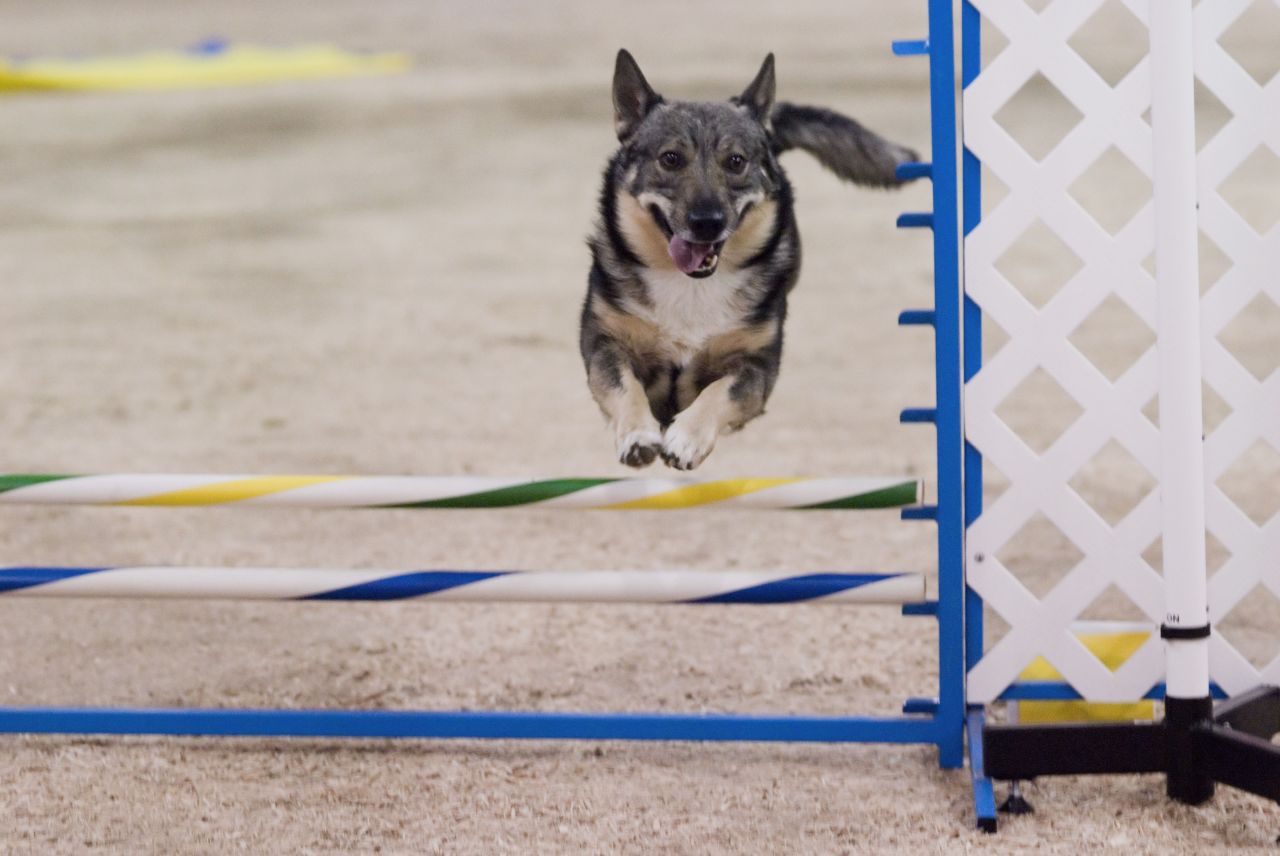
Don’t be fooled by its short legs: the Swedish Vallhund is an athlete. It needs real daily exercise, not a token walk. A couple of active outings a day, combined with play and, above all, mental stimulation, is the minimum to have a happy and calm dog at home.
Where he really shines is in dog sports. The breed stands out in agility, obedience, rally, flyball, tracing and, as it could not be otherwise, in the tests of grazing, where its millennial instinct reappears. It’s also an excellent hiking companion. For a dog with this brain, physical exercise without mental challenge falls short: What really tires you and balances you is the combination of body and mind.
Care: fur and hygiene
The Swedish Vallhund has a short, rough coat with a tight outer coat and a soft, dense undercoat – a classic double spitz coat. It does not need hairdressing, cuts or special arrangements: just a regular brushing, weekly in the normal routine and more frequent during the two major mowing seasons, when it sheds hair in quantity.
The rest of the care is that of any healthy dog: inspection and cleaning of ears (here with advantage, because having the ears erect they are well ventilated and suffer much less problems than the races of fallen ears), cutting nails when they need it, regular dental hygiene and baths only when it is really dirty, so as not to spoil the natural protection of its coat.
Foodstuffs
As a small, active dog, the Swedish Vallhund needs a complete, high-quality food, appropriate to its size, age and activity level. The key with this breed is watch your weight: Its elongated body makes being overweight especially harmful, as it weighs on the spine and joints. An overweight Swedish Vallhund has more ballots for back problems, so it’s good to measure rations, moderate rewards, and keep him fit.
If you have any questions about diet, quantities, or changes in food, it is best to consult your veterinarian.
Health and life expectancy
The Swedish Vallhund is generally a healthy and very long-lived dog, with a half-life of around 15 years. Their small size favors their longevity, and their erect ears make ear infections, so common in other breeds, rare. In addition, its double coat allows it to tolerate the heat well – always with shade and water on hand – even though its lower body makes it suffer in deep snow.
The main documented health concern of the breed is an inherited form of progressive atrophy of the retina (PRA), present in a significant portion of the population and manifesting as mild to moderate night blindness, typically around ten years of age. That’s why it’s so important to go to serious breeders who do eye tests on the breeders. As with all long-bodied dogs, it is also advisable to take care of the back by avoiding overweight and excessive jumping.
Physical appearance

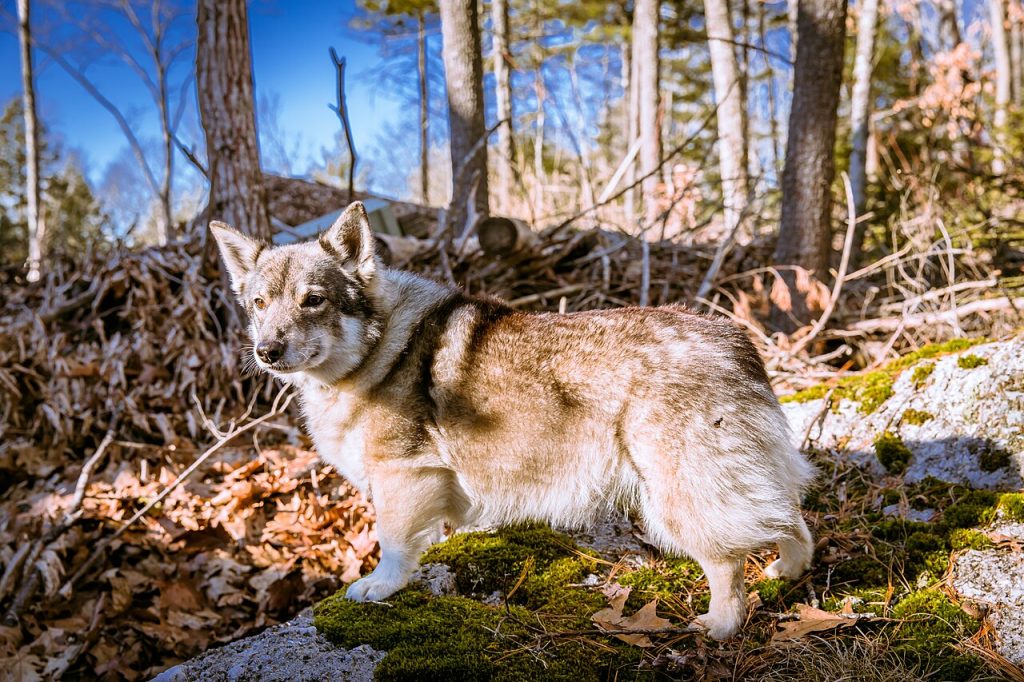
The Swedish Vallhund is a small, strong and remarkably long-bodied dog, with a height-to-length ratio of approximately 2:3 which gives it that low and unmistakable silhouette.
A very peculiar feature is the tail: it is born with all possible lengths, from full tail to total absence, so it is sometimes mistakenly believed to have been amputated (something, by the way, illegal in Sweden).
The coat is short and rough, with a tight outer coat and dense undercoat. Colors range from gray to purplish gray, yellowish gray and reddish brown, always with darker hair on the back, neck and sides, and lighter tones on the snout, throat, chest, belly and extremities. I.D. ‘ s are harness marks: lighter areas on the shoulders that resemble a harness. Some discrete white spots may appear, with a maximum of 30% white.
Origin and history
This is a truly ancient. breed, the national dog of Sweden, with origins that could be traced back to the 8th or 9th century. It was born in the province of Västergötland, south of Lake Vänern, where this small dog proved to be excellent at guarding, guarding and herding livestock. Its Swedish name, other, literally means “herding dog”, and it is also known as Västgötaspets, after the province of its rebirth.
His story is intertwined with that of the the Vikings.. It is believed that during Viking times these dogs traveled between Sweden and the British Isles, and that they played a role in the development of the modern Welsh Corgi and the Lancashire Heeler – hence the “family air” with the Corgi. One theory, collected by the American Kennel Club, holds that in the 8th or 9th century “either the Swedish Vallhund was brought to Wales, or the Corgi was brought to Sweden”, which would explain the similarity between the two breeds. The breed is related to the larger spitz and the Scandinavian moose hunting dogs.
In 1942 was on the verge of extinction.. It was saved by the work of Count and artist Björn von Rosen and Karl-Gustaf Zettersten, who located the few remaining specimens and started a careful breeding program, avoiding inbreeding even from a handful of dogs. In 1943, the Swedish Kennel Club officially recognized the breed. Although still relatively rare in the world, today it is bred in more than ten countries and was admitted by the AKC in 2007.
Curiosities
- The Viking dog. Its nickname is not marketing: it accompanied the Nordic peoples more than a thousand years ago and its trace goes back to the Viking settlements of England.
- He was on the verge of disappearing. was almost extinct in 1942; today it exists thanks to the tenacity of two people who rebuilt the breed from scratch.
- The surprise tail. Each layer is a lottery of tails: there are long ones, short ones and tailless ones, all naturally.
- It was a stellar debut. In 2008, the Swedish Vallhund competed for the first time at the prestigious Westminster Kennel Club Dog Show.
- Harness marks. That lighter pattern of hair over the shoulders, so characteristic, is precisely called “harness marks”.
- Shepherding championship dog. In Sweden he still competes herding cattle in official events called Vallhundsprov.
If you are attracted to the Swedish Vallhund for its blend of intelligence, energy and manageable size, you may want to meet other breeds with a similar profile. Take a look at the Pembroke Welsh Corgi, its almost identical silhouette relative; the tireless Border Collie, another shepherding genius; the versatile Pastor Australiano; or the sleek Shetland Shepherd, a bright-minded little shepherd.
Frequently asked questions about the Swedish Vallhund
Is the Swedish Vallhund a difficult dog to keep?
It’s not hard, but it’s demanding in a certain sense: He needs to do things. It is a very alert-minded herding dog, so if you give it mental work, daily exercise, and clear guidelines, it becomes a balanced, loving, and easy-going companion. The problem arises when he is treated like an ornamental dog: That’s when he barks, nibbles his heels and looks for trouble out of sheer boredom.
How long does a Swedish Vallhund live?
It is a robust, long-lived breed; with proper nutrition, exercise, and veterinary checkups, many specimens easily exceed a dozen years in full health.
Why don’t some Swedish Vallhund have tails?
It’s natural. The breed is born with a huge variety of tail lengths, from complete tail to total absence (tail “bob”), going through all the points in between. That’s why they are sometimes mistakenly thought to be amputated. In fact, in Sweden, tail cutting is illegal: what you see is pure genetics.
Is the Swedish Vallhund the same as a Corgi?
They’re cousins, not twins. They share a silhouette (long body, short legs) and probably part of their history was crossed during Viking times, when these dogs travelled between Sweden and the British Isles. But the Vallhund is a Nordic spitz, with a wedge-shaped head, wolf-like coat, and harness marks, while the Corgi belongs to another breeding tradition. They look alike, but they’re not the same breed.
Does the Swedish Vallhund bark a lot?
It can do that. It’s an alert, vigilant, and very vocal dog by nature, inherited from its past as a farm guardian. It’s not a senseless, nervous barking, but a warning: it warns of visitors, noises, and news. With early socialization and teaching a silent order, it’s well controlled, but if you’re looking for a 100% quiet dog, this isn’t your breed.
Do you get along with children and other dogs?
Yes, it is a family and sociable dog. It enjoys children and usually integrates well with other dogs if it is socialized from a puppy. The only nuance is its herding instinct: it can try to “lead” small children by gently nibbling their heels. It is not aggression, it is its factory work; it is corrected with education and supervision.
How much exercise do you need a day?
Enough for his size. With one or two good walks a day plus some playtime or mental training, he covers the basics, but he’s a covert athlete: he enjoys agility, shepherding, rallying and long walks.
Does the Swedish Vallhund lose a lot of hair?
It loosens hair moderately during most of the year and intensely in the two moult seasons, because it has a double coat. It does not require hairdressing or cuts, only regular brushing (more frequent in moult season).