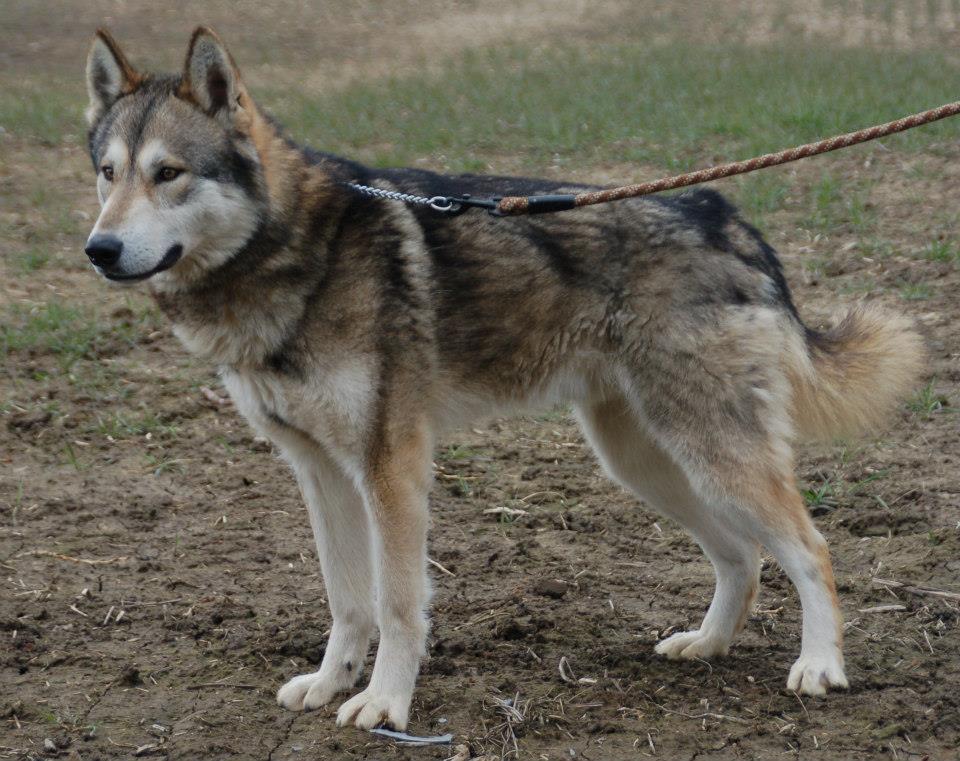
The Tamaskan is a large, athletic and surprisingly wolf-looking dog, bred in Finland and northern Europe to look like a wild wolf without being one. Behind that wild image is an affable, intelligent and hardworking domestic dog, designed for companionship and sport. If you’re looking for a companion who’s spectacular in appearance but stable in character, the Tamaskan deserves to be thoroughly acquainted with before you decide.
Is the Tamaskan for you?

The Tamaskan is a rare breed, recent and very demanding in terms of exercise and companionship. It is not a decorative dog: whoever chooses it for its resemblance to the wolf but cannot give it hours of activity and presence ends up with a frustrated animal. First of all, look at this honest summary of its lights and shadows.
In favour .
- Spectacular-looking, very much like a wolf, but not a hybrid.
- Balanced temperament, sociable and not aggressive.
- Very smart and eager to work and learn.
- Good companion for active families and dog sports.
- On the whole, they’re a healthy breed.
- He gets along well with other dogs and children.
To be taken into account
- He needs a lot of daily exercise; he gets bored easily.
- I’m not good with loneliness. I’m prone to separation anxiety.
- It sheds a lot of hair and moults abundantly.
- Rare breed: few serious breeders and limited availability.
- Not recognized by the FCI; it is advisable to choose the line very carefully.
- Not recommended for small apartments or sedentary living.
Character and temperament
The great success of this breed is precisely here: it was created looking for the appearance of a wolf but with the head of a good family dog. The Tamaskan is affable, sociable and remarkably balanced. It is not an aggressive or suspicious guard dog; on the contrary, it tends to be friendly with people, even with strangers, so it does not stand out precisely as a defense dog.
It is a very intelligent and sensitive dog, which is very attached to its family and needs to feel part of it. That same sensitivity makes it affected by loneliness and lack of stimuli: a Tamaskan that spends too many hours alone or without activity can become anxious, noisy or destructive.
Coexistence: children, other pets, flat and loneliness

With children the Tamaskan usually behaves very well: it is patient and sociable. As with any large and energetic dog, it is advisable to supervise play with the youngest and teach children to respect the dog’s times.
With other dogs it tends to be tolerant and enjoys canine companionship, something logical in a breed with herding and sled dog roots.
As for the floor, it is not its ideal environment. It can adapt if it receives a lot of exercise and stimulation, but it performs better with space and access to the outdoors. And about the loneliness: it is its weak point. The Tamaskan is a dog very dependent on contact with its family and is unable to stay alone for many hours, with a real risk of separation anxiety.
Education and training
The good news is that it is a quick and collaborative dog; the opposite, which is also independent and soon gets bored with repetition. It works very well with positive reinforcement, short, varied and motivating sessions.
early socialization is key: the more and better you are exposed as a puppy to people, dogs, environments and noises, the more balanced you will be as an adult. It is advisable to work from the beginning on tolerance to being left alone, in small and increasing doses, to prevent separation anxiety.
Exercise and activity
There are no shortcuts here. The Tamaskan descends directly from sled dogs and working dogs, and needs to expend a lot of energy every day. Long walks, running, hiking and, above all, shooting and drag sports such as canicross, bikejoring or mushing are activities for which it is especially gifted.
In addition to physical exercise, it requires mental stimulation: olfactory games, obedience, agility, interactive toys. A dog of this breed that is bored finds its own amusements, almost always at the expense of the sofa or garden.
Care: fur and hygiene

The Tamaskan wears a dense double coat, with longer guard hair and a woolly undercoat that insulates it from the cold.
It does not need haircuts or complicated hairstyles, and baths should be fair so as not to damage the natural protection of the mantle. Complements hygiene with the routine care of nails, ears and teeth. Its coat is designed for the cold, so in very hot climates you have to watch it and avoid exercise in the hottest hours.
Foodstuffs
As a large, athletic and very active dog, the Tamaskan needs a complete and quality diet, adjusted to its size, age and activity level.
It is advisable to distribute the food in two doses a day and avoid overweight, which especially punishes the joints of a dog of this size. In large dogs with deep chest it is also advisable to keep in mind the precautions against gastric dilation-torsion(avoid intense exercise just before and after eating).
Health and life expectancy
Overall, the Tamaskan is considered a healthy breed, something to be expected in a dog of broad genetic basis and relatively recent breeding.
- Criptorquidia(non-descending testicle): affects about 10% of males, in which often only one testicle descends.
- Epilepsia: diagnosed in around 1 in every 100 registered cases worldwide.
- Degenerative myelopathy: Dogs have been found to carry the gene, so genetic testing helps to avoid risky crosses.
- Dysplasia of the hip: as with all large dogs, it is a risk to be monitored by radiographic testing.
The best guarantee of health is to go to a serious breeder who performs health tests on the breeders and keeps records of their lines, in addition to good veterinary control throughout the dog’s life.
Physical appearance
The Tamaskan is a large, athletic dog, slightly taller than a German shepherd: Bigger than a typical sled dog, but lighter than the Alaskan Malamute. Sources describe specimens that are around 60 – 70 cm at the withers and a usual weight of between 25 and 40 kg, with males that can approach 50 kg. The females is somewhat smaller and thinner looking; the female, more robust, with a wider head and heavier bone.
Its distinguishing feature is the lupine appearance: Straight and stocky tail, thick double coat and an acute coat in which each guard hair shows bands of color along. The main colors are three: grey wolf(wolf grey), red grey(red grey) and black grey(black grey). The eyes, almond shaped, range from yellow to amber and brown; blue or disparate eyes are not considered desirable. The result is a dog that many confuse with a real wolf.
Origin and history
The history of the Tamaskan begins in the United Kingdom in the 1980s, when five dogs of Siberian husky origin were imported from the United States that were crossed with Alaskan malamutes, Siberian huskies and German shepherds. The goal was to get a dog with wolf phenotype but good temperament. At that time they were simply labeled “wolf dogs” or wolf-like, and records of the time were poor, so the exact ancestry of many of those dogs is unknown.
The founders of Lynn Hardey and Jennie Peacock, members of the Utonagan society, felt that those lines were becoming too closely related and sought genetic diversity abroad. In Finlandia they found working husky crosses and acquired several to expand their lines. As most Utonagan breeders were unwilling to incorporate these new contributions, the founders separated and created the Tamaskan Dog Register in the year 2006, the birth certificate of the breed as we know it. Today there are clubs in the United States, Canada, France, Germany, the Netherlands, Croatia and the United Kingdom.
Curiosities
- The Tamaskan belongs to a family of “wolf” breeds born from the same British project, along with the northern Inuit, the Utonagan and the British timber dog.
- Northern Inuit dogs, related to the Tamaskan, were used in the Game of Thrones series to give life to the huargo wolves.
- A Tamaskan named Wave(“Tuffy”) is since 2010 the live mascot of the North Carolina State University football team, the NC State Wolfpack.
- A Tamaskan named Luchta played “The Wolf” in a Broadway production of Arthur Miller’s The witches of Salem, in 2016.
- Their resemblance to the wolf is such that on more than one occasion specimens of the breed have been mistaken for real wolves.
If you are attracted to the Tamaskan for its wild air and hardworking nature, you will surely be interested in other Nordic and working breeds with which it shares energy, sociability or genetic heritage. Husky Siberiano Samoyedo Pastor Alemán Akita
Frequently Asked Questions about Tamaskan
Is the Tamaskan a wolfhound or does it carry wolf blood?
No. Despite its wolf appearance, the Tamaskan is a 100% domestic dog. It was created by crossing Nordic and working breeds (Siberian husky, Alaskan malamute, Alaskan husky and German shepherd, among others) to achieve a lupine phenotype, but without introducing a real wolf into the lines.
Does the FCI recognize the Tamaskan?
No. The Tamaskan is not recognized by the Fédération Cynologique Internationale nor by the big traditional clubs. It is recognized by the American Rare Breed Association and is managed through the Tamaskan Dog Register and national clubs in several countries. It is a young and still developing breed.
How long does a Tamaskan live?
As a recent breed with a broad genetic base, there is no official consolidated figure, but due to its size and relatively good health it is usually placed in the typical range of active large dogs.
Is he a good dog for families with children?
Yes, the Tamaskan was selected for its balanced, sociable temperament, and it usually gets along well with children and other dogs. Like any large, energetic dog, it is wise to supervise the treatment of young children and teach them respect for the animal.
How much exercise do you need?
It is descended from sled dogs and working dogs, so it needs plenty of daily exercise: long walks, running, hiking, canicross, mushing or dog sports.
Do you lose a lot of hair?
Yes, it has a dense double coat that sheds hair year-round and undergoes two strong moultings a year. It requires frequent brushing, which intensifies in moulting season, but it does not require haircuts or complex hairstyles.
Does he adapt to living in a flat?
It’s not his ideal environment. He can live on the floor if he gets a lot of exercise and stimulation, but he performs better with space and access to the outdoors. He doesn’t tolerate prolonged solitude: he’s a very sociable dog who may suffer from separation anxiety.
What health problems does the Tamaskan have?
The described problems affect a small percentage of lines: cryptorchidism in about 10% of males, epilepsy in about 1 in 100 registered specimens, some carrier of degenerative myelopathy and, as in all large dogs, risk of hip dysplasia.