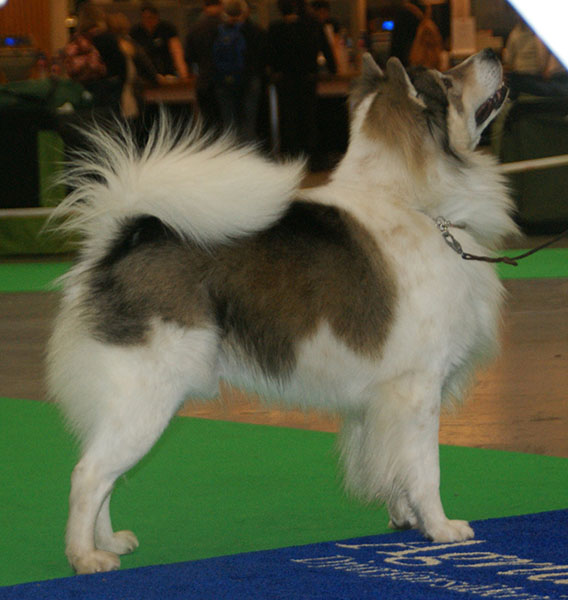
The Thai Bangkaew(Thai Bangkaew Dog) is one of those breeds that almost no one knows outside their homeland and that, however, catches whoever discovers it: a medium-sized, elegant, spectacular-coated spitz, born in a small village on the banks of the Yom River in Thailand. A devoted watchdog and loyal family dog, he combines rustic beauty, intelligence and a character as affectionate with his own as reserved with strangers. In this guide, we review, with verified data, everything you need to know before considering living with a Thai Bangkaew.
Is Thai Bangkaew for you?

Before you get carried away by its undeniable beauty, you should be honest about what it means to live with this breed. The Thai Bangkaew is not a decorative stuffed dog: it is an intelligent, sensitive and characterful guard dog, which demands commitment, socialization and a relationship based on trust. These boxes sum up the good and what you should value with your head.
In favour .
- Extraordinarily loyal and devoted to his family.
- Excellent guard and warning dog, very attentive to his surroundings.
- Intelligent and highly capable of learning.
- Medium size, comfortable both in the garden and on the floor.
- Showy coat and rustic and healthy constitution.
- Very clean and discreetly scented.
To be taken into account
- Reserved or suspicious of strangers if he doesn’t socialize well.
- Territorial instinct and a tendency to bark as a warning.
- It sheds a lot of hair, with intense seasonal shifts.
- He needs company; he suffers from prolonged loneliness.
- Very rare breed outside Thailand: difficult to find.
- It requires a consistent and consistent owner in education.
Character and temperament
The Thai Bangkaew is defined by a deep bond with his family. It is a dog that is completely devoted to its owners, with whom it is affectionate, playful and surprisingly attentive to their moods. That devotion coexists with an equally marked trait: his protective instinct. Descended from village dogs that guarded houses and temples, it carries a guardian vocation in its DNA, and so it is always aware of what is happening around it.
With strangers he is usually reserved, cautious, even suspicious if he has not been properly socialized. He’s not an aggressive dog by nature, but he’s selective: He gives his confidence little by little and warns with barks of any presence or noise he finds suspicious. This combination of loyalty, alertness, and sensitivity makes it an excellent companion for those looking for an engaged dog, provided it is trained out of respect and not imposition, for it responds poorly to harsh methods.
It is also an intelligent and somewhat independent dog, with its own criteria. It learns quickly, but does not obey to obey: it needs to understand why it does things and trust who asks it.
Coexistence: children, other pets, flat and loneliness

With children. Socialized as a puppy, the Thai Bangkaew is usually an affectionate and protective companion with the little ones in the house.
With other pets. The key lies in the early introductions. Raised alongside other dogs or animals, it can coexist without problems; but its territorial character makes it dominant in front of unknown specimens of the same sex.
On the floor. Its medium size makes it perfectly compatible with living in an apartment, as long as you go out enough and don’t get bored.
The Thai Bangkaew is a family dog that needs companionship and participation in home life. Long and repeated absences make it feel bad and can translate into anxiety, barking or destructive behavior. It is not the ideal breed for those who spend the whole day outside the house.
Education and training
Training a Thai Bangkaew is rewarding if done right. Its intelligence and desire to please the family play in its favor, but its independence and sensitivity force it to forget about the hard hand. Positive reinforcement – rewards, play, kind voice – is the way: with it it learns quickly and builds confidence; with punishment or yelling, instead, it closes or becomes reactive.
Exposing a puppy to people, noises, other dogs, and a variety of situations during its first few weeks makes the difference between a balanced adult and an overly suspicious one. Similarly, it is advisable to work early on managing warning barking and introductions to strangers, channeling its guarding instinct without completely repressing it.
Consistency and consistency are essential: this dog needs clear and stable rules, and a reference figure to rely on.
Exercise and activity
The Thai Bangkaew has medium-high energy. It is not a tireless athlete, but it is also not a sedentary dog: it appreciates one or two good daily walks, moments of play and, above all, mental stimulation. Its awake head needs occupation, and activities such as olfactory games, interactive toys or positive obedience sessions keep it balanced and happy.
An individual who does enough physical and mental exercise is a quiet companion inside the house. On the contrary, lack of activity pays off: boredom usually translates into barking, restlessness or destructive behavior. Combining movement and mental work is therefore the best recipe for their well-being.
Care: fur and hygiene

The coat is one of the hallmarks of the breed. The Thai Bangkaew wears a double coat: a dense inner coat that isolates it and a longer outer coat, especially abundant in the neck, forming a striking throat, and in the tail.
To keep it in good condition, a brushed several times a week is enough, which is intensified during moulting to remove the dead undercoat and avoid knots.
The rest of the care is typical of any dog: checking and cleaning the ears, cutting the nails when they do not wear out on their own and, very importantly, a good dental hygiene routine to prevent tartar.
Foodstuffs
The Thai Bangkaew needs a complete and balanced diet, adapted to its average size, age and activity level.A quality food, whether feed, wet diet or a well-formulated home ration under veterinary advice, meets its needs provided it provides the right proteins, fats and micronutrients.
As with any rustic and active dog, monitoring rations and avoiding overweight suits, splitting food into two daily intakes in the adult and adjusting amounts to his actual expenditure. Fresh water always available is essential, especially considering that it is a dog of tropical origin with an abundant coat. When in doubt about the ideal diet, it is best to consult your veterinarian, who will tailor the plan to each individual.
Health and life expectancy
The Thai Bangkaew is an indigenous and rustic breed, selected for decades in its native Thailand from hardy village dogs. That basis gives him a healthy and robust constitution. There are no specific life expectancy figures or a specific list of hereditary diseases in the official standard, partly because the breed is not as widespread outside their country.
By analogy with other mid-sized and similarly built spits, it is reasonable to expect a longevity around 12 to 15 years with good care, although it is advisable to take it as an orientation and not as a closed data. The keys to a long and healthy life are the same as in any dog: adequate nutrition, exercise, weight control, dental hygiene and regular veterinary checks, including daily vaccination and deworming.
Physical appearance
The Thai Bangkaew is a medium-sized spitz with a balanced, harmonious and elegant appearance. According to the International Kennel Federation standard, the males measure between 46 and 56 cm to the cross and the females between 41 and 49,5 cm.
The head is of a wakeful expression, with triangular-shaped upright ears and dark eyes of vivid gaze. The tail, generously covered with hair, is worn curled or curved over the back, very much in the style of the spitz.
As for the color, the breed has a very characteristic pious pattern (white with spots), on a white background that combines with black, gray, brown, red or cream tones.
Origin and history
The Thai Bangkaew takes its name from Bangkaew, a village located in Bang Rakam District, Phitsanulok Province, in the central region of Thailand. It was there, near the Yom River, that the race was born from a story with a flavor of legend: It is said that the local dog of a Buddhist abbot, in a black and white cloak, was crossed with a wild dog – now extinct – from the area, and from that union emerged the first specimens.
Starting with 1957, selective breeding over successive generations fixed the type until shaping the breed we know today. Over time, the Thai Bangkaew went from being the watchdog of a county to becoming one of Thailand’s most prized native breeds, officially recognized by the International Kennel Federation. Despite this recognition, it is still a rare dog outside its country of origin, where most of its population remains concentrated.
Curiosities
- His name in Thai is spelled ไทยบางแก้ว, in direct reference to the village of Bangkaew where he was born.
- The legend of its origin unites a Buddhist abbot, his black-and-white dog, and a now-extinct wild dog: myth and reality are intertwined in the history of the breed.
- It is one of the few native to Thailand canine breeds recognized internationally by the FCI.
- It belongs to the large group of spitz, related by type to Nordic and Asian dogs with erect ears and a curled tail, despite having developed in the tropics.
- Its characteristic hairy throat around the neck is one of its most admired features and gives it an almost “melena” air.
If you are attracted to the profile of the Thai Bangkaew – a loyal, intelligent, medium-sized guardian – you may be interested in other temperamental or related breeds. You can continue to explore the Akita, another strong-willed Asian spitz; the Chow Chow, with its abundant fur and protective link; the fast and noble Samoyedo, spectacular coat spitz; or the intelligent and versatile Husky Siberiano. Each has its own personality, but they all share the essence of a robust, alert dog with much to offer.
Frequently Asked Questions about Thai Bangkaew
Is the Thai Bangkaew a dog suitable for beginners?
It can be if the new owner is willing to socialize early and to maintain a firm, loving routine. It’s an intelligent breed and very close to its family, but with a strong guarding instinct and some reservations about strangers. A committed beginner, with time for training and socialization, can get along very well with him; anyone looking for an indifferent dog with no need for handling should consider other options.
How long does a Thai Bangkaew live?
Since it is a medium-sized spitz with a rustic build, it is reasonable to expect a longevity in line with other similar dogs, around 12 to 15 years, provided it receives good nutrition, exercise, dental care and regular veterinary checkups.
How tall and how much does a Thai Bangkaew weigh?
According to the FCI standard, the males measure between 46 and 56 cm at the cross and the females between 41 and 49,5 cm. In weight, the males are around 18 to 19,5 kg and the females 16 to 18 kg. It is, therefore, a dog of medium size and balanced proportions.
Does the Thai Bangkaew lose a lot of hair?
It has a double coat, with a dense inner coat and a longer outer coat, especially on the neck and tail. It sheds hair regularly and performs more intense seasonal moults in which it is advisable to brush it several times a week.
Do you get along with children and other pets?
With good socialization from puppyhood, the Thai Bangkaew is usually affectionate and protective of the children in his family. With other pets coexistence depends a lot on early upbringing and introductions; his guarding instinct and territorial character make it advisable to supervise the first encounters and educate the boundaries with patience.
Do you need a lot of exercise?
It has a medium-high energy. It does well for one or two long walks daily, games and activities that stimulate its mind, such as olfactory work or positive training. It is not a hyperactive dog of extreme sports, but it also does not settle for minimal outings: bored and without stimuli it can become barking or destructive.
Can he live in a flat?
Yes, as long as his needs for exercise and companionship are met. He is very attached to his family and does not tolerate prolonged loneliness.
Is it a rare breed outside Thailand?
The Thai Bangkaew is an indigenous breed from Phitsanulok Province, Thailand, recognized by the FCI but still very rare outside its country of origin.