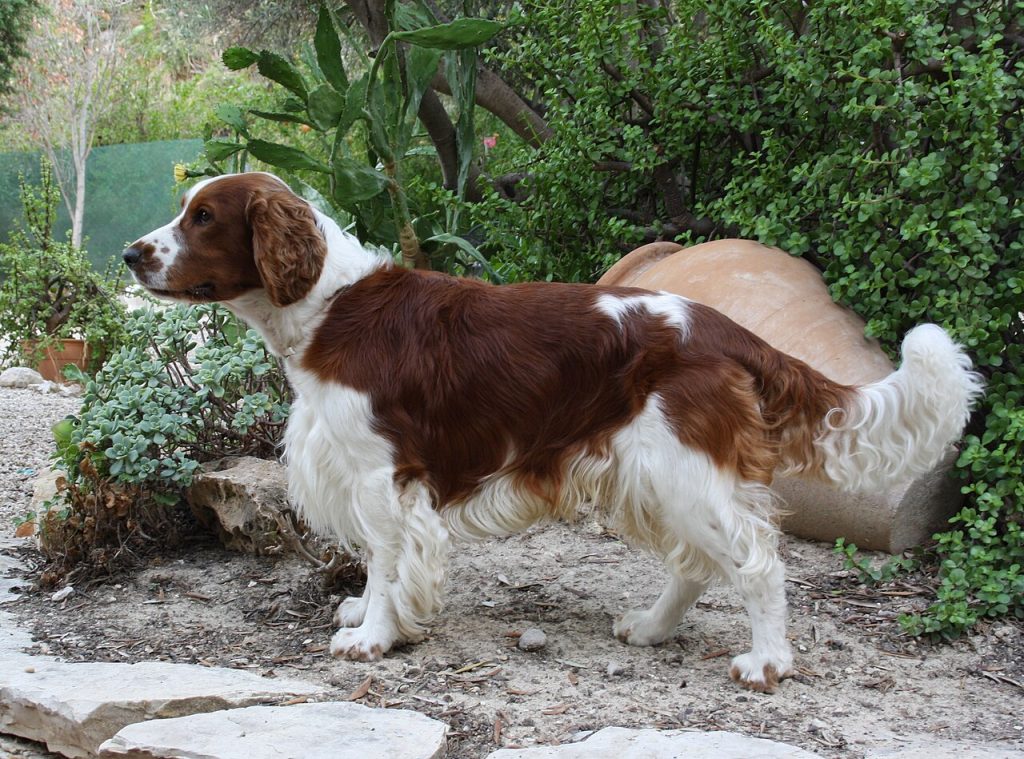
The Welsh Springer Spaniel(or Welsh Springer Spaniel) is a medium-sized Welsh hunting dog, unmistakable for its white coat with red spots and for its affectionate and clingy character. A tireless fighter in the field and a devoted companion at home, this hoisting spaniel combines energy, docility, and a family attachment that has earned it the nickname “velcro dog”. If you’re looking for an active, sociable, well-balanced dog, and you can give him the exercise he asks for, the Welsh Springer Spaniel is a serious candidate.
Is the Welsh Springer Spaniel for you?

The Welsh Springer Spaniel is a time- and activity-demanding dog, but hugely rewarding to those who fit its profile. It is the ideal choice for an active person or family, who goes outdoors, does sports or spends time in the countryside, and who wants a dog that is involved in everything. It’s not a decorative dog or a permanent couch dog: He needs his head and body on the move. In return, he offers loyalty, gentleness and a remarkable work ethic.
In favour .
- Very affectionate and attached to the whole family, excellent with children.
- Intelligent and eager to please, he learns fast.
- Sociable with other dogs and pets if socialized well.
- Long-lived and generally healthy breed (up to ~14 years on average).
- Medium size manageable and water and weed resistant mantle.
- Versatile: hunting, obedience, agility, tracking and therapy.
To be taken into account
- He needs plenty of daily exercise; bored, he becomes destructive.
- Tendency to have separation anxiety (“velcro dog”).
- He can be reserved or barking at strangers on his turf.
- Drooping ears prone to otitis: frequent examination.
- Hunting and smelling instinct. It can disconnect if it picks up a trail.
- Rare breed: Finding a serious breeder can be expensive.
Character and temperament
The temperament is, along with the color, the hallmark of the Welsh Springer Spaniel: active, loyal and deeply affectionate. It is intensely attached to its people and enjoys being close to them; hence the nickname “velcro dog”.
With strangers it may behave differently. In its territory it is usual to receive strangers barking, or to adopt a distant, cautious and somewhat suspicious attitude. It is not an aggressive dog, but this natural reserve makes it a good warner. Early socialization helps it channel this instinct without going overboard.
It is an alert and hardworking dog, bred for hunting and endurance, and that heritage is noticeable: when it does not expend energy, it may appear hyperactive and invent its own – usually destructive – way of entertaining itself.
Coexistence: children, other pets, flat and loneliness

With children: is one of its strong points. The Welsh Springer Spaniel is known to be friendly and demonstrative with all family members, and very especially with the smallest.
With other pets: accepts other dogs and pets with a friendly and mischievous attitude. Its lifter instinct means that caution is warranted with cats, rabbits or small birds at first, but many individuals coexist perfectly with cats if they grow together.
On the floor: can adapt to a floor because at home it is usually serene, but only if its enormous exercise needs are met.
Soledad:‘s greatest weakness is that it is so attached that some breeds develop separation anxiety when they spend too much time alone, and it is not the ideal breed for those who are away from home for many hours at a time without alternatives of companionship or wear.
Education and training
The Welsh Springer Spaniel learns quickly and has a marked will to please, which makes it a very docile dog. Well guided, it can become extremely obedient. The point to watch is its character, which can become stubborn, and its sense of smell: if an interesting smell appears in the environment, it is able to “stay deaf” to commands for a while.
It works best with positive reinforcement, rewards, play, and short and varied sessions. It is a sensitive dog that blocks itself with harsh or coercive methods. Early socialization with people, environments, and other animals is key to softening its reserve against strangers and for its energy to be channelled in a healthy way.
His intelligence and his instinct for collecting make him shine in such activities as obedience, agility, mantrailing, hunting trials or home-scented games.
Exercise and activity
An adult Welsh Springer Spaniel requires at least one to two hours a day of quality exercise: long walks, running in a safe area, swimming (he loves the water) and games that combine physique and smell.
Without this wear and tear, the dog does not relax: it accumulates energy and searches for exhaust valves that often result in barking, holes in the garden, furniture nibbling, or restless behavior.
Care: fur and hygiene

The coat of the Welsh Springer Spaniel is smooth, flat and soft to the touch, never rough or wavy. It is a medium-length coat, impermeable and designed to protect it from thorns and weeds, with characteristic fringes on the back of the legs, chest, belly, ears and tail.
Brushing two to three times a week is enough to keep it in good condition and prevent the freckles from forming knots. It is advisable to trim the excess hair between the pads and around the ears.
The most important point of hygiene are the ears: being long, hanging and hairy, they retain moisture and dirt, which favors otitis (external otitis). They must be checked and cleaned regularly, especially after bathing or going to the water.
Foodstuffs
The Welsh Springer Spaniel feeds on a quality and complete diet, adjusted to its age, weight (16-20 kg) and, above all, to its activity level.
It is important to monitor weight: some specimens of the breed have a predisposition to gain weight. Overweight aggravates joint problems such as hip dysplasia and reduces quality of life. Divide food into two daily servings, monitor rewards and always keep fresh water available, especially after exercise.
Health and life expectancy
Overall, the Welsh Springer Spaniel is a healthy and remarkably long-lived breed. A British study from 2024 placed its average life expectancy around 14 years old, above the average of purebred dogs.
- The breed scores worse than average in some studies, so hip testing of breeders is highly recommended.
- Eye disorders: highlights entropy (eyelid that curves inward and rubs the cornea) and narrow-angle/closed-angle glaucoma, inherited in the breed and a major cause of blindness.
- Otitis: by its dangling ears is prone to ear infections, preventable with good hygiene.
- Tendency to overweight: controllable with diet and exercise.
Acquiring the puppy from a responsible breeder who performs health tests (hip and eye) is the best way to reduce risks and enjoy a healthy dog for many years.
Physical appearance
The Welsh Springer Spaniel is a compact and solidly built dog, bred for hard work and endurance. Its body can give the impression of length by the angulation of its front quarters and the good development of the hindquarters; the silhouette is slightly longer than high, although square specimens are also allowed.
The female measures between 46 and 48 cm at the withers, and the females between 43 and 46 cm. The average weight is between the 16 and 20 kg. The eyes should be brown (yellow ones are penalized in exposure); the ears are small, hanging, vine-leaf-shaped and with light setter-like fringes.
Its most distinctive feature is the colour: the only one accepted is a rich red and white, usually in a piebald pattern, and any white area may appear mottled in red. This coat distinguishes it from the English Springer Spaniel, which it is often mistaken for having black spots or liver. Unlike other spaniels, in the Welsh Springer there is no division between exposure and working lines.
Origin and history
The origin of the Welsh Springer Spaniel is lost in time, but very similar red and white-coated dogs are depicted in ancient engravings and paintings. They were known as Land Spaniel, and specimens of this type are believed to have made their way to the Welsh valleys, where local hunters and sportsmen preserved them in their pure state. As early as 1570, John Caius described white spaniels with “commonly red” spots.
At first it was used to “lift” (spring) the hunt, originally for hunters with falcons. The breed was at various times called Welsh Spaniel and even Welsh Cocker, and during the 19th century was relatively unknown. Everything changed in 1900, when Mr. A’s dog team T. Williams, from Ynysygerwn, beat eight established teams in the Sporting Spaniel Club trials, a success that was repeated in successive years and shot up his popularity.
The British Kennel Club recognised the breed in 1902, giving it its modern Welsh Springer Spaniel name, until then exhibited alongside the English Springer. It arrived in the United States in the late 19th century and was recognized by the American Kennel Club in 1906. The two world wars hit the race hard in the UK: After World War I, there were no dogs of recorded pedigree, and the modern Welsh Springer was rebuilt from surviving specimens in the 1920s and 1930s. Today it is still much less numerous than the English Springer, to the point of being listed as a vulnerable native breed by the Kennel Club.
Curiosities
- In Welsh it is known as Llamgi Cymru or Tarfgi Cymru.
- His affectionate nickname is “velcro dog” because of how much he sticks to his family.
- Many experts believe it shares ancestry with the Breton Braco (Brittany), due to its similarity in color and size.
- The name “springer” comes from the way he “jumps” (spring) over the game to lift it; he also does so, playing, over his toys.
- Their exhibition champion Corrin was the first Welsh Springer Spaniel photographed.
- All records of the breed club in the UK were destroyed in a bombing during World War II.
- It is on the Kennel Club’s list of vulnerable native breeds due to its low registration figures.
If you are attracted to the Welsh Springer Spaniel for its energy and affectionate nature, you will be interested in learning about other similar collection and show breeds. Compare it with its close relative the Cocker Spaniel, with the versatile Golden Retriever, with the energetic Labrador Retriever or with the elegant Hungarian show dog Vizsla, all active and family-oriented dogs.
Frequently Asked Questions about the Welsh Springer Spaniel
Is the Welsh Springer Spaniel a good family dog?
Yes, it is one of its greatest virtues. The Welsh Springer Spaniel is affectionate, loyal and very attached to its people, especially children, with whom it is usually patient and playful. It needs to live in the house and participate in family life: it is not a dog to be left isolated in a yard.
How much exercise does a Welsh Springer Spaniel need?
It is a hunting dog with real stamina, so it demands a lot: at least one or two hours a day of quality activity, combining long walks, loose running, and sniffing or collecting games.
Do you get along with other dogs and cats?
In general, yes. It is sociable and accepts other household pets with a good attitude, especially if it has been socialized since puppyhood.
Is it easy to train the Welsh Springer Spaniel?
It learns fast and wants to please, which makes it very easy to train. It can have a stubborn point and get lost if there’s an interesting smell nearby, so it works best with positive reinforcement, short sessions and consistency. It’s a sensitive dog: harsh methods block it.
Can he live in a flat?
It can, as long as it is given the exercise and stimulation it needs. It is not a giant-sized dog and is usually quiet at home, but its energy is high: without long outings and daily activity, a small floor remains for it. The key is not the square meters, but physical and mental wear.
Are you suffering from separation anxiety?
They are called “velcro dogs” because they are attached to their family, and spending long hours alone can cause them anxiety.
How much hair does it loosen and how much skin care does it need?
It has a smooth, waterproof coat of medium length with fringes on the ears, chest, legs and tail. It loosens hair moderately and thanks to a brushing two or three times a week to avoid knots in the fringes.
How long does a Welsh Springer Spaniel live and what health problems does it have?
It is a long-lived and fairly healthy breed: a British study from 2024 estimated an average life expectancy of 14 years. The most watched problems are hip dysplasia, some eye conditions (entropy and glaucoma) and otitis for their drooping ears.