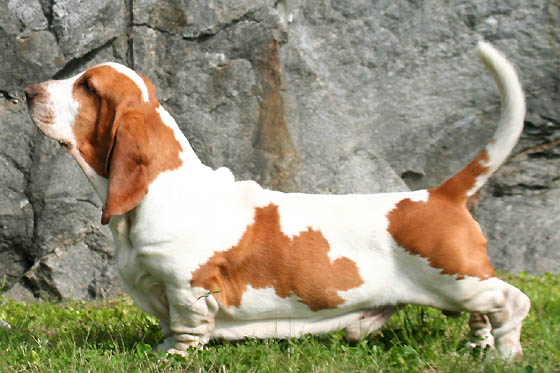
The Basset Hound is one of the most recognizable dogs in the world: Extremely short legs, ears that sweep the floor, melancholy eyes and a smell only surpassed by that of the Bloodhound. Beneath that endearing appearance lurks a stubborn, calm, and deeply affectionate hound. In this comprehensive guide, we review the character, care, health, and history of the Basset Hound so you know if this breed fits into your life.
Is the Basset Hound for you?

The Basset Hound is an exceptional family dog: Patient with children, sociable with other animals and happy to lie beside you for hours. It is not, however, an “easy” dog in the classic sense. Their inherited stubbornness from tracking work, their tendency to gain weight and their specific hygiene needs make it worthwhile to get to know them well before making a decision. Here’s an honest summary of their strengths and their drawbacks.
In favour .
- Sweet character, quiet and very close to the family.
- Tolerant and playful with children and other pets.
- He does not need strenuous exercise – daily walks are enough.
- Short hair and easy to maintain.
- Rarely aggressive; usually gets along well with strangers.
To be taken into account
- Very stubborn: education requires patience and constancy.
- Dominant smell: if it picks up a trace, it disconnects from you.
- It howls and barks with a powerful voice to demand attention.
- Prone to obesity and back and ear problems.
- Babea, you’re losing some hair and you need fold and ear hygiene.
Character and temperament
If we had to define the Basset Hound in three words it would be: quiet, affectionate and stubborn. It is a dog of a gentle temperament, not shy and deeply loyal, enjoying human company above almost anything else. At home it tends to be peaceful and less nervous, able to spend a good part of the day sleeping on the couch or following you from room to room with its characteristic wobbling gait.
Such placeness should not be confused with lack of intelligence. For centuries the Basset was selected to follow a trail autonomously, making decisions without waiting for orders from the hunter. Hence his reputation as a stubborn man: It’s not that he doesn’t understand what you’re asking, it’s that he’s been raised precisely to think for himself. When its nose detects something interesting, it can selectively turn deaf to your call. Understanding this independence is the key to living with it without getting frustrated.
The Basset Hound is also a vocal dog. Its repertoire includes everything from the low barking to the melodic howl typical of hounds, which it uses to claim food, attention or to express boredom.
Coexistence: children, other pets, flat and loneliness
- With children: is one of its great virtues. Patient, robust and playful, it fits very well in families with children. It is convenient to teach children not to ride on or force their long spine, which is delicate.
- With other pets: as a good pack dog, usually accepts other dogs willingly and, with early socialization, also cats.
- On the floor: adapts well to living in an apartment due to its quiet nature, as long as it has its walks.
- In the face of loneliness: is very attached and it’s not good to be alone for too many hours. Boredom can translate into howling that your neighbors won’t appreciate, or destructive behavior. It needs company and routine.
Education and training

Raising a Basset Hound requires one virtue above all others: patience. It’s not a dog that learns to please you like a Border Collie would; it needs to find a motivation, and that motivation almost always comes through food. Positive reinforcement with appetizing rewards, short sessions and lots of repetition gives much better results than any hard correction, which will only get you to close in on the band.
He begins socialization and basic rules as a puppy, when he is still most malleable. Two challenges deserve special attention. The first is the called: With its prodigious sense of smell, a loose Basset can follow a trail and ignore you completely, so it’s best to work on the “see” from a young age and be very careful with loose ones in unfenced areas. The second is the consistency: This dog will test the limits again and again, so the whole family must apply the same rules without exception. With good humor and gentle firmness, the Basset perfectly learns what it needs.
Exercise and activity
The Basset Hound is not an athlete and does not pretend to be. Its short legs and heavy body make it a slow-paced dog, which enjoys smelling every corner more than running. However, needs daily exercise: between 40 and 60 minutes of walking spread over one or two outings are usually enough to keep it fit and, above all, to avoid the overweight to which it is so prone.
The ideal activity for this breed is the olfactory walk: Allowing him time to trace and explore with his nose is mentally and physically more tiring than a brisk walk. It is not a good companion for long-distance running or for jumping sports, which are also counterproductive to its spine. Avoid strenuous exertion in puppies and older dogs, and watch out for heat: With those ears and that low body, he gets tired sooner than he looks.
Care: fur and hygiene

The Basset Hound’s coat is short, dense, and fairly easy to maintain: a weekly brushing is enough to remove the dead hair, although it loosens more than its size would suggest. The bathroom is reserved for when it’s really dirty, every few weeks.
- Orejas: Their long, sloping ears have poor ventilation and drag on the ground, making them very prone to infection.
- Folds and skin: loose and wrinkled skin, especially around the face and neck (the “dewlap”), accumulates moisture and dirt.
- Eyes and drool: her slightly droopy eyelids can accumulate scabs, and she drools more than average, so a routine face cleanse is fine.
A practical detail: Being a long and heavy dog, you must always hold it carefully, holding both the chest and hindquarters so as not to strain the spine.
Foodstuffs
Feeding is, along with the back and ears, the great health issue of the Basset Hound. This breed she loves to eat. and has an amazing facility to gain weight, which is especially dangerous in a dog whose spine already bears a lot of strain. Each extra kilo punishes its joints and vertebral discs.
The golden rule is to measure your rations, divide your food into two servings a day, and resist those begging eyes that ask for leftovers from your plate. Choose a quality feed appropriate to your age and activity level, check your weight regularly, and use head prizes, deducting them from your daily ration. Because of its predisposition to gastric dilation-torsion, it is advisable to avoid vigorous exercise just before and after eating and, if recommended by your veterinarian, to use slow-feeders.
Health and life expectancy
The Basset Hound usually lives between 10 and 12 years, and some recent studies place its average even somewhat above.
- Back problems:‘s long body and short legs make it prone to intervertebral disc disease and hernias.
- Osteocondrodisplasia: the genetic condition responsible for their short legs, which affects the development of long bones.
- Otitis and ear infections: as a direct result of his long, poorly ventilated ears.
- Glaucoma: the breed is among the most predisposed to this eye disease, linked to a genetic mutation; it is advisable to monitor the sight.
- Gastric dilation and torsion: a veterinary emergency to which the Basset is especially prone because of its deep chest.
- Skin problems and obesity: Fold dermatitis, yeast infections and overweight are common if hygiene and diet are neglected.
With regular veterinary checkups, a controlled weight, and good ear and fold hygiene, most Basset Hounds enjoy a long and comfortable life.
Physical appearance
The Basset Hound is unmistakable. It has the bone structure of a large dog compressed on very short legs: in fact, in proportion to its size, it is the heaviest bone dog that exists. It measures around 33 to 38 cm at the cross and, depending on the bloodline, can weigh between 20 and 35 kg, making it a surprisingly dense and compact medium dog.
Its silhouette combines a long body and deep chest with a long tail that wears high and slightly curved, almost like a sword. The head, with its loose, wrinkled skin and that dangling paw, gives it a permanently melancholy expression that is part of its charm. The ears, very long and furry, are not an aesthetic whim: They help to remove and concentrate odors from the soil towards the nose as it crawls.
The hair is short and rough. As for the color, it supports practically all the layers of the hounds except the blackbird (merle) and the tiger. The most typical are the tricolors(black, fire and white) and the two colors lemon and white, although they are also seen in different shades of red and white.
Origin and history
The story of the Basset Hound is a journey from France to England. His name says it all: “basset” derives from the French low, “low”, and “hound” is “sabueso” in English. I mean, “low shoulder”. Its roots go back to the ancient dogs of St. Hubert, the famous hounds of the Belgian Benedictine monastery that are also the origin of the Bloodhound. From this trunk, and most likely from deliberately selected short-legged mutations, came the French basset hound.
Why was he interested in such a short hound? Before the French Revolution, hunting on horseback was the privilege of royalty and high nobility. Those who hunted on foot greatly valued a slow, short-legged dog that could be kept walking. Controlled breeding of the modern Basset began in France around 1870, with the lines of Count Le Couteulx and Louis Lane converging into the Basset Artésien Normand.
Beginning in the 1870’s, these dogs began to be imported into England, where the Basset Hound as we know it took shape. Everett Millais, considered the father of the modern breed, even crossed a Basset with a Bloodhound to obtain larger specimens. The first standard was drawn up in Great Britain at the end of the 19th century and, therefore, although its blood is French, the FCI today recognizes the Basset Hound as a British sponsored breed, framed in the group of hounds.
Curiosities
- His sense of smell is legendary, surpassed only by that of the Bloodhound of all breeds.
- He has been the face of the Hush Puppies footwear brand since 1958; the dog in the logo is named Jason.
- Droopy, the phlegmatic cartoon character created by Tex Avery, is a Basset Hound.
- In 1956, Elvis Presley sang “Hound Dog” to a Basset named Sherlock, with chisterna included, on television.
- Lieutenant Colombo had a Basset Hound that, without much imagination, he simply called “Dog”.
- In the Disney movie Los Aristogatos, a Basset named Lafayette appears.
- The British comic strip Fred Basset has been in print since 1963.
If you are attracted to the character and smell of hounds, you will be interested in meeting other breeds in the same family. The Beagle shares a tracking vocation in a more sporty and compact format; the Bloodhound is the older relative of the descendant and possesses the best olfactory sense in the canine world; the Dachshund shares that long, low silhouette with a tendency to back problems; and the Harrier is another British hound with a similar sociable temperament.
Frequently Asked Questions About the Basset Hound
Is the Basset Hound a good dog for families with children?
Yes, it is one of its greatest virtues. It is patient, robust and playful, and usually tolerates children very well. It is necessary to teach the little ones to treat it with respect and not to force its spine, which is delicate.
How much exercise does a Basset Hound need?
Not too much: 40 to 60 minutes of walking a day, spread out over one or two trips, is enough. You enjoy snooping more than running, and exercise is key to keeping you from gaining weight.
Is it hard to educate?
It is stubborn and independent, a product of its past as an autonomous tracking dog. It is not that it is unintelligent: it was simply bred to decide on its own. With positive reinforcement, food rewards, patience and a lot of perseverance it learns perfectly.
How long does a Basset Hound live?
Their average life expectancy is about 10 to 12 years, and some recent studies put it a little higher. With proper nutrition, weight control, and veterinary checkups, they can reach a comfortable old age.
Why is your back so delicate?
Their long body on very short legs, due to a genetic condition called osteochondrodysplasia, makes them prone to hernias and intervertebral disc disease, which is why it’s important to avoid jumping and stairs and keep them at their ideal weight.
Does it need a lot of hygiene?
The hair is short and easy, but requires special attention on long ears (prone to infection), skin folds and eyes.
Does the Basset Hound bark or howl a lot?
It is a vocal dog, with a deep and melodic howling typical of hounds. It uses it to demand attention, food or when it is bored, especially if it spends too much time alone.