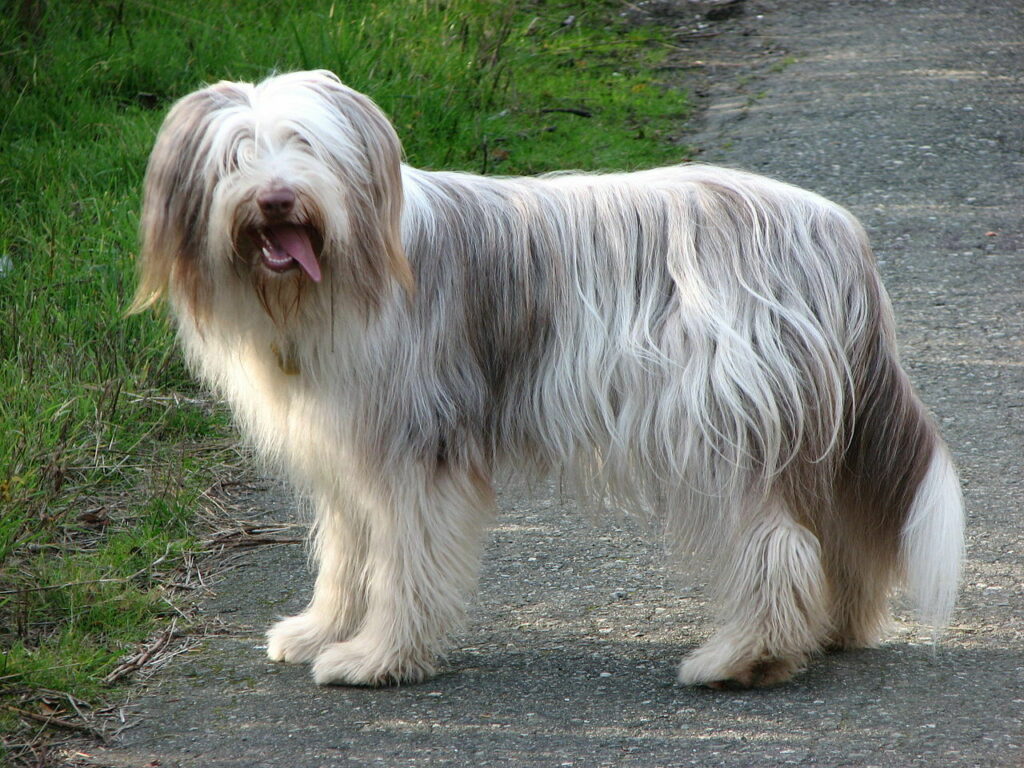
The Collie Barbudo(Bearded Collie, affectionately nicknamed “Beardie”) is a medium-sized, long-haired Scottish shepherd dog with a relentlessly cheerful character. Born to move sheep and cattle through the Scottish Highlands, today he is above all an active, sociable and highly intelligent family companion. If you’re looking for a lively, furry, devoted dog, the Bearded Collie deserves your full attention.
Is the Bearded Collie for you?

Before you fall in love with his freckle and beard, you should be honest: The Bearded Collie is a working dog with a lot of energy and a coat that requires constant maintenance. It’s not a decorative breed or a couch race. It’s a great fit for families and active outdoorsmen who can devote time to exercise, mental stimulation, and brushing. These are their lights and their shadows.
In favour .
- Very smart and easy to train, learns fast.
- Cheerful, balanced and not prone to aggression.
- Excellent with children and very sociable with family.
- Resilient and rustic: it withstands cold and bad weather.
- It is an ideal companion for dog sports (agility, obedience, flyball).
- Good longevity for a medium-sized dog.
To be taken into account
- High energy level: needs plenty of daily exercise.
- The long coat requires frequent brushing to avoid knots.
- It can bark and retains a strong herding instinct.
- He doesn’t like prolonged loneliness.
- Hereditary tendency to certain diseases (such as Addison’s).
- He stains and drags mud and water with that beard and that cloak.
Character and temperament
If I had to sum up the Bearded Collie in one word, it would be enthusiasm. It’s an alert, lively and permanently good-humored dog that faces life with an infectious joy. Breeders and canine sources agree in describing it as an intelligent animal, easy to train and without signs of nervousness or aggression, making it one of the most balanced shepherd breeds for family life.
Their intelligence is both their best quality and their most demanding. A bored Beardie makes up his own entertainments, and they rarely match the ones you had in mind. He needs to feel part of the group, participate in household activities and receive constant encouragement. In return, it gives you back enormous loyalty and an amazing ability to read people’s moods.
It retains, of course, the temperament of a dog bred to work alone in the face of difficult herds: it is independent when necessary, decisive and with initiative. It is not a submissive dog that obeys out of fear, but a collaborator who cooperates when he understands the why. That spark of character, well channeled, is just what makes the breed fall in love.
Coexistence: children, other pets, flat and loneliness
- With children: is one of its great virtues. The Bearded Collie has a reputation for being patient, playful and affectionate with the little ones, and enjoys being part of the family bustle. However, due to its energy and size, it is advisable to supervise the game with very young children to avoid involuntary pushes.
- With other pets: is sociable by nature, usually gets along well with other dogs. Its herding instinct may cause it to try to “group” children, cats or other animals by running after them; it is corrected with early education.
- On the floor: can adapt to living in a flat as long as it is guaranteed the daily exercise it needs.
- In the face of loneliness: is a dog very attached to its people and does not tolerate spending many hours alone. Boredom and separation anxiety can lead to barking or destructive behavior. It needs company and routine.
Education and training
Few breeds are as grateful for training as the Bearded Collie. Its intelligence and willingness to please make it a quick learner, able to compete successfully in obedience, agility and dog freestyle tests. In fact, the breed’s history is dotted with obedience champions who demonstrated how far their learning ability goes.
The key is in the method. The Beardie responds wonderfully to positive reinforcement (rewards, play, cheerful voice) and closes in band to harshness or screams. Sessions should be short, varied, and enjoyable, for monotonous repetition will quickly bore you. It’s best to start early with socialization: exposing him as a puppy to people, noises, other dogs and different environments creates a safe and calm adult.
It works especially on call and self-control, because its herding instinct can push it to shoot out after anything that moves. A Beardie with a solid “come here” and obedience games integrated into day to day is a happy and manageable dog.
Exercise and activity

There are no shortcuts here: The Bearded Collie was bred to spend the whole day moving herds through rough terrain, and that translates into a high energy level that needs to be met every day. A short walk around the block isn’t enough for him. As a reference, the recommendations for the breed speak of at least a couple of daily sessions of half an hour of play and active exercise, ideally combined with free running space.
Beyond physical exercise, he needs mental exercise. Dog sports are his favorite field: He shines in agility, obedience, flyball and freestyle, where he combines speed, agility and obedience. He also enjoys herding instinct tests, a great way to get him a “real” job. Olfactory games, interactive toys, and training routines complete the picture of a balanced Beardie.
A Bearded Collie who gets enough activity is calm and well-behaved at home. One who doesn’t get it becomes nervous, barking and prone to getting into trouble. Exercise is not optional with this breed: it is the foundation of their well-being.
Care: fur and hygiene
The coat is the Bearded Collie’s hallmark and also its greatest commitment to maintenance. It has a medium-length double coat: a soft, dense inner coat that insulates it from the cold, and a smooth, rough, loose outer coat that repels water and dirt.
Weekly brushing is mandatory to keep the hair free of tangles, and many owners choose to brush several times a week, especially during mowing. Pay special attention to friction areas: behind the ears, the armpits and the hindquarters, where the knots form first. If you don’t want to spend that much time and you’re not going to take it to exhibitions, a practical option is to cut the cloak in the “puppy cut” style, which greatly facilitates maintenance even if it changes its characteristic appearance considerably.
The rest of the hygiene is the usual for any dog: checking and cleaning ears, cutting nails, dental care and punctual baths when it gets really dirty.
Foodstuffs
The Bearded Collie does not have exotic dietary needs, but its activity level does set the bar. It needs a complete and quality diet, adjusted to its age, weight and, above all, to its actual energy expenditure: a Beardie who practices dog sport daily burns much more than one with a quieter life.
Divide the daily ration into two meals instead of one, a practice recommended in deep-breasted dogs to promote digestion. Control the quantity and monitor the weight regularly, because under all that hair it is easy for overweight to go unnoticed until it is already evident. Overweight punishes the joints and aggravates any orthopedic predisposition.
Always have fresh water available and avoid strenuous exercise just before and after meals.If you have any doubts about the type of diet, quantities or possible intolerances, it is best to consult your veterinarian, who will tailor the regimen to your particular dog.
Health and life expectancy

The Bearded Collie is, in general, a healthy and long-lived dog. A British study from 2024 placed its life expectancy around 13.9 years, above the average of purebred dogs, an excellent figure for a dog of its size.
The most characteristic is hypoadrenocorticism or Addison’ s disease, a hereditary-based adrenal gland disorder that affects the breed in a significantly higher proportion than the general canine population.
- Skin problems such as: such as foliar pemphigus, black skin disease and follicular dysplasia.
- Eye problems: corneal dystrophy, cataracts and progressive retinal atrophy (PRA).
- Musculoskeletal problems such as: as the congenital elbow dislocation.
According to a survey by The Kennel Club, the leading causes of death in the breed include old age, cancer, cerebrovascular disease, and chronic kidney failure. The best prevention is to go to responsible breeders who perform health tests on the breeders, maintain veterinary checks and monitor any changes in behaviour, appetite or energy, which in the case of Addison’s can be the first signs.
Physical appearance
The Bearded Collie is a medium-sized dog with a slender build, clearly longer than tall, giving it a stylized and athletic silhouette.
The head is square and proportionate, with a moderate stop and medium-sized dropped ears. The pigmentation of the nose, lips and eyes follows and harmonizes with the coat color of each specimen. It has a level back and low insertion tail, which should never be wrapped around the back; its movement is flexible, smooth and powerful, capable of covering ground with very little effort.
The coat, already described, is double and of medium length: inner soft and outer rough and ragged. As for colors, the breed supports black, blue, brown and fawn, with or without white spots, which are sometimes accompanied by light fire-colored marks.
Origin and history
The Bearded Collie originates from Escocia, where for centuries it was the working tool of shepherds to move sheep and cattle through the demanding highlands.
There’s a long-running legend about its origins: In 1514, a Polish merchant named Kazimierz Grabski is said to have arrived in Scotland to exchange a shipment of grain for sheep, bringing with him several Polish lowland sheepdogs (the ancestors of today’s Polski Owczarek Nizinny). A Scottish shepherd, impressed by his ability with the herd, would have traded some sheep for those dogs, which were later crossed with the local dogs to give rise to the Beardie. Spanish sources collect this story by placing that foundational cross with imported dogs in 1514.
The first written reference to the breed dates from 1891, when D. J. , please . Thomson Gray described them in his book The Dogs of Scotland as a large, rustic and unkempt dog with hard fur like a felp. The modern show breed, however, is considered to have been founded in 1944 by Mrs. G. Olive Willison, who started breeding from her brown female Jeannie of Bothkennar and a grey male, Bailie of Bothkennar; that pair is the origin of the present exposure lines.
The Beardie gained popularity in the latter half of the 20th century, driven in part by The Potterdale Classic at Moonhill, a Bearded Collie that was proclaimed Best in Show at the prestigious Crufts show in 1989.
Curiosities
- Their English nicknames are most expressive: Beardie, Highland Collie(Highland Collie) and even Hairy Mountain Dog(Hairy Mountain Dog).
- Many puppies are born with one color and change hue as they grow: a black Beardie can lighten to silver gray with age.
- The Kennel Club considers it a vulnerable native breed, meaning that very few new specimens are registered each year in its country of origin.
- He won a Best in Show at Crufts in 1989, one of the most important dog shows in the world.
- Unregistered Bearded Collies still exist working as herding dogs in the Scottish countryside, faithful to their original function.
- In the United States it is a relatively minority breed: the American Kennel Club places it around 140th out of more than 200 breeds in popularity.
If you’re attracted to the Bearded Collie’s shepherding character and intelligence, you’ll be interested in comparing the breed to other dogs in the same family and fitness. Check out the tireless Border Collie, the sleek Collie, the unmistakably furry Old English Sheepdog (Bobtail), and the versatile Pastor Australiano, all shepherd dogs with a lot to offer active families.
Frequently Asked Questions About the Bearded Collie
Is the Bearded Collie a good family dog?
Yes, it is one of his great virtues. He has a cheerful, balanced and non-aggressive character, and gets along especially well with children. He is very sociable and enjoys being part of family life, as long as he is given the exercise and company he needs.
How much exercise does a Bearded Collie need?
It was bred as a herding dog and has a high energy level. As a reference, at least two sessions a day of about 30 minutes of play and active exercise are recommended, ideally with space to run freely and some mental stimulation such as dog sports.
How long does a Bearded Collie live?
It is a long-lived breed. A British study from 2024 placed its life expectancy at around 13.9 years, above the average of purebred dogs.
How much does it cost to take care of your fur?
Its long, double coat requires brushing at least weekly to avoid knots, and many owners brush it several times a week.
Does he adapt to living in a flat?
It can adapt if it is guaranteed the daily exercise it needs, but it is not ideal. It performs much better with access to a garden or large space. Moreover, it does not tolerate prolonged solitude and may bark if bored.
Is it easy to educate?
It is a very intelligent and eager to learn dog, which excels in obedience, agility and freestyle. It responds to positive reinforcement and short and varied sessions; it rejects harsh methods. It is advisable to socialize it early and work well the call for its instinct of shepherding.
What health problems does the breed have?
It is a generally healthy dog, but has a hereditary predisposition to Addison’s disease (hypoadrenocorticism), as well as certain dermatological, ocular (cataract, retinal atrophy) and musculoskeletal problems.
Where did the Bearded Collie originate from?
From Scotland, where it was used for centuries as a sheep and cattle herding dog.