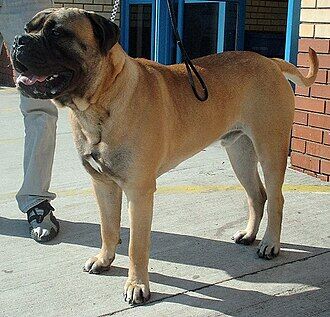
The Bullmastiff is a large British moose, bred in the 19th century to guard large English farms and deter poachers. It combines the mass and strength of the mastiff with the determination of the ancient bulldog, but its character is surprisingly serene and homely. If you’re looking for a quiet keeper, a little barking and deeply attached to his family, the Bullmastiff is one of the most interesting breeds you can meet.
Is the Bullmastiff for you?
Before you fall in love with his wrinkled face, you should be honest: the Bullmastiff is a large, strong and protective dog that needs a calm, present and willing owner to educate it well from puppyhood. It is not a complicated dog to maintain in the day to day, but it is a lot of dog. These are its lights and shadows.
In favour .
- Natural guardian, deterrent and very reliable, no need for aggressive training.
- Quiet and homely: little barking and only moderately active at home.
- It adapts well to life on the flat and in the city.
- Simple hair maintenance, short hair.
- Loving and loyal, he takes orders from the whole family, not from one master.
- Moderate exercise needs.
To be taken into account
- It is a very large and heavy dog: 50 kg or more in males.
- Short life expectancy, around 10 years.
- Prone to dysplasia, gastric torsion and certain tumors.
- It babbles and snores from its short snout; poorly tolerant of heat.
- He needs socialization and firm boundaries since puppyhood.
- He can’t stand prolonged loneliness.
Character and temperament

The Bullmastiff is, above all, an intelligent, discreet and effective guard. Unlike other more reactive moloses, it stands out for its great ability to discriminate: it knows how to distinguish a normal situation from a real threat and does not waste bark.
At home he is a calm, quiet and deeply familiar dog. He likes to be close to his own, watch without straining and rest at their feet. This domestic calm is coupled with a strong protective instinct that is activated when it senses that its people or territory are in danger. A particularly valued feature of the breed is that it measures its strength very well and never attacks to make blood: Their instinctive way of neutralizing an intruder is to knock him down and block him with the body, not bite him.
Another trait that makes it much easier to get along with is that it is not a “one-owner” dog. It readily accepts directions from all members of the household, including the youngest, making it a very balanced family companion provided it is well trained.
Coexistence: children, other pets, flat and loneliness
- With children: is usually tolerant, patient and affectionate with the children in the family.
- With other pets: well socialized from puppyhood can coexist with other dogs and domestic animals. Males may show some rivalry with other males, so early socialization is key.
- On the floor: adapts surprisingly well. It is homely, barks little and is moderately active indoors, so life on the floor and in the city is not a problem if you go out for a walk every day.
- Soledad: is a family dog who is very attached to his people. He has a poor tolerance for prolonged loneliness, so he is not the best choice if he is going to spend many hours alone every day.
Education and training
The Bullmastiff is intelligent and wants to please, but retains the point of independence and stubbornness typical of moles. The formula that works best is consistency: short sessions, positive reinforcement, patience and clear rules from the first day. A dog of this size and with this guardian character cannot grow without limits.
Early socialization is absolutely non-negotiable. Exposing the puppy to people, noises, other dogs and different situations during its first few months builds the balanced and confident adult the breed promises. Basic obedience – going to the call, walking on a leash without pulling, sitting and standing – must be well established before it reaches its final size and weight.
An important point: training in attack is totally discouraged in this breed. The Bullmastiff is already a guardian by nature; enhancing aggressiveness only distorts his character and creates problems.
Exercise and activity
Its exercise needs are moderate. An adult needs a couple of daily walks and some quiet playtime to be happy and fit; it is not a hyperactive dog or an endurance athlete. Its mass and short snout make it badly tolerate intense effort and, above all, heat, so it is advisable to avoid the central hours of the day in summer.
The most delicate chapter is exercise during growth. It is essential to control it well at the critical stage of development – up to 15-16 months in males and about 10 months in females – so as not to overload joints that are still forming. Jumping, stairs, and long runs in the puppy can result in musculoskeletal problems in the adult. For the same reason, care must be taken that the puppy does not become overweight.
Care: fur and hygiene

One of the great advantages of the Bullmastiff is the ease of its maintenance. It has short hair and a single moult that stands out annually, in the spring. With vigorous brushing three times a week, for and against the coat, it is enough to keep the coat clean and shiny and to control body odor.
Frequent bathing is discouraged because it alters the natural pH of the skin. If at any time it is imperative to bathe, it is advisable to do so with shampoo of neutral pH and warm water, cleaning very well so as not to leave soap residue and carefully drying the whole body, paying special attention to the folds.
It is precisely these folds of the face and ears that deserve regular inspection: they must be kept clean and dry to avoid irritation and ear infections, to which the breed is prone.
Foodstuffs
As a slow-growing giant, the Bullmastiff needs quality food and, above all, well-measured. In the puppy stage, the priority is not that it grows quickly, but that it grows in a controlled way: excess weight and energy during development overload the joints and favors dysplasia.
For an adult, it is reasonable to divide the daily allowance into two meals rather than one large meal, and to avoid exercise just before and after eating. This is an important precautionary measure because the breed, like other large deep-chested dogs, is prone to gastric torsion (dilatation-volvulus), a serious veterinary emergency. If in doubt about quantities, type of feed or supplements, it is best to follow the veterinarian’s instructions.
Health and life expectancy
The Bullmastiff’s life expectancy is about 10 years; a British study from 2024 put the average of the breed at 10.2 years, below the average of purebred dogs.
Among the breed’s most common ailments are:
- Hip and elbow dysplasia: are relatively common joint problems in the breed; puppies from parents with hip and elbow tests should be chosen.
- Gastric torsion (dilatation-volvulus) is defined as: severe urgency typical of large deep-chested dogs.
- Progressive retinal atrophy: is an inherited form in the breed, associated with a mutation in the RHO gene, which causes vision loss.
- Cáncer: has a relatively high incidence of lymphoma and mastocytomas (mastocyte tumors).
- Entropion and hypothyroidism: among other hereditary problems described in the breed.
- Infections of the ear: to which it is prone, hence the importance of checking and drying the ears well.
It should also be noted that the Bullmastiff is a brachycephalic dog, with a flat face and short snout, although this morphology does not usually compromise its breathing as much as in other breeds.
Physical appearance

The Bullmastiff is a large dog, with a solid constitution and an imposing and dissuasive appearance. It has good bones, a broad and deep chest and a powerful back that transmits strength without falling into heaviness.
His mark of identity is the head: square seen from any angle, with a broad, medium-length nose covered by a black mask that extends around dark, intense, deep-looking eyes. The V-shaped ears are darker in hue than the mantle, preferably black. The hair is short and the coat can be leathery – in all shades, from sand to deep red – or brindle; some limited white is allowed on the chest.
Origin and history
The Bullmastiff is a British breed that was forged in England in the 19th century from the crossing between the English Mastiff and the old English Bulldog, now extinct.
Their great task was to guard large estates and private estates against poachers. This earned him the nickname “forester’s night dog” (Gamekeeper’s Night Dog): He patrolled at night and, when he caught a burglar, he chased him and knocked him down to immobilize him with his body weight until the guard arrived, without having to bite him. That containment is part of its essence from the beginning.
The breed gained official recognition from the British Kennel Club in 1924, with an initial standard that has hardly changed since then. The American Kennel Club recognized it in 1934 and the International Cinological Federation (FCI) accepted it definitively in 1955; today it is included in Group 2 of the FCI, that of the molosoids of the mastiff type. To register a specimen as a purebred Bullmastiff required at least four generations of Bullmastiff descendants, with no bulldog or mastiff contributions.
Curiosities
- Its historic nickname, “the forest ranger’s night dog”, perfectly sums up its original job: silent surveillance and bloodless capture.
- In 1928, the De Beers diamond company imported Bullmastiffs to South Africa to police their diamond mines.
- Unlike other molluscs, its instinct is not to bite but to knock down and block the intruder with its body: it measures its strength and rarely causes harm.
- It is a dog of one aim and a thousand nuances: imposing to strangers and surprisingly tender to its family.
- The male does not complete “making” until about three and a half years of age, when he reaches his full physical development.
If you are attracted to the Bullmastiff’s balanced character and appearance, you will be interested in learning about other breeds in the same molose family and comparing sizes, temperaments, and care. Take a look at its ancestor, the towering Mastiff, and the other pillar of its origin, the Bulldog. Also worth a visit are the Italian Cane Corso and, in a more athletic and familiar key, the Boxer, which shares roots with the old bulldog.
Frequently Asked Questions About the Bullmastiff
Is the Bullmastiff a dangerous or aggressive dog?
He’s not an aggressive dog by nature. The Bullmastiff was bred precisely to reduce and immobilize the intruder with the weight of its body without biting, so it measures its strength very well. He’s a calm, balanced guardian and very close to his family. That said, we’re talking about a moose that weighs 50 kilograms or more with a strong protective instinct, so it needs early socialization, clear boundaries and a responsible owner. Attack training is totally discouraged.
How long does a Bullmastiff live?
Their average life expectancy is around 10 years.[citation needed] A British study from 2024 placed the average of the breed at 10.2 years, below the average of purebred dogs.[citation needed] As with almost all large molosses, longevity is shorter than that of small breeds; taking care of weight, feeding and veterinary checkups helps to make the most of those years.
How much does a Bullmastiff weigh and measure?
It is a large and massive dog. Males measure about 64-69 cm at the cross and weigh between 50 and 59 kg approximately. Females measure 61-66 cm and weigh between 41 and 50 kg. The male reaches full physical development around three and a half years, and the female over eighteen months.
Is the Bullmastiff adapted to living in a flat?
Yes, surprisingly well. It barks little, is very homely, and is only moderately active indoors, so it adapts to life on the floor and in the city better than many smaller, nervous dogs. What it cannot miss are a couple of daily walks and, above all, companionship: it is a family dog that has a hard time with prolonged solitude.
Is the Bullmastiff good with children?
It is usually a tolerant and affectionate dog with the children of the house, and one of its virtues is that it accepts the orders of all members of the family, not only of a single owner.
How much exercise does a bullmastiff need?
Moderate needs: two daily walks and some quiet play are enough for an adult. The most important thing is to control a lot of exercise during the growth stage (up to 15-16 months in males and about 10 months in females) so as not to damage their joints, and avoid overweight in the puppy.
Does the Bullmastiff drool and snore a lot?
It has a short snout and a wrinkled face, so some drooling and snoring is common, especially after drinking or in heat.
Is it easy to train a Bullmastiff?
It is intelligent and wants to please, but also has its point of independence and soft stubbornness. It learns well with short sessions, positive reinforcement, patience and consistency from puppyhood. Early socialization and good basic education are non-negotiable in a dog of this size and guardian character.