The Neapolitan Mastiff (Mastino Napoletano) is a giant-sized Italian mollusk, unmistakable for its abundant skin, folds and ancient guardian demeanor. Beneath that harsh look lurks a quiet, loyal and deeply attached family dog, bred for centuries to protect home and property. It’s not a race for everyone: He weighs, he sucks, he lives a few years and he needs a firm hand. If you understand what this entails, you will have at your side a noble companion and a deterrent without equal.
Is the Neapolitan Mastiff for you?
Before you fall in love with its wrinkled face, let’s be honest: the Neapolitan Mastiff is a giant dog with specific needs and delicate health.
It suits you if…
- You’re looking for a dissuasive guardian, serene and very attached to his family.
- You have a house with a fenced-in garden and plenty of room.
- You can take on a piggy bank, hair and a 60-70-pound dog at home.
- You’ve been willing to socialize and educate consistently since you were a puppy.
- You accept veterinary expenses and a short life expectancy.
Maybe it’s not your breed if…
- You live in a small apartment with no outdoor space.
- It’s your first dog or you don’t want to work education.
- You’re bothered by drooling, dirt or snoring.
- You’re looking for a sports buddy to run with or do long walks.
- You can’t take care of your eyes, skin and joints.
Character and temperament
The Neapolitan Mastiff is, above all, a guardian. Its temperament is determined and loyal, but not aggressive: it does not bite without reason or seek a fight. It lives attentive to its territory and its own, always vigilant, and reserves its affection for the family, with which it shows itself sweet, calm and surprisingly affectionate. It is an intelligent, noble and majestic dog, aware of its size.
With strangers he is naturally suspicious and acts as a deterrent without needing to bark: In fact, it’s a quiet dog, which prefers to impose its presence. He’s very brave and stoically resists pain. In front of other dogs, it tends to be dominant, especially among males, and this should be kept in mind from puppyhood. Well socialized, however, it is balanced, patient and an excellent family dog.
Coexistence: children, other pets, flat and loneliness
- With children: is affectionate and patient with the little ones in the house if it has been well socialized.
- With other pets: can coexist with dogs if it grows up with them, but its dominant nature makes it advisable to monitor the relationship with other males.
- On the floor: is not your thing, it’s quiet and not very barking, but its size, its strength and its need for space call for a house with a fenced garden.
- Soledad: is very attached to his family and does not do well with prolonged neglect.
Education and training
Early socialization – people, noises, other animals, and situations – is the most important investment you will make with a puppy of this breed.
It responds well to firm, serene and consistent guidance, never to harshness: it is a proud dog that closes in on conflict. It is advisable to set clear rules from the beginning, reward calmness and establish house rules before it reaches adult size, when it is already too heavy to correct by force. Patience, repetition and calm leadership are the formula.
Exercise and activity
Don’t expect an athletic dog. Its massive structure makes movement heavy and somewhat clumsy, and it gets tired easily. It just needs quiet daily walks and a space to patrol and watch; it’s there, in its guardian role, that it feels more accomplished than in intense exercise.
Avoid over-exertion, high temperatures and, especially, demanding exercise in puppies: the breed grows very quickly and straining the joints at this stage favors future problems.
Care: fur and hygiene
The hair is short, dense and fine, easy to maintain with a weekly brushing that removes the dead hair.The really demanding thing is not the cloak, but the skin: its abundant folds on the face and neck accumulate moisture and dirt, so you have to check and dry them frequently to prevent dermatitis and infections.
Pay special attention to the eyes and the area of the paw, where drooling is constant: having a cloth on hand and cleaning after eating or drinking is part of the routine.
Foodstuffs
Feeding is a serious matter for such a large and overweight dog. The priority is to prevent it from gaining weight: excess weight multiplies the risk of dysplasia and punishes joints that already bear a lot of weight. What is recommended is a balanced and quality food, adjusted to its size and age, and agreed with the veterinarian.
In the puppy, which grows at a great speed, nutrition must be taken care of especially to accompany this development without over-accelerating it.
Health and life expectancy
It is, honestly, one of the great shadows of the breed.The life expectancy is around 9-10 years, with a median of about 9.3, clearly below that of the whole of the dogs.Much of its problems derive from the so-called hypertype: the pressure of some exposures by specimens increasingly heavy and with more wrinkles than the natural ones.
- Ojos: excess skin favors entropy, ectropion and prolapse of the third eyelid gland (cherry eye); sometimes they require surgery.
- Piel: folds are prone to dermatitis and infection; increased vulnerability to leishmaniasis has been reported in hyper typical specimens.
- Articulaciones: is one of the breeds most affected by hip dysplasia, aggravated by their weight.
- Corazón: may cause heart problems.
- Digestivo: is among the breeds subject to gastric dilation with vulvulus (torsion of the stomach), a veterinary emergency.
The best prevention starts with the selection of the breeder: avoid excess skin and oversized specimens, and prioritize parents with evaluated hips.
Physical appearance
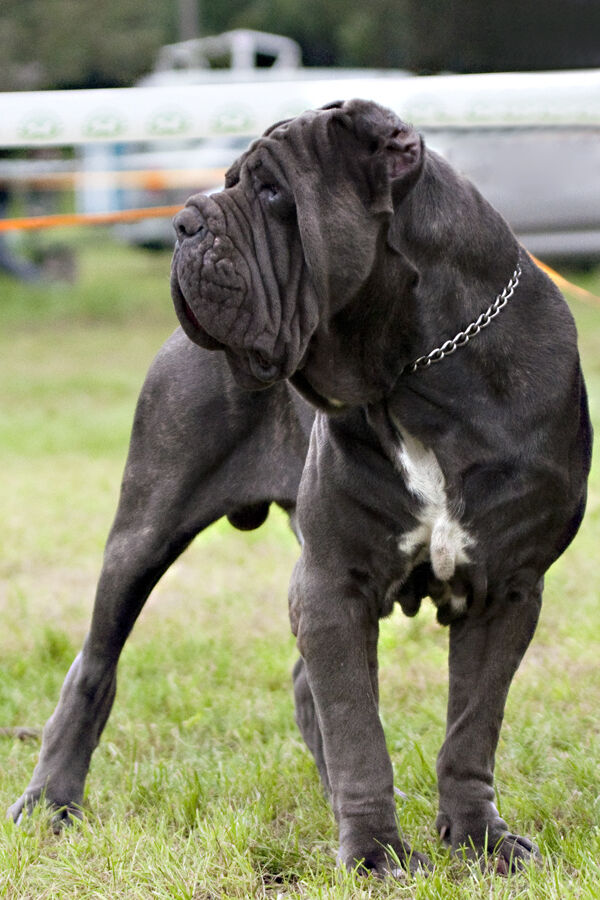
The Neapolitan Mastiff is heavy, massive and large. It weighs between 50 and 70 kg and measures about 60-75 cm at the cross, with the males at the top of the range. The trunk is longer than the height at the cross, which gives it that rectangular and powerful silhouette.
The mantle is short, dense and thin. The preferred colors are black, gray, and lead, although mahogany, lemonade, hazelnut, dove gray, and isabella are also acceptable; any of these may be tapered, and small white marks on the chest and fingers are tolerated. The set conveys strength, solemnity and a point of antiquity, as if it were a dog from another era.
Origin and history
The Neapolitan Mastiff has its roots in the ancient molluscs of the Mediterranean and descends from the guard and prey dogs of southern Italy, heirs to the Roman molluscs. For centuries, while similar breeds became extinct in other parts of Europe, in the Campania region around Naples, the breeding of these great guardians was kept alive. It is thought that the dog has been associated with those lands for at least two thousand years, making it a kind of living monument of cynology.
Its modern history begins in 1946, when the cynologist Piero Scanziani saw a specimen at an exhibition in Naples and set out to fix the breed. He drafted the first standard, officially recognized by the Ente Nazionale della Cinofilia Italiana (ENCI) in 1949, and the breed gained full recognition from the International Cinological Federation (FCI) in 1956, framed in Group 2 of molosoids. It is closely related to the Cane Corso, the other great Italian mole.
Curiosities
- Its Italian name, Mastino Napoletano, ties it forever to Naples and the Campania region.
- Throughout history, it has been credited with a wide variety of jobs: as a war dog, as a combat dog in the Roman circus, as a tractor, as an assistant, and even as a companion for disabled people.
- It is a remarkably quiet dog: it prefers to deter with its presence rather than bark.
- There are several historical bloodlines recognized by Italian breeders, reflecting the care with which the breed has been preserved.
- His image as an ancestral guardian has made him appear in film and popular culture as a symbol of strength and mystery.
If you are drawn to the world of large molossos, you may be interested in comparing the Neapolitan Mastiff with other breeds in its family: the Cane Corso, its more athletic Italian relative; the imposing Mastín Inglés; the sturdy Doge of Bordeaux; or the ancestral Mastín Tibetano, another millennial independent keeper.
Frequently Asked Questions about Neapolitan Mastiff
Is the Neapolitan Mastiff a dangerous or aggressive dog?
It’s not a dog that attacks for no reason. The standard describes him as determined, loyal and balanced: He watches and protects his stuff, but he doesn’t bite because he does. His imposing appearance is more of a deterrent than his character. The real risk comes when you don’t socialize or educate. Because of their strength and guarding instinct, a Neapolitan Mastiff without socializing work can become suspicious or territorial. With firm guidance and early treatment, he’s a calm, confident dog.
How long does a Neapolitan Mastiff live?
Some studies place the median at around 9.3 years, well below the average for all dogs. Keeping the dog in its weight, watching its hips, heart and eyes, and choosing responsible breeders who run away from the hypertype helps to make the most of those years.
How much does a Neapolitan Mastiff weigh?
The standard marks a range of 50 to 70 kg, with the males in the upper part and heights at the cross of 60 to 75 cm. In very stocky and well-bred specimens the weight can approach 100 kg. It is a massive and heavy dog: it is necessary to control the feeding so that this weight does not shoot and punish the joints.
Can you have a Neapolitan Mastiff on a floor?
It is not the ideal breed for a flat. Because of its giant size, its strength and its need for space, the recommended thing is a house with a fenced garden where it can move and play its role as a guardian. It can live indoors because it is quiet and less barking, but it needs to go out, space to lie down and a safe environment.
Does the Neapolitan Mastiff drool a lot?
Yes. Their droopy lips and loose facial skin cause them to drool, especially after drinking, in the heat, or when they smell food. It’s something inherent in the breed: you have to assume drool on walls, clothes, and floors, and always carry a handkerchief. Cleaning the folds of the face regularly also helps to prevent odors and irritation.
Is it a good breed for families with children?
Well socialized, the Neapolitan Mastiff is affectionate and patient with the children of his family and very attached to his own. His problem is not character, but size: a 60-70 kg dog can pull or displace a small child unintentionally.
What special care do your wrinkles and eyes need?
The folds of the face and neck must be checked and dried often to avoid dermatitis and moisture infections. The eyes are its weak point: excess skin favors entropy, ectropion and prolapse of the third eyelid gland (cherry eye), problems that sometimes require surgery.
Do you need a lot of exercise?
It is not an athletic or hyperactive dog: its movements are heavy and it gets tired quickly. It only needs quiet daily walks and some space to patrol, avoiding intense exercise, heat and overstrain in puppies, whose growth is very fast. The key is not the amount of exercise, but constancy and weight control to protect their joints.