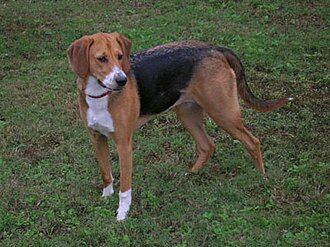
The Foxhound Americano(American Foxhound) is one of the most genuinely American hounds: A track dog, athletic and with a prodigious nose, bred for centuries to chase the fox in the open. Sweet and sociable at home but tireless in the mountains, it is a companion of balanced character who needs space, exercise and an active family. Here’s the complete guide to finding out if this breed fits you.
Is the American Foxhound for you?
The American Foxhound is not a dog for any household. It is one of the rarest in the American Kennel Club registry and carries centuries of selection as a pack dog, which defines everything: its energy, its tracking instinct and its famous voice. Before you fall in love with its sweet look, look honestly at the two columns below.

In favour .
- Sweet, gentle temperament and very sociable with people and other dogs.
- Excellent with children and, raised in groups, with other pets.
- Robust and healthy: few documented hereditary diseases.
- Short coat that barely needs maintenance.
- Extraordinary endurance and speed – an ideal sports companion.
- Rarely aggressive; remarkable emotional balance.
Against
- He needs a lot of daily exercise and space to run.
- His barking-owl (the “bay”) sounds very loud: bad neighbor for a flat.
- Unstoppable tracking instinct: never reliable loose without a fence.
- Independent and sometimes stubborn in education.
- It’s no use as a guard dog or alarm.
- He gets fat easily if he overfeeds.
Character and temperament
Anyone who lives with an American Foxhound always points out the same thing: His kind character. It is a dog of a docile and gentle temperament, calm in day-to-day life, enjoying company and rarely seeking conflict. That nobility comes from his past as a pack dog: For generations, individuals have been selected who can work side by side with dozens of equines and horses without fighting, so that tolerance and sociability are etched into their DNA.
But that sweetness coexists with a very different second soul: The hunter’s. As soon as the American Foxhound catches an interesting trail, it transforms. Keep your head down, follow the smell and disconnect from the world (and your voice). It’s a dog that thinks for itself, used to making decisions in the field away from the guide, so it combines domestic docility with a good dose of independence. It is not stubbornness on a whim, but the result of centuries of self-employment.
It is also a cheerful, optimistic and energetic dog, which needs to feel part of the family. It does not take isolation or inactivity well: a bored and unspent-energy Foxhound can become vocal and restless.
Coexistence: children, other pets, flat and loneliness
- With children: is excellent. It is gentle, patient and playful, and its endurance allows it to keep pace with the smallest without getting tired. Like any large and enthusiastic dog, it is advisable to supervise play with very young children to avoid accidental pushes.
- With other dogs: is one of the best in this regard. It is bred to live in packs, enjoys canine company and usually integrates easily. In fact, it is grateful to have a four-legged companion.
- With other pets: with cats and other small animals you have to be careful. His hunting instinct is strong; if he grows up with them from a puppy he can get along well, but a small animal that runs out activates his chase impulse.
- On the floor: is not recommended, not for its size, but for its powerful voice (which can be heard from miles away) and for its very high need for movement.
- In the face of loneliness: bad. It’s a social dog that needs company and encouragement. Long days in solitude generate boredom, anxiety and barking. If you spend many hours outside, this is not your breed unless you have another dog and a lot of exercise.
Education and training
Training an American Foxhound requires patience and method. It is intelligent, but its independence and tracking instinct make it a selective learner: it quickly learns what interests it and “forgets” the rest as soon as a more attractive smell appears.
It works much better with positive reinforcement – rewards of food, play, friendly voice – than with harsh methods, which only get it to close in on the band. Short, varied, and motivating sessions yield better results than long repetitions. Early socialization, exposing the puppy to people, noises, environments, and other animals, is key to its natural sociability flourishing.
There’s a golden rule: never trust him loose in unfenced areas.. No matter how well-educated he is, the moment his nose catches a trace he’ll stop hearing you. The call (the “see”) is the most difficult exercise and will never be 100% reliable against his instinct. Enclosed spaces, long training and a lot of perseverance are your allies.
Exercise and activity

Here’s the point that most people underestimate. The American Foxhound is a distance runner. It was bred to gallop for hours following a fox, and that machinery is still intact. It needs a lot more than a walk around the block: we’re talking long walks, runs, and, perhaps, ample space to stretch its legs every day.
It is a great companion for running (running and, when physically mature, mountain biking with adequate safety), for hiking and for canine sports that take advantage of its smell, such as mantrailing or sports tracking, which combine physical and mental exercise.
A healthy adult Foxhound appreciates between one and two long hours of intense activity a day. It’s not a weekend dog: it needs routine. If you’re looking for a quiet couch dog, this breed will make your life impossible; if you’re looking for a four-legged athlete who never gives up, you’ve found your perfect mate.
Care: fur and hygiene
In terms of maintenance, the American Foxhound is one of the most comfortable dogs out there. Her hair is short, hard and thick, designed for the countryside, and requires no styling or sophisticated care. A weekly brushing with a glove or bristle brush is enough to remove dead hair and keep it clean and shiny.
The baths are given only when necessary, because their cloak gets little dirt. The rest of the hygiene is the basic routine of any dog, with an important nuance in this breed: the ears.. Because they are long, fallen, and stuck to the head, they are poorly ventilated and collect moisture and wax, so they should be checked and cleaned frequently to prevent infection. Complete with cutting nails when they don’t wear out on their own and regular good dental hygiene.
Foodstuffs
The American Foxhound needs a quality diet, complete and balanced, adjusted to its size and, above all, to its very high level of activity.
And here’s the key warning: this breed gets fat easily if you overfeed it. Their ravenous nature, typical of hounds, causes them to eat anything put in front of them, so control of rations and prizes is the responsibility of the owner. Overweight is one of the few really common health problems in the Foxhound, and it’s totally preventable. Divide your food into two servings a day, monitor your body condition, always have fresh water available, and avoid strenuous exercise just before and after eating, especially in deep-breasted dogs.
Health and life expectancy
One of the great virtues of the American Foxhound is its robustness. Being a breed bred strictly for work, with little extreme aesthetic selection, it has retained remarkable health and, in general, does not carry a long list of hereditary diseases.
That said, there are a few points to watch:
- Sobrepeso: the most common problem and, as we saw, preventable with diet and exercise.
- Trombocitopatía: a platelet disorder that can cause excessive bleeding from minor wounds or blows. It is a minor but known risk in the breed; some owners do blood tests to detect it early.
- Dysplasia and eye problems: traditionally almost non-existent in the breed, have begun to appear occasionally.
- Orejas: because of their hanging shape, they’re prone to otitis if they’re not checked regularly.
Regular veterinary checkups, a daily vaccination and deworming schedule, and good weight management are the best recipe for your Foxhound to enjoy a long, active life.
Physical appearance

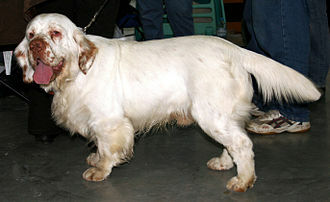
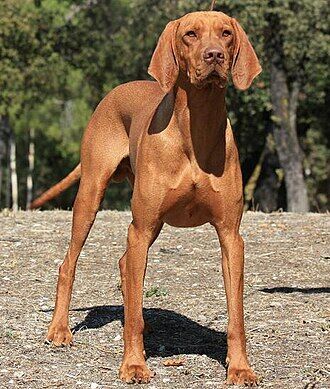
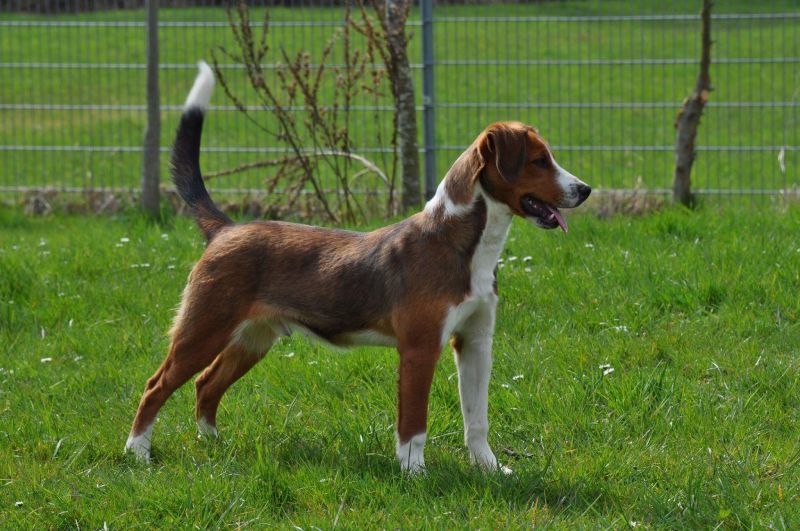
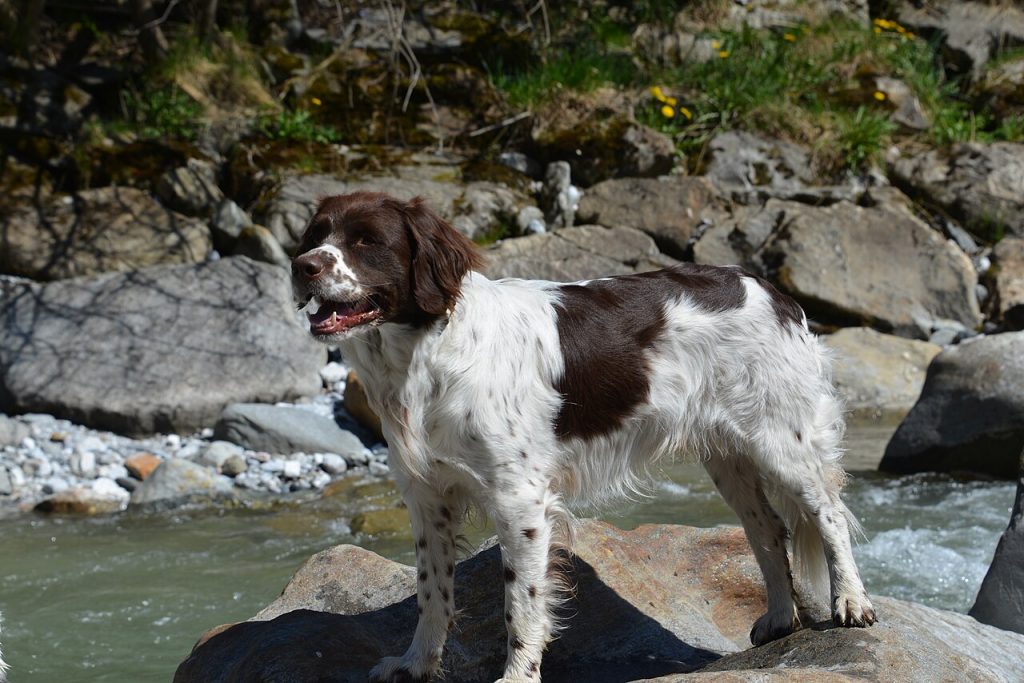
The American Foxhound is a large-sized dog, with elegant lines and athletic build, clearly taller and stylized than its cousin the English Foxhound. The standard marks a cross height of about 53 to 64 cm and a weight between 25 and 32 kg, although many exhibit specimens are taller (males can reach 74 cm) and, at the same time, slightly lighter in weight.
Its legs are long and straight-boned, made for galloping, and its chest is rather narrow. The head has a broad, slightly bulbous skull, a long snout, and broad, low-inserted ears that fall close to the cheeks. The eyes, large and well separated, are hazel or brown in color and convey that characteristic sweet expression. The tail is carried high and slightly curved, without bending over the back.
Although the standard supports any color, the most common is the classic tricolor in black, white and fire; there are also examples in red, black and fire or bluish tones.
Origin and history
The history of the American Foxhound is, to a large extent, the history of hunting in the United States. Its roots go back to 1650, when Robert Brooke sailed from England to Maryland with his pack of hunting dogs. Those animals, known as “Brooke Hounds”, remained in the family for nearly 300 years, in one of the longest documented breeding records for a single breed and family.
The great driver of the breed was, however, George Washington, whom the American Kennel Club recognizes as “father of the American Foxhound”. Passionate about fox hunting, Washington wanted faster dogs with better tracking. He received French hounds – including the Great Blue Hound of Gascony – as a gift from the Marquis de Lafayette, and crossed them with his own dogs, descendants of the Brookes, and with specimens brought from Philadelphia and England. From that mixture came the modern American Foxhound.
The breed was forged in the states of Maryland and Virginia, where Washington lived, and today is the official dog of the state of Virginia. With the arrival of the red fox, Irish Foxhound blood was added to gain speed and endurance, qualities that still define it. The American Kennel Club officially recognized it in 1886. Over time several strains emerged – Walker, Calhoun, Goodman, Trigg, July or Penn-Marydel – each with its appearance and use, but all recognized as one breed. In the FCI nomenclature it is classified in Group 6 (sows and similar breeds), Standard No 303.
Curiosities
- Few dogs can boast that a president of the United States is behind their development.
- State dog: is the official canine symbol for Virginia.
- A musical voice: its hunting bark, the “bay”, is a melodic howl that can be heard from miles away.
- Among the rarest of the AKC: despite its history, is one of the least numerous breeds in the American registry, eclipsed by its small relative, the Beagle.
- Many strains, one race: Walker, Trigg, Penn-Marydel and company may look like different dogs, but they’re all American Foxhounds.
- Bad watchman, great friend:, though “voiced” like a good hound, his sociable nature makes him a terrible watchdog… and an excellent companion.
If you are attracted to the American Foxhound, you will surely enjoy meeting other hounds and tracking dogs from the same family. Check out its closest relative in size, the Harrier, and the popular Beagle, both specialists in sniffing hunting. Bloodhound Plott Hound
Frequently Asked Questions About the American Foxhound
Is the American Foxhound a good family dog?
Yes. It is of a gentle, gentle and very sociable temperament, gets along well with children and other dogs, and rarely shows aggression. The condition is that it can expend its enormous energy daily: well exercised, it is an exceptional family companion.
Can he live in a flat?
It’s not ideal, not because of its size, but because of its powerful voice – which can be heard from a great distance and can disturb neighbors – and because of its very high need for movement.
How much exercise do you need?
He’s a long distance runner bred to gallop for hours. He needs one to two long hours of intense activity a day: running, hiking, olfactory sports. Without that outlet, he becomes vocal, restless and prone to wreckage.
Can it be released in the park or the countryside?
With great caution and only in fenced areas, its tracking instinct is so strong that as soon as it catches a scent, it stops paying attention to the call, it’s never 100% reliable loose in unfenced open spaces.
Is it hard to educate?
It is intelligent but independent and somewhat stubborn, the result of its autonomous work in the field. It responds well to positive reinforcement, short sessions and early socialization, but requires patience and constancy.
How long do you live and what health problems do you have?
Their life expectancy is around 10-12 years. They are a robust breed with few hereditary diseases. The points to watch out for are overweight (the most common), thrombocytopenia or platelet disorder, some dysplasia or occasional eye problem and ear infections due to their dropped ears.
Does it serve as a guard dog?
No. Though he “voices” like a good hound, his character is too sociable and friendly to watch. He warns with his barking, but he does not defend or distrust strangers; he is a lousy guard and an excellent friend.
How much care does your coat need?
Very little. Their short, hard hair only needs a weekly brushing to control the mildew, which is plentiful. Baths only when necessary. The most important thing is to check and clean their long ears often to avoid otitis.