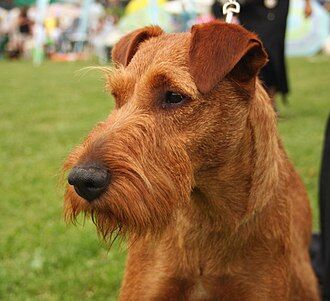
The Terrier Irlandés is one of the oldest terriers in Ireland: A red-haired dog, athletic and of a rambunctious nature, bred to hunt game and watch the farm. Compact but tireless, it adapts to both the countryside and a city flat as long as it expends its energy daily. If you are looking for a brave, loyal, sparkling companion, the Irish Terrier has few rivals.
Is the Irish Terrier for you?

The Irish Terrier is a medium-sized dog with a giant soul. It is ideal for active people who enjoy daily exercise and who know how to set boundaries with affection and constancy. It’s not the easiest breed for a novice owner: He needs calm leadership, early socialization and a healthy dose of patience with his independent nature. In return, it offers absolute loyalty, a lot of joy and an unusual physical endurance.
In favour .
- Loyal, affectionate and very close to his family.
- Excellent warning dog and attentive guard.
- Smart and quick to learn.
- Hair that barely sheds if you take good care of it.
- Robust and long-lived, with few relevant hereditary diseases.
- It adapts to the floor if you get enough exercise.
To be taken into account
- He’s usually domineering or fighting with other dogs.
- Strong hunting instinct for small animals.
- He needs plenty of daily exercise, not just a little.
- Stubborn character; less “complacent” than other breeds.
- The coat requires periodic trimming.
- It requires socialization from a puppy to avoid conflict.
Character and temperament
If one word defines the Irish Terrier, it is value. Historically it has been nicknamed “the reckless little devil” for its boldness in the face of danger, and the breed retains that fiery spirit. It is a lively dog, sporty and vivacious, but not hyperactive: indoors it can relax and behave, and goes from zero to a hundred in a matter of seconds when there is action.
With his family he is extraordinarily loyal, affectionate and sensitive. He has a highly developed sense of loyalty and enjoys participating in everything his people do. He’s quick-witted, curious and loves solving problems; he has plenty of mental capacity. Of course, he’s not one of those dogs who lives to please: It shows a very terrier independence, so it responds better when you convince it than when you force it.
Its guarding instinct is remarkable. Well channeled, it makes it an excellent warning dog: it will bark to warn, without being an aggressive guard for free. The delicate point is its relationship with other dogs: it tends to dominate and does not shy away from a fight, especially if it has not been socialized as a puppy. With people, however, it is usually sociable and close.
Coexistence: children, other pets, flat and loneliness
- With children: most Irish Terriers love children and tolerate well moving play within a reasonable limit. As with any dog, coexistence must be supervised and children taught to respect the animal.
- With other dogs: is his pending subject. He is usually domineering and prone to arguing with peers, especially of the same sex.
- With other pets: retains a strong hunting instinct towards rats, rabbits and small animals.
- On the floor: accepts apartment life as long as it meets his exercise needs.
- In the face of loneliness: is a very family-oriented dog, so it is not good to spend too many hours alone.
Education and training

The Irish Terrier is intelligent and quick to learn, but with a twist: it has a will of its own. It’s not enough to repeat commands; it needs to be motivated. It works very well with positive reinforcement, food rewards and toys, and with short, varied sessions that don’t bore it. The key is to be consistent, fair and firm without harshness: violence is counterproductive and only achieves a suspicious dog.
Socialization is the most important part of their education. Expose them from puppyhood to people, noises, environments and, above all, to other well-balanced dogs, to curb their tendency to confrontation.
For those who want to go further, this breed excels in dog sports. Many individuals excel in agility, enjoy tracking – they have a very good sense of smell and learn to follow animal or human tracks – and have a great time with olfactory games.
Exercise and activity

The Irish Terrier requires regular and abundant exercise: long walks, runs and active play. Its physical endurance is remarkable, to the point that it is an ideal companion for runners, cyclists and people who practice outdoor sports.
The good news is that once its daily activity quota is met, it behaves wonderfully at home and knows how to rest.
When walking in public areas, it is advisable to be attentive to meetings with other dogs, given their tendency to dominance.
Care: fur and hygiene
The coat of the Irish Terrier is twofold: a rough, dense outer coat of hard hair (“wiry”) that is attached to the body, and a softer inner undercoat, also reddish in tone.
The golden rule is not to cut your hair with scissors or a machine. The coat is maintained by stripping or hand plucked (with fingers or a bladeless knife), which removes the dead hair and allows a new one to grow with the correct texture and color. If torn, the mantle loses color, softens, and is no longer waterproof. For a companion dog, stripping is usually enough once or twice a year.
Careful, barely loosens hair, an advantage for anyone looking for a clean dog at home. It is not advisable to bathe it excessively: shampoos remove natural oils from the skin and damage the coat, so the ideal is to wash it only when it’s really dirty. Complete the routine with ear check and cleaning, nail check and dental care. Some puppies need to be “educated” in the position of their ears when they are young.
Foodstuffs
The Irish Terrier is a voracious dog that tends to eat everything that falls within its grasp, so control of rations is essential to avoid overweight.A healthy and balanced diet, adapted to its age, weight and activity level, is the best basis for its health and longevity.
Choose a quality food with a good source of animal protein and adjust the amount to your actual expenditure: An athlete who runs every day needs more energy than a more sedentary one. Split food into two servings, always have fresh water available, and avoid excess rewards outside of training sessions. If you have any questions about diet, rations or stage changes (puppy, adult, senior), it is best to consult your veterinarian.
Health and life expectancy
The Irish Terrier has a reputation for being a rustic and healthy breed, with few important hereditary diseases. It is a robust, climate-resistant and generally long-lived dog. A British study from 2024 placed its life expectancy at around 13.5 years, above the average of purebred dogs; many well-kept specimens reach 13-15 years without problems.
This strength does not exempt from basic care: regular veterinary checks, daily vaccination and deworming, weight control, dental hygiene and attention to ears and skin.As with any breed, the best guarantee is to go to a responsible breeder who selects for health and temperament, and maintain veterinary monitoring throughout the entire life of the dog.
Physical appearance
The standards describe the ideal Irish Terrier with three res: racy(stylized and athletic), network(red) and rectangular. It is a dog that transmits power without heaviness, with elongated and elegant lines.
In size it is a medium terrier: The standard states that it should not exceed 48 cm at the withers, with a typical height of around 45-46 cm, somewhat lower in females. The weight is around 11-12 kg, slightly higher in males. The head is long, with a short beard on the chin and marked eyebrows; the ears are small, V-shaped and bent forward just above the skull, preferably somewhat darker than the rest of the mantle. The eyes are small, dark brown and have a “burning” expression.
The tail, traditionally amputated in the past, is today kept intact in countries where cutting is prohibited and it is valued that it is carried high, without twisting over the back.
Origin and history
The Irish Terrier is native to Ireland – often associated with County Cork – and is among the oldest terrier breeds. Its exact origin is not documented, but it is thought to descend from the old black and fire terriers of the British Isles, related to other Irish breeds such as the Kerry Blue and the Soft Coated Wheaten Terrier. In the early days, there were specimens of many different colors and types; what mattered was not their appearance but their courage and effectiveness in hunting prey.
It was, above all, the dog of the farmer and the humble man: “the poor man’s watchman, the farmer’s friend and the gentleman’s favourite”, as an old Irish author described it.
Modern selective breeding began in the late 19th century. The Dublin dog show of 1873 was the first to offer a specific class for the breed, and in 1879 the first club was founded in Dublin. By the 1880s it was already one of the most popular breeds in Britain and Ireland, and was the first terrier recognised by the English Kennel Club as an Irish native breed. He arrived in the United States at the end of that century, where his club was founded in 1896. During World War I, the British Army employed it as a messenger dog and sentry dog on the front, earning praise for its intelligence and reliability under pressure.
Curiosities
- Its Irish Gaelic name is Brocaire Rua, literally “red terrier”.
- It belongs to Group 3 (Terriers), Section 1, of the FCI, with standard number 139.
- For his bravery, he became known as “the reckless little devil” (or “red devil”).
- The University of Notre Dame had an Irish Terrier as its official mascot until the 1960s; the last was named Clashmore Mike.
- The cinema has recruited him more than once: he stars in the film Firehouse Dog(2007) and appears as “Goodyear” in Finch(2021), with Tom Hanks.
- Writer Jack London dedicated two novels to the breed: Jerry of the Islands and Michael, brother of Jerry.
- Canadian Prime Minister William Lyon Mackenzie King had several Irish Terriers, all named Pat.
If you are attracted to the character of this breed, you may be interested in other Irish terriers and dogs with similar personalities. Check out the Irish cousins Kerry Blue Terrier and Soft Coated Wheaten Terrier; the “terrier king”Airedale Terrier; or another hard-haired terrier with whom he shares family airs. Wire Fox Terrier
Frequently Asked Questions About the Irish Terrier
Is the Irish Terrier a good family dog?
Yes, it is very loyal and affectionate to its family and usually gets along very well with children, tolerating moving play well. It needs clear rules, daily exercise and supervision with the little ones, like any dog.
Does he get along with other dogs?
This is its weak point. It tends to be domineering and can be quarrelsome with other dogs, especially of the same sex. Early and constant socialization greatly reduces the risk of conflict.
How much exercise do you need?
Enough. It is a working dog with great endurance: it needs long walks, runs and active play daily. It is an excellent companion for runners and cyclists. If it spends its energy, at home it is quiet.
Do you lose a lot of hair?
No, if properly cared for. Its hard coat hardly sheds hair when kept stripping (hand-ripped) once or twice a year instead of being cut by machine.
How do you take care of your fur?
Stripping by hand, never with scissors or a machine, to preserve the rough texture, color and waterproofness.
How long does an Irish Terrier live?
It is a long-lived and healthy breed. A British study from 2024 estimated its life expectancy at around 13.5 years, and many well-kept specimens reach 13-15 years.
How big is it?
It is a medium terrier. The standard marks a maximum of 48 cm at the withers, with a usual height of about 45-46 cm and a weight of 11-12 kg, slightly higher in males.
Is it easy to train?
It is intelligent and quick to learn, but has a strong will and is less “complacent” than other breeds. It responds very well to positive reinforcement, short sessions and firm but not harsh treatment.