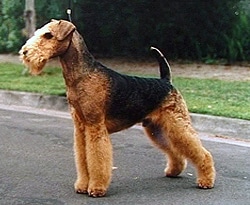
The Airedale Terrier is the largest of all terriers, to the point that it is known as the “King of Terriers”. Born in the valley of the River Aire in Yorkshire, England, he combines in one dog the sparkle and determination of a terrier with the size and versatility of a real working dog. Intelligent, courageous, and deeply loyal, the Airedale Terrier is as capable of hunting and guarding as it is of becoming an inseparable family companion. In this comprehensive guide we review their character, their care, their health and everything you need to know before sharing your life with one.
Is the Airedale Terrier for you?
The Airedale Terrier is a magnificent dog, but it is not for every household. It needs an active, patient family with a hand in education, able to channel its energy and strong personality. Before you decide, weigh honestly what it brings and what it demands.
In favour .
- Very intelligent and versatile: he learns almost any task.
- Loyal and devoted to his family, excellent deterrent.
- Handled size to be so sturdy and athletic.
- Hair that barely changes, good choice for homes that care about their hair.
- Brave, well-adjusted and with a sense of humor that hooks.
To be taken into account
- Independent and stubborn – he needs constant and consistent guidance.
- A lot of energy: bored or not exercising, he gets naughty.
- A marked hunting instinct for small animals.
- The coat requires periodic stripping or grooming, not brushing.
- Not the best first dog for someone with no experience.
Character and temperament

If we had to sum up the Airedale Terrier in one sentence, it would be this: a terrier with the head of a working dog. It was bred to hunt independently on the banks of the Air, so it thinks for itself, solves problems and doesn’t wait to be told what to do. That autonomy makes it fascinating, but it also explains its reputation for being stubborn.
It is a safe, alert and brave dog, classically described as “nothing aggressive, but fearless”. It does not seek a fight, although it also does not wrinkle if something threatens its own.
It has a mischievous, pranky point that its owners love: Steals socks, invents games and seems to enjoy hanging out with her. In Stanley Coren’s classification of canine intelligence it occupies a prominent place among the working breeds of above-average capacity. That awake head, combined with its independence, demands constant mental stimulation: A bored Airedale will seek his own amusement, and it will rarely be the one you would have chosen.
Coexistence: children, other pets, flat and loneliness
- With children: is usually an enthusiastic and protective companion, patient with the little ones in the house as long as it has grown up with them.
- With other dogs: can coexist well, but retains the terrier’s combative character and sometimes does not tolerate dogs of the same sex well.
- With cats and small animals: here you have to be realistic. His hunting instinct is strong and tends to chase what moves. He can learn to respect the house cat if they grow up together, but with rabbits, rodents or birds coexistence is risky.
- On the floor: is possible if his exercise needs are covered, but he is more comfortable with space and, if possible, a well-fenced garden (he is a good jumper and digger).
- Soledad: is a very attached dog who does not like to spend long hours alone. Prolonged isolation leads to anxiety, barking and destruction. He needs to be an active part of family life.
Education and training
Training an Airedale Terrier is an exciting challenge. On the one hand, it is one of the most intelligent terriers and learns quickly; on the other hand, its independence and strong character make it constantly ask “why should I listen to you?”
It responds much better to positive reinforcement – rewards, play, praise – than to harshness, which only makes it close in a band. The sessions should be short, varied and fun, because it is bored of monotonous repetition. It is advisable to establish clear rules from puppyhood and always maintain them: this dog instantly detects any inconsistency and takes advantage of it.
early socialization is non-negotiable. Exposing it as a puppy to people, dogs, noises and different environments forges the balanced, sociable adult we want. To bring out its full potential, it does wonders in disciplines like obedience, agility, tracking or nose work, where its body and its head find outlet at the same time.
Exercise and activity
The Airedale Terrier is a energetic and athletic dog that needs plenty of daily activity to be balanced. It is not satisfied with a short walk around the block: it asks for at least one or two good long walks a day, with time to sniff, explore and, when the environment allows, run.
He greatly enjoys play-and-bring games, long walks, hiking, swimming and any dog sports. Just as important as physical wear is the mental stimulation: Interactive toys, olfactory games, obedience challenges and learning tricks keep your mind occupied. An Airedale that exercises both body and head is a calm and happy dog at home; one that has too much energy becomes a little wrecker.
Care: fur and hygiene

The coat of the Airedale is one of its most characteristic features and also the one that requires the most maintenance. It has a double coat: a hard, rough and wired outer layer (the typical “broken” hair of the terrier) and a softer and denser inner sublayer. This combination is what gives it its clean look and its waterproofness.
The good news is that barely moves, so it leaves little hair around the house. The counterpart is that, to preserve the correct texture and color, dead hair must be removed by hand using the so-called stripping(manual pulling), usually every six to eight weeks. Those who do not compete can opt for machine peeling, which is more comfortable, although over time the hair loses hardness and becomes lighter. Regular brushing is recommended to avoid knots, especially on the beard and legs.
The rest of the hygiene is the usual: check and clean the ears frequently (it is a problem-prone area in the breed), brush your teeth, cut your nails and monitor the skin, as irritations and so-called “hot spots” may appear.
Foodstuffs
As a medium-sized, active, muscular dog, the Airedale Terrier needs a quality diet, balanced and adjusted to its age, weight, and activity level.
The daily amount should ideally be divided into two doses. watch your weight is appropriate: Even though he’s athletic by nature, being overweight punishes his joints and promotes other problems. As a deep-chested breed, it can be sensitive to gastric torsion, so it is wise to avoid strenuous exercise just before and after eating and not allow it to swallow on impact. Always have fresh water available and adjust rations according to your physical fitness, not what you ask for with those begging eyes.
Health and life expectancy
The Airedale Terrier is generally a sturdy and long lasting dog, with a life expectancy around 12 years, in line with other breeds of its size.
- Cáncer: is, according to studies, the most frequent cause of death in the breed, especially in old age.
- Dysplasia of the hip: occurs somewhat more frequently than in the average canine, especially in large lines.
- Heart and urological problems: are also among the recorded causes of death.
- Gastric torsion (dilatation-volvulus) is defined as: risk associated with deep-breasted dogs; it is a veterinary emergency.
- Skin and ear problems: irritations, “hot spots” and otitis if hygiene is not maintained.
Choosing a responsible breeder who performs breeder health tests, keeps veterinary checks up to date, takes care of diet and exercise, and monitors coat and ear hygiene are the best guarantees for your Airedale to live many quality years.
Physical appearance

The Airedale Terrier is a medium to large-sized dog with square lines, firm musculature, and an elegant and alert demeanor. Males measure around 58 to 61 cm at the cross and females are somewhat smaller; the weight in form is approximately between 19 and 25 kg, with females at the bottom of the fork. In North America there are notably larger specimens (the old “Oorang” line), although they deviate from the standard.
Its head is long and flat, with a well-proportioned skull and snout, powerful jaws and the unmistakable beard. The eyes are small, dark and of lively and intelligent expression; the ears, V-shaped, fall folded to the sides.
The hallmark of the breed is its black and fire: a black “riding chair” (or jasper gray, the grizzle.) that covers the back and sides, while the head, ears, chest and legs have a warm fire or cinnamon hue.
Origin and history
The Airedale Terrier was born in the mid-19th century in the West Riding of Yorkshire, in the middle of industrial England. It was the workers and miners of the area who created it, looking for a versatile dog capable of hunting rats and otters on the banks of the river, controlling alligators and serving as a guardian and companion. Hence their former names of Waterside Terrier(“shore terrier”) and Bingley Terrier.
To accomplish this, they crossed the old Old English Black and Tan Terrier with the Otterhound– an otter-hunting hound that provided size, smell, and water prowess – and probably some other terrier breed. The result was a dog larger than any other terrier, hence his nickname “King of the Terriers”. It was first exhibited in 1864 and, by 1879, enthusiasts agreed to give it the definitive name Airedale Terrier; the English Kennel Club officially recognized it in 1886.
His versatility took him far from the valley of air. During the Primera Guerra Mundial he stood out as a messenger dog, carrying parts across the front, and as a Red Cross dog looking for wounded soldiers; there are celebrated accounts of Airedales fulfilling their mission despite being badly wounded. Before the German Shepherd occupied that role, the Airedale was one of Britain’s first police dogs. It crossed the Atlantic in the 1880s and in the 1920s became one of the most popular breeds in the United States, with several presidents – Theodore Roosevelt, Calvin Coolidge and Warren Harding – among its owners.
Curiosities
- It is called “King of the terriers” because it is by far the largest of all terrier breeds.
- President Theodore Roosevelt said of him, “An Airedale can do anything another dog does… and then beat him up if necessary”.
- President Warren Harding’s Airedale Laddie Boy was considered the White House’s first “famous pet”, with its own carved chair for cabinet meetings.
- Actor John Wayne owed his nickname “Duke” to an Airedale Terrier he had as a youngster.
- Kitty, the Airedale of John Jacob Astor IV, was traveling on the Titanic and sank with the liner.
- To promote his line of giant “Oorang” Airedales, breeder Walter Lingo created an NFL team, the Oorang Indians, led by legendary athlete Jim Thorpe.
- The breed contributed genetically to the development of other dogs, including the popular Yorkshire Terrier.
If you are attracted to the character of the Airedale Terrier, you may be interested in other breeds with similar spirit or abilities. Within the family of hard-haired terriers stand out the Irish Terrier, the agile Wire Fox Terrier and the compact Lakeland Terrier. And if what you are looking for is a large, intelligent and bearded working dog with a guardian vocation, the Schnauzer Gigante shares many of the virtues that make you fall in love with the Airedale.
Frequently Asked Questions about the Airedale Terrier
Is the Airedale Terrier a good family dog?
Yes, it is an excellent family companion – loyal, affectionate, protective, and playful with its own. It works best in active families that can give it exercise, mental stimulation, and consistent education, and supervision of play with very young children is advisable because of its energy and size.
How tall and how much does an Airedale Terrier weigh?
The males measure about 58-61 cm at the withers and the females slightly less. The weight in form is around 19-25 kg, with the females located in the lower part.
How long does an Airedale Terrier live?
Their life expectancy is around 12 years, similar to other breeds of their size. With good nutrition, exercise, veterinary checkups and a breeder who does health checks, many specimens reach active and quality old age.
Does the Airedale Terrier shed a lot of hair?
Their coat is often described as suitable for allergy sufferers, although studies have found no significant differences in allergens compared to other breeds: no dog is 100% hypoallergenic.
Is it hard to train?
It is very intelligent and learns quickly, but it is also independent and stubborn, so it requires patience and perseverance. It responds to positive reinforcement with short and varied sessions, and needs early socialization and clear rules from puppyhood.
How much exercise does an Airedale Terrier need?
Enough. He needs at least one or two long walks a day, with time to sniff and, when he can, run. He enjoys hunting, hiking, swimming and dog sports. Without enough physical and mental exercise, he tends to get bored and develop destructive behaviors.
Do you get along with other dogs and pets?
With early socialization, it can coexist well with other dogs, although it retains the terrier’s combative character and sometimes does not tolerate others of the same sex.
Why do they call him the King of the Terriers?
Because it is the largest of all terrier breeds, that size, coupled with its intelligence, bravery, and enormous versatility as a hunting, guard, war, police, and companion dog, has earned it a nickname that well sums up its stately, multifaceted character.