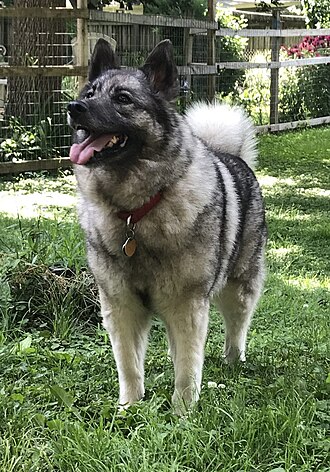
The Elkhound Noruego is the national dog of Norway: a medium-sized, robust and brave Nordic spitz, bred for centuries to track and corner elk, bears and wolves. Beneath his gray stuffed appearance lurks a tireless hunter, a watchful guardian, and a deeply loyal family companion. If you’re looking for a dog with character, energy and a thousand-year history, here’s everything you need to know about the Norwegian Elkhound.
Is the Norwegian Elkhound for you?
The Norwegian Elkhound is not a dog for everyone. It is independent, energetic and vocal, and needs an active family that understands its essence as a Nordic hunting dog. In return, it offers absolute loyalty, rusticity and a balanced character. Before you decide, weigh the good and the demanding.
In favour .
- Loyal and very close to his family.
- Robust, healthy and long-lived.
- Excellent guard and alarm dog.
- Very smart and versatile.
- Enjoy the cold and the outdoors.
- Clean and with hardly any dog smell.
To be taken into account
- He’s letting loose a lot of hair on the seedlings.
- Barking by nature.
- Independent and stubborn in training.
- He needs a lot of exercise every day.
- Strong hunting instinct with small animals.
- Badly adapted to the heat.
Character and temperament
The Norwegian Elkhound combines boldness and sweetness in equal parts. It ‘s a brave, alert, playful and independent dog , with an intelligence well above average: In Stanley Coren’s well-known classification of dog intelligence, it ranks 36th, within the working and obedience intelligence group ⁇ above average ⁇ . That waking head, however, comes with its own criteria: He was raised to decide alone in the middle of the riding, away from the hunter.
With his family he is affectionate and forms an almost inseparable bond. He is not a clingy or dependent dog, but he wants to be present in the home life and participate in everything. Its powerful barking, a direct inheritance from its hunting work, makes it a born guardian that warns of anything new. Sometimes he’s a little noisy and mischievous, especially as a youngster, but rarely aggressive: Their courage translates into security, not nervousness.
Coexistence: children, other pets, flat and loneliness
Well socialized, the Norwegian Elkhound is an excellent family dog, but it is advisable to know its limits in each situation:
- With children: is patient and playful, enjoys the little ones if he grows up with them.
- With other dogs: usually gets along well, especially if socialized as a puppy; some males may be dominant with other dogs of the same sex.
- With other pets:‘s hunting instinct is strong. It can chase cats, rabbits or birds if it has not been raised with them; coexistence is possible with early and careful introduction.
- On the floor: is not its ideal environment. It can adapt to lots of daily exercise, but its tendency to bark and abundant silt make it more suitable for homes with a garden and cool climate.
- In the face of loneliness: tolerates alone time better than other breeds, but should not be left isolated for many hours: boredom results in barking and destructive behavior.
Education and training
Training a Norwegian Elkhound is an exercise in patience and ingenuity. It is very smart and learns quickly, but its independence leads it to wonder ⁇ and why should it do it? ⁇ in the face of an order that seems boring to it. It is not a dog of mechanical obedience like a border collie; it thinks for itself.
The keys that work best are the positive reinforcement, short, fun sessions, variety and, above all, consistency. Punishments, screaming and monotonous repetition achieve the opposite effect: It closes in on the band. Early socialization with people, dogs, and environments is essential, as is early training to control barking. He who seeks a submissive dog will be frustrated; he who enjoys a companion with personality will find in him a brilliant pupil.
Exercise and activity
This is a long-distance runner. The Norwegian Elkhound was bred to track a moose for hours through forests and snowy mountains, and that endurance is still intact. It needs at least one or two hours of daily exercise: long walks, hiking, running, tracking games and mental work.
It is an ideal companion for mountaineering, hiking and canine sports such as canicross, tracking or agility. Outdoors and in the cold it transforms. Without sufficient physical and mental wear and tear, instead, it channels its energy into barking, digging and wrecking. Beware of releasing it in open areas without control: its hunting instinct can lead it to go out after a trail and ignore the call.
Care: fur and hygiene
The double coat of the Norwegian Elkhound is both its greatest virtue and its main requirement of maintenance. The good news: it is a hair that repels dirt, hardly emits odor and is kept relatively clean. The least good: she loses her hair all year long and changes massively. once or twice a year.
During the normal season, brushing once or twice a week is enough. In the midst of moult, however, brush daily with a good scalpel to remove the dead undercoat; otherwise, your home will be covered in gray fluff. Bathing should be occasional, only when it is really dirty, so as not to damage the protective layer. You should never shave: The mantle insulates it from both cold and heat. Complete the routine with regular nail trimming, ear cleaning, and dental hygiene.
Foodstuffs
The Norwegian Elkhound is a medium-sized dog with an efficient metabolism, the result of its origin in a harsh and scarcity environment. That means easily gains weight if it is overfed or not exercised enough. Obesity is one of its biggest enemies, so it is advisable to watch the rations and avoid excessive rewards.
A quality diet tailored to your age, weight and activity level is the best investment in your health. Divide your food into two servings a day, monitor your body condition regularly – you should be able to feel your ribs without seeing them – and always consult your veterinarian if you have any questions about the quantity or type of food.
Health and life expectancy
Overall, the Norwegian Elkhound is a rustic, healthy and long-lived breed, with a life expectancy of about 12 to 15 years. A British study from 2024 placed its average around 12.9 years, slightly above the average of purebred dogs.
- Primary renal glucosuria: a hereditary disorder that reduces the kidney’s ability to reabsorb glucose and predisposes to urinary tract infections.
- Diabetes mellitus is characterized by: the breed shows some predisposition to progesterone-related forms of diabetes in females.
- Hereditary chondrodysplasia: described in the breed since the 1980s, caused by a mutation in the ITGA10 gene, which causes limb deformities.
- Primary open-angle glaucoma: the Elkhound is one of the most affected breeds; it is due to a mutation in the ADAMTS10 gene.
- Tendency to overweight: is not an inherited disease, but its thrifty metabolism makes weight control imperative.
Acquiring the puppy from a responsible breeder who tests the health of the breeders significantly reduces the risk of these hereditary problems.
Physical appearance
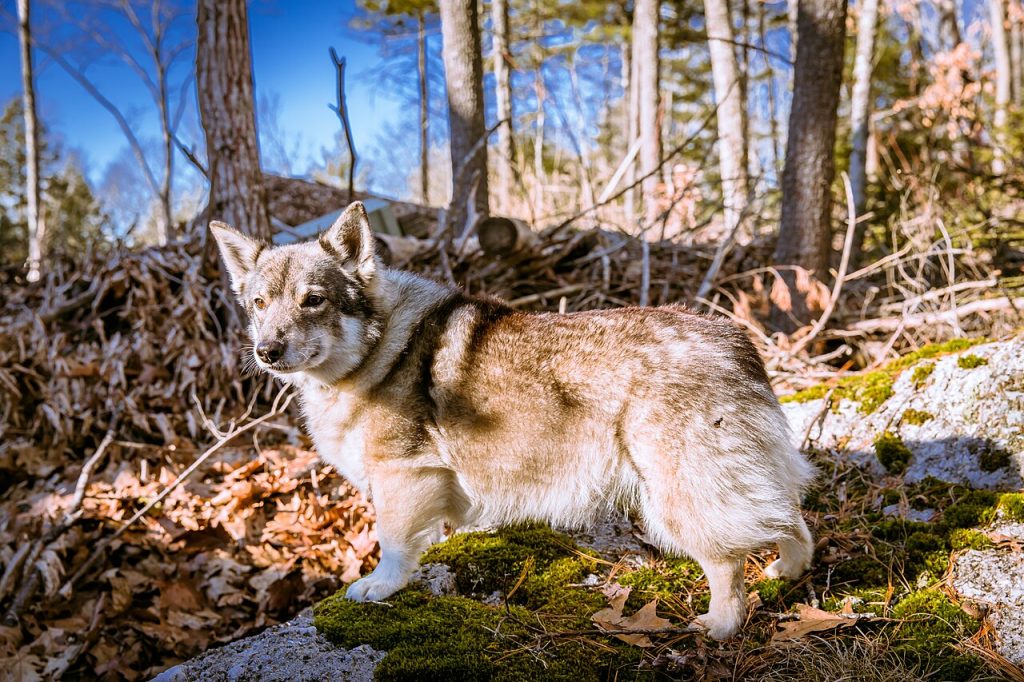
The Norwegian Elkhound is a spitz of square proportions, compact and rugged appearance. The males measure about 52 cm to the cross and the females about 49 cm, with an approximate weight of 20 to 25 kg depending on sex and constitution.
Their hallmark is their fur: a dense double coat consisting of a soft, woolly undercoat and an outer coat of rougher guard coat, with black tips. The color is a characteristic gray, darker on the back and sides, with silvery tones on the legs, belly and tail, and black areas on the snout, ears and tail tip. The head is wolf-like, with erect and highly mobile triangular ears, dark eyes of vivid expression and a tightly coiled tail on the back, another of its unmistakable markings.
Origin and history
The Norwegian Elkhound is one of the oldest dog breeds and a true national symbol of Norway. It comes from the spitz-type dogs of northern Scandinavia, a region of subarctic temperatures, heavy snowfall, and thick forests that shaped its resilience. Genetic studies place it within a maternal lineage (the mitochondrial subclade d1) typical of northern Scandinavia, shared with other Nordic races related to the Sami people, and the result of an ancient cross between dog and wolf that occurred after domestication. In fact, it’s genetically almost identical to the Swedish Jämthund.
For centuries it accompanied Norse hunters in the pursuit of moose and other big game, as well as acting as a guard, shepherd and defense dog. Their method of hunting is unique: tracks independently, corners the moose and keeps it at bay by jumping around it while barking loudly to guide the hunter to the spot. The breed was first presented at a dog show in Norway in 1877, was rarely seen outside the country until its arrival in England in the 19th century, and was officially recognised by the British Kennel Club in 1901.
Curiosities
- It’s the norwegian national dog and one of the oldest known living races.
- Its Norwegian name is Norsk elghund, which literally means ⁇ Norwegian moose dog ⁇ .
- Hunting by barking: keeps the moose motionless and only barks when prey is still, to guide the hunter by sound.
- US President Herbert Hoover had a Norwegian Elkhound named Weegie.
- It shares ancestry with other Nordic races linked to the Sami people, such as the Finnish Lapphund and the Jämthund.
- Its dense coat repels dirt and scarcely smells, unusual for such a furry dog.
Related breeds
If you are attracted to the Norwegian Elkhound because of its Nordic, spitz-like essence, you are likely to be interested in other breeds in the same family. The Husky Siberiano shares its love of cold and its inexhaustible energy; the Samoyedo is another spectacular double-coat Nordic spitz; the Spitz Finlandés is a close cousin, also a hunter and barker; and the Akita shares that independent and loyal character of spitz-type dogs. Browse your chips to compare and find out which one suits you best.
Frequently Asked Questions About the Norwegian Elkhound
Is the Norwegian Elkhound a good family dog?
Yes. It is a loyal dog and very attached to its group, playful and patient with children if it grows up with them and is supervised. It needs to be part of family life: isolated in a yard it is bored and barks. With enough socialization and exercise it is an excellent companion.
How much exercise does a Norwegian Elkhound need?
It’s quite a hardy Norse hunter, bred to follow moose for hours on end in rough terrain, with at least one or two hours of activity a day: long walks, hiking, play and mental work.
Does the Norwegian Elkhound shed a lot of hair?
Yes, a lot. It has a double coat and sheds heavily once or twice a year, when it sheds much of its undercoat.
Does the Norwegian Elkhound bark a lot?
The bark is part of its hunting work, in which it warns the hunter by keeping the prey at bay, and also makes it a good alarm dog.
Is it easy to train?
It is very intelligent, but also independent and stubborn, because it was bred to make decisions on its own in hunting. It learns quickly with positive reinforcement, short and varied sessions, patience and consistency; harsh or repetitive methods do not work with it.
How long does a Norwegian Elkhound live?
It is a long-lived and rustic breed. Its life expectancy is around 12 to 15 years; a British study from 2024 calculated an average of about 12.9 years, slightly above the average of purebred dogs.
Does he adapt to living in a flat?
He can live in a flat if he gets plenty of daily exercise and company, but he’s not ideal: he’s active, barks and sheds a lot of hair. He feels better with access to a safe garden and cool climate. Without stimulation, in a small flat he becomes frustrated.
Can you handle the heat?
Bad. It is a cold climate dog, designed for the Norwegian winter, and its dense double coat makes it very sensitive to heat. In summer you should avoid exercise in the middle hours, ensure shade and water, and never shave it, because the coat also insulates it from the heat.