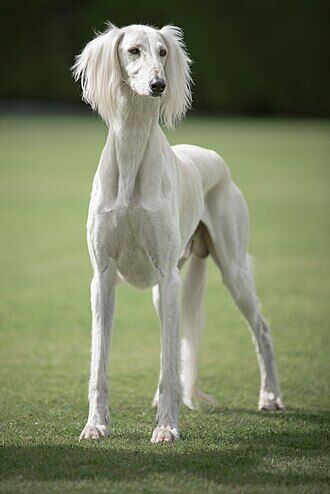
The Persian Greyhound (Saluki) is one of the oldest and most elegant hares in the world: A hunter by sight born in the Fertile Crescent who for millennia ran gazelles alongside desert nomadic tribes. It combines astonishing speed with a serene, dignified, independent character that surprises the expectant nervous dog. If you are looking for a quiet companion at home but a pure outdoor athlete, it is good to understand what this breed really is like before deciding.
Is the Persian Greyhound (Saluki) for you?
The Saluki is not a dog for everyone, it’s quiet, clean and discreet at home, but it carries a very intact hunting instinct and an uncompromising need to run, so before you fall in love with its image, weigh the pros and cons honestly.
In favour .
- Quiet, quiet and very clean inside the house.
- Low mucus and silky fur with almost no dog smell.
- Affectionate and loyal to his family, not clingy.
- Extraordinary athlete: ideal for active people.
- Relatively robust health and good longevity for his size.
- Adaptable to living on the floor if it covers your exercise.
Against
- Very strong prey instinct, chasing anything that moves.
- It’s unreliable loose; it rarely comes back when it starts running.
- Independent and stubborn, difficult to train to classical obedience.
- Reserved with strangers; needs early socialization.
- He’s bored and doesn’t do well in prolonged solitude.
- Their thinness and sensitivity require an informed owner (cold, anesthesia).
Character and temperament

The best way to describe the Saluki is as a worthy dog . It’s not outrageous or overly effusive: He shows his affection in a restrained way, choosing his people and always maintaining a certain cat independence. With his family, he is affectionate, sensitive, and very close; with strangers, he becomes reserved and aloof, but this does not mean nervousness or aggression. A well-socialized Saluki is polite and calm, not a fearful dog.
That domestic serenity hides, however, a pure-bred hunter. The Saluki retains intact the instinct that made him famous in the desert: It detects movement at a great distance and starts chasing without thinking. It is intelligent, but its intelligence is that of an autonomous predator that decides for itself, not that of a utility dog that lives by human orders. That’s why he may seem stubborn: It’s not that he doesn’t understand, it’s that he values whether it pays to obey.
At home it’s surprisingly quiet. Adults spend a good part of the day sleeping, barking little and rarely making a fuss. That duality – missile in the field, carpet in the living room – is just what his followers fall in love with.
Coexistence: children, other pets, flat and loneliness
- With children: is gentle and patient with the children in the house, especially if you grow up with them. It does not tolerate rough treatment or violent games as well, so it fits better with toddlers who respect their space than with very rebellious babies.
- With other dogs: usually gets along well with other dogs, and many breeders recommend having more than one because they keep company.
- With cats and small animals: here is the delicate point. His prey instinct pushes him to chase cats, rabbits, birds or squirrels. He can learn to respect the cats he is raised with, but you should never trust 100% with other small animals.
- On the floor: yes, it can live on the floor. as an adult it is quiet and quiet, and needs little indoor space… as long as it goes out galloping regularly. a Saluki without exercise on a floor is a recipe for boredom.
- Soledad: is a dog that gets bored easily and isn’t made to spend long hours alone.
Education and training
Training a Saluki requires humility and patience. Forget the idea of the dog executing commands with military precision: this hare is independent, bored with repetition and does not obey to please. Harsh methods are counterproductive; with such a sensitive dog they only get him to shut down or get scared. Positive reinforcement, short and varied sessions, and a lot of calm are the way.
Early socialization is the most profitable investment you can make. Exposing the puppy to different people, noises, surfaces and situations prevents adult shyness and withdrawal. The call (come back when called) is the great war horse: Once the hunting instinct takes over, most Salukis stop listening to you. That is why the golden rule is never to release them into unfenced areas; call work is trained, but the dog’s life cannot be entrusted to it.
Exercise and activity

There are no shortcuts here: the Saluki needs to run. It is designed for galloping, and a couple of laps around the apple with a leash is not enough for it to expend its energy or to keep its athletic body in shape. Ideally, it should be given the opportunity to gallop at full throttle in a secure, fenced enclosure, where it can free itself without the risk of being shot out behind a dam.
His profile is that of an explosive long-distance runner: It reaches speeds of up to 68 km/h and, above all, it has formidable endurance over long distances thanks to its cushioning pads. She loves activities like lure coursing(race after a lure) and canicross or long walks. What he doesn’t usually get excited about are the games of seeking and bringing the ball: He’s not a collector like the Labrador, he prefers to run for a run.
A tired Saluki is a perfect companion; a bored one will look for ways to be entertained, almost never for good.
Care: fur and hygiene
The maintenance of the Saluki is, fortunately, simple. Its hair is short, fine and silky, with a low coat compared to other breeds, and practically without that typical “dog smell”. There are two varieties of coat: the smooth (smooth) and the freckled or feathered (feathered), which has longer hair feathers on the ears, tail and back of the legs.
In the smooth variety, a weekly brushing is enough. In the feathered one, it is advisable to pay attention to the fringes to avoid knots, especially behind the ears and in the tail, brushing them a couple of times a week. The baths only when necessary. The rest is basic hygiene: checking and cleaning the ears, cutting the nails regularly and taking care of dental hygiene.
An important detail: the Saluki is a dog with a smooth body and very little body fat, so it does not tolerate cold and humidity.
Foodstuffs
The feeding should respect the athletic and slender nature of the Saluki. It is normal and desirable that the last ribs are slightly marked: these hares are thin by design, not by carelessness, and overweight is especially harmful to their light structure and joints.
Provide a high-quality food or diet, with good protein intake, adjusting the ration to its age, weight and actual activity level. Divide the food into two servings a day and, as with all deep-breasted dogs, avoid intense exercise just before and after eating to reduce the risk of gastric torsion.
Health and life expectancy
The Saluki is, in general, a healthy and long-lived breed. A British study from 2024 placed its life expectancy at around 13 years, above the average of purebred dogs.
That said, it’s good to know your weaknesses. According to a breed-specific health survey, cancer is the leading cause of death (about one-third of cases, mostly liver and lymphoma), followed by heart disease (myocardiopathy, heart murmurs and heart failure) and, further afield, dermatological problems such as dermatitis or alopecia. The good news is that hip dysplasia is very rare in the breed, one of the lowest on record.
Like other hares, their low body fat makes them sensitive to anesthesia, something your veterinarian should consider before any intervention.
Physical appearance

The Saluki is the elegance made dog: everything in it transmits grace and symmetry. It is a hare of medium-large size, with a height to the cross that is around 58 to 71 cm in the males – the females are somewhat smaller – and a weight that usually moves between 16 and 32 kg depending on the specimen.
The head is long and narrow, with a skull wider than the snout, large, sweet-expressed almond-shaped eyes, and dropped ears covered with hair in the feathered variety. The neck is long and flexible, and the tail, also long, curves at the tip. The silk mantle comes in a wide variety of colors: white, cream, beige or lionside, red, grizzle (with shading), black and fire, and even tricolor. That combination of lightness, muscularity and harmony is the visual signature of the breed.
Origin and history
Few breeds can boast such an ancient history.[citation needed] The Saluki is descended from hares raised in the Fertile Crescent, the same region where agriculture was born, and is considered one of the oldest domesticated dogs we know of.[citation needed] Images of long and narrow-bodied dogs appear on pottery from about 6,000 years ago in Susa (present-day Iran) and on reliefs from the Sumerian civilization.
In ancient Egypt, dogs very similar to the Saluki gained prominence from the Middle Kingdom and were associated with pharaohs and kings; their bodies came to be mummified like those of royalty, earning them the nickname “royal dog of Egypt”. The nomadic Bedouin tribes highly valued him as a hunter of gazelles, hares, foxes, and jackals, and they let him sleep in their tents to protect him from the heat of the day and the cold of the night. In the Gulf it’s known as tazi, “the galloping one”.
The Saluki arrived in England around 1840, where it was christened Persian Greyhound, although it did not arouse real breeder interest until Florence Amherst imported its first Arabian specimen in 1895. Since then it has been bred purely in both the West and the Middle East. Genetically, its closest relative is the Afghan Greyhound, another ancestral breed, and it is related to the North African Sloughi.
Curiosities
- The Greyhound Greyhound is the fastest at short distances, but the Saluki is thought to outperform it at long distances: the Guinness Book even recorded one reaching 68.8 km/h.
- Its padded pads absorb the impact of running and give it exceptional endurance on rough terrain.
- It is so ancient that it is depicted in art from thousands of years ago; some even link it to the enigmatic “animal of Set” of Egyptian mythology.
- The origin of its name is disputed: it has been associated with the ancient city of Saluq in Yemen, the Seleucid Empire and even a Sumerian term.
- Bedouins sometimes hunted by throwing the dog from a camel at full speed to give it an advantage over prey.
- His coat is short and his hair barely smells, which makes him very pleasant to have at home despite his size.
If you’re attracted to this desert hare, you’ll be interested to meet its relatives and other breeds from the same family of sighthounds. Its closest genetic cousin is the sleek Galgo Afgano, while the Greyhound and Whippet share its passion for galloping and its quiet home temperament. And if you’re fascinated by ancient and primitive air hares, don’t miss the spectacular Podenco Faraónico (Pharaoh Hound).
Frequently Asked Questions about the Persian Greyhound (Saluki)
Is the Persian Greyhound (Saluki) a good family dog?
Yes, for the right family. He’s affectionate and loyal to his own and gentle with the children in the house, especially if he grows up with them. He fits best in quiet, active homes that understand his independence and ensure daily exercise.
How much exercise does a Saluki need?
Enough: more than an hour a day of quality activity, ideally with the opportunity to gallop at full gallop in a fenced and safe space.
Can you release a Saluki without a leash?
Its hunting instinct is so strong that as soon as it detects prey, it stops responding to the call and can travel a huge distance in seconds.
Does Saluki shed a lot of hair?
It is not a hypoallergenic breed guaranteed, but it is usually tolerated better than others. If there are allergies at home, it is advisable to live with a specimen to check it.
Is it hard to train?
It is independent and bored with repetition, so it has difficulty with classic obedience. It does not respond to harsh methods. With patience, positive reinforcement, short sessions and early socialization, very good results are achieved, but do not expect the docility of a working dog.
How long does a Saluki live?
It is a long-lived breed: a British study from 2024 estimated its life expectancy at around 13 years, and many well-kept specimens approach 14 years.
Do you get along with cats and other small animals?
He may learn to respect the cats with whom he is raised, but his strong prey instinct causes him to chase small, unfamiliar animals.
Can he live in a flat?
Yes. As an adult, it is quiet, clean and very quiet indoors, and needs little indoor space. The condition is non-negotiable: it must run and exercise outside regularly.