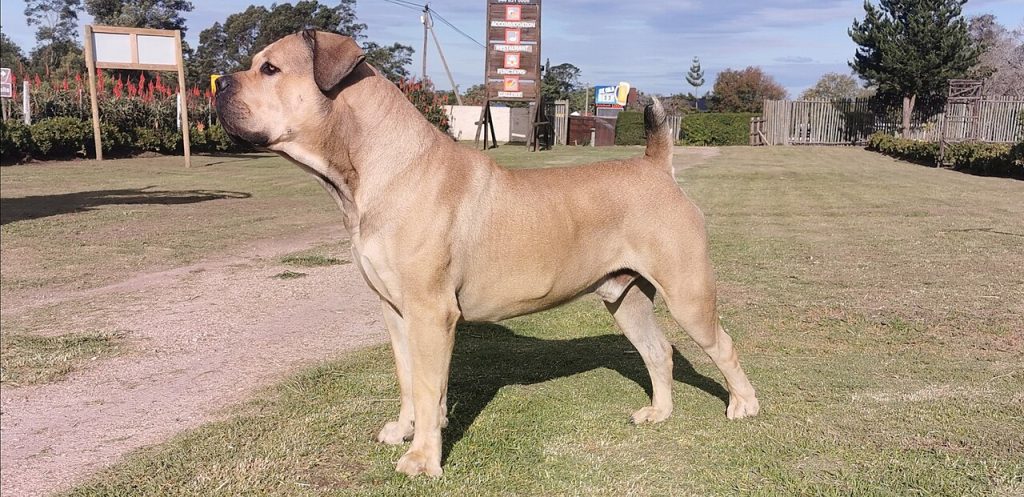
The Boerboel is the quintessential South African farm mollusk: A large, massive and deeply protective dog, bred for centuries to watch over the home, livestock and family on the most isolated farms in South Africa. Its name says it all – from Afrikaans boer, “farmer”, and boel, short for boelhond, “dog-type dog” -: It’s literally the farmer’s dog. If you are looking for an imposing, loyal keeper and have experience with strong-tempered breeds, the Boerboel can be an exceptional companion.
Is the Boerboel for you?
The Boerboel is not a dog for just anyone, and it’s best to be honest before falling in love with his image. It’s a 70- to 90-kg animal with an intense guarding instinct, an alert mind and a will of its own. He’s well-mannered, balanced, affectionate with his own and of a bomb-proof loyalty. Mismanaged, its size and its distrust of strangers make it a serious problem. Keep in mind, too, that in some countries their possession is restricted or outright forbidden.

In favour .
- Natural guardian, brave and deterrent without the need for aggressive training.
- Very loyal and attached to his family; affectionate and playful at home.
- Smart and eager to please his owner.
- Short coat and minimal maintenance.
- Patient and tolerant of the children in the house.
- Resilient and rustic, he knows how to dose his strength.
To be taken into account
- It’s not a dog for beginners: it requires experience and leadership.
- Huge size and strength; he needs serious socialization as a puppy.
- Distrustful of strangers and sometimes conflicted with other dogs.
- It requires space and daily exercise; it doesn’t fit in small floors.
- Restricted or prohibited in several countries.
- Prone to dysplasia and eye problems.
Character and temperament
The temperament of the Boerboel can be summed up in three words: safe, brave and protective. It is a fearless dog that stops without hesitation in the face of any perceived threat, but with its people it transforms into a calm, affectionate and surprisingly sensitive animal. It constantly seeks the approval of its owner, which makes it very dedicated to work and training when there is a strong bond.
His guardian instinct is so ingrained that he doesn ‘t need anyone to teach him . The Boerboel watches by default. That same quality explains their distrust of strangers and their tendency to mark and defend territory. It is not a nervous dog or barks without reason; rather, it is serene and observant, but when it decides to act, it does so with a forceful attitude in keeping with its physique. That is why the emotional stability of the specimen and the quality of its socialization are everything in this breed.
Coexistence: children, other pets, flat and loneliness
With the family, and especially with the children of the house, the Boerboel is usually patient and protective. Nevertheless, its size requires prudence: it should never be left alone with very small children, not for bad intentions, but because a sudden movement of a dog of this size can pull a child unintentionally.

With other dogs the situation is more delicate. The Boerboel can be dominant or territorial, especially among males, so early socialization and well-made introductions are essential. It usually coexists better with a dog of the opposite sex.
It is not a breed designed for the floor: it needs space to move and, above all, a firm exercise routine. It also does not tolerate prolonged solitude well; it is a dog very attached to its family and, if left alone for too many hours, it can get bored and become destructive.
Education and training
The Boerboel is intelligent and quick to learn, but it’s also independent and domineering, which means it will test boundaries and need to be clearly marked. The recipe that works is calm and consistent leadership, without yelling or harshness, combined with positive reinforcement and a lot of consistency. Rewarding what you do well and being predictable gives you confidence.
Socialization is the number one pillar: The earlier and more varied your exposure to people, dogs, noises and situations, the better you will manage your adult guard instinct. The basic obedience – calling, standing, together – must be consolidated before the puppy becomes an 80-pound animal that cannot be physically contained. For all this, it’s not the breed recommended for a first-time owner: Here previous experience with dogs of character makes the difference.
Exercise and activity
The Boerboel is a working dog, resistant and active, but not a continuous running athlete: it has the virtue of knowing how to dose its strength according to the situation. This does not mean that it can lie down all day. It needs daily quality exercise – long walks, play and, if possible, some task that makes it think – to keep the body and mind in shape.
One or two long walks a day is the reasonable minimum, ideally combined with some training or scent work that gives it a purpose. A Boerboel that gets enough exercise is a balanced and calm dog at home; a bored and unstimulated one is the recipe for nibbling, garden holes, and destructive behaviors.
Care: fur and hygiene
Its coat is short, dense, and soft-textured, so maintenance is minimal: just an occasional brushing, once a week, to remove the dead hair and distribute the natural fat that keeps the skin healthy.

Bathing is only necessary when you get really dirty, about once a month or so. As a good cleaner, it is advisable to check and clean the folds of the face and paw to prevent moisture, watch the ears, keep the nails at bay and take care of dental hygiene. Because of its tendency to eye problems such as ectropion and entropy, it is worth checking your eyes regularly and seeing your veterinarian for any persistent redness or tearing.
Foodstuffs
Feeding a 70 to 90 kg dog requires a head. The Boerboel needs a high-quality diet, rich in protein and adjusted to its size, age and activity level, preferably divided into two servings per day to reduce the risk of gastric torsion, a problem associated with large dogs with deep breasts.
The puppy stage is especially sensitive: Too fast growth from overfeeding or too much calcium can damage joints that already carry a lot of weight. Ideally, a specific feed for growing large breeds and control that the puppy stays stylized, not rolled. In the adult, monitoring your weight is one of the best investments for your hips and your longevity.
Health and life expectancy
The Boerboel is, in general, a rustic and robust dog, but it shares the typical vulnerabilities of large moles. The most watched are hip and elbow dysplasia, eye problems – especially ectropion and entropion, that is, the eyelid turned outward or inward – and, in females, vaginal hyperplasia. Cases of juvenile epilepsy, which may be triggered by stress or metabolic changes, as well as thyroid and heart conditions, have also been reported.
Their life expectancy is around 10 to 12 years, and some sources extend it to 11-13. The best way to tip the scales toward the high band is to go to responsible breeders who perform hip, elbow and eye tests, keep the dog at a healthy weight throughout its life and not force exercise in the growth stage.
Physical appearance
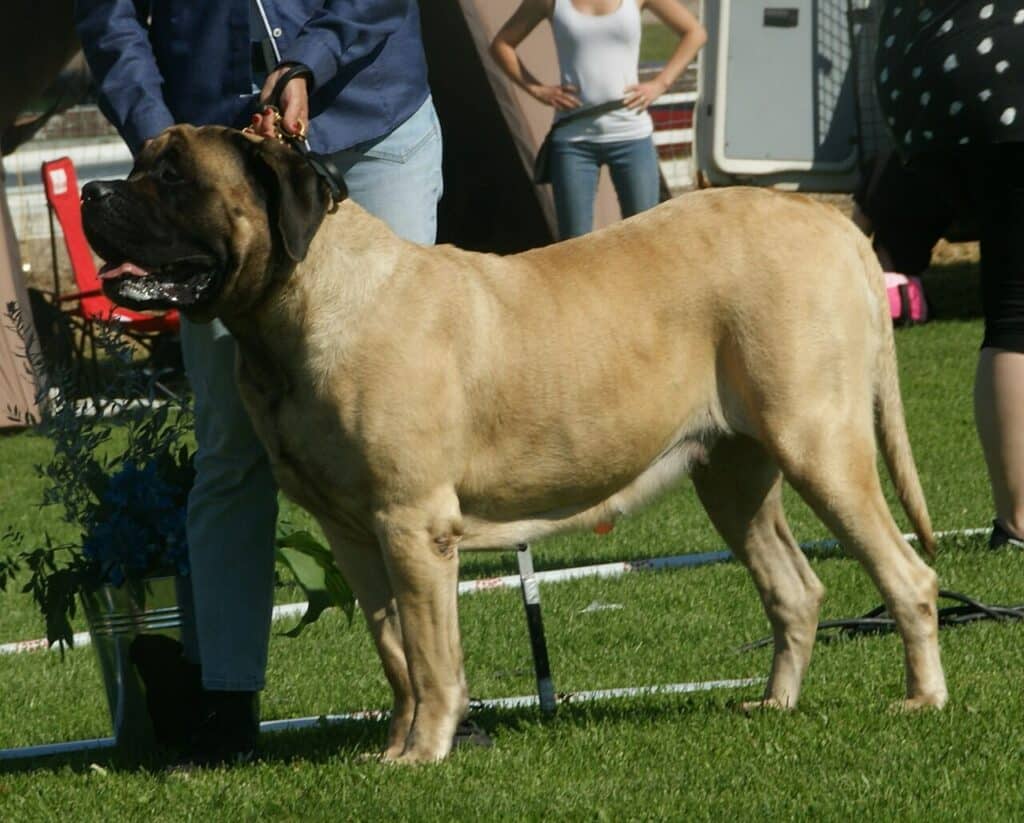
The Boerboel is a large, strong and well-proportioned mollusk, with a heavy bone structure and impressive musculature that transmits power without losing agility. The head is short, broad, and square in appearance, with well-filled cheeks, a black snout with wide nostrils, and a confident expression. The ears, medium and V-shaped, hang attached to the face, and the neck is thick and muscular.
The coat is short, dense and soft in texture. The recognized colors are atigrade, leonade (yellow) and red or brown, with or without a black mask on the face; the all-black coat is considered disqualifying in the breed standards. The eyes range from brown to yellowish, with the dark and well-pigmented ones being especially appreciated. The tail, traditionally amputated in its country of origin, now looks increasingly natural where the practice is prohibited.
Origin and history
Boerboel has its roots in colonial South Africa. It is descended from an ancient cross of molose and dog brought by European settlers – Dutch, German, French, and English – known as the Boer Dog or Boer hunting dog, which served both as a guardian of farms and more remote stays and as a large hunting dog. Chronicles of the early 20th century describe it as the best dog for hunting leopards and baboons in packs, able to reduce a cat caught in a trap. Their ancestors include the Bullmastiff, the Great Dane and the now extinct Bullenbeisser.
Organized breeding of the breed as we know it began in the 1950’s. In 1983 the first association, the Suid-Afrikaanse Boerboel Telersvereniging (South African Boerboel Breeders’ Association) was founded, and in 2012 the South African Boerboel Breeders’ Society (SABBS) was born, officially registered with the Department of Agriculture in 2014. The Boerboel is recognized by the Kennel Union of Southern Africa, although not by the International Kennel Federation (FCI). In South Africa, the Animal Welfare Act considers it an indigenous breed of the country.
Curiosities
- Its name literally means “farmer’s dog”: boer(farmer) plus boel, from boelhond(dog type).
- It is considered an autochthonous breed or landrace of South Africa by its own legislation.
- It is not recognised by the FCI, but by the Kennel Union of Southern Africa and by local societies such as the SABBS.
- Its possession is restricted or prohibited in several countries, including Denmark, France, Qatar, Tunisia, Mauritius and Bermuda.
- The all-black coat disqualifies the specimen in the traditional breed standard.
- Historically it was used in packs to hunt leopards and baboons on South African farms.
If you are attracted to the Boerboel because of its guarding demeanor, you may want to compare its character and needs with those of other moles and guard dogs before deciding. Cane Corso English Mastiff Rottweiler Bóxer
Frequently Asked Questions about Boerboel
Is the Boerboel a dangerous dog?
The Boerboel is not dangerous by nature, but it is a very powerful guard dog, weighing 70 to 90 kg, with a strong territorial instinct and distrust of strangers. In the hands of an experienced owner, who socializes and educates from puppyhood, it is stable and reliable. Without that foundation, its size and protective nature can make it a difficult animal to handle. It should also be noted that their possession is restricted or prohibited in countries such as Denmark, France or Qatar.
How much does an adult Boerboel weigh and measure?
The males usually measure between 64 and 75 cm at the withers and the females between 59 and 65 cm. The weight is around 70 to 90 kg, always distributed in a strong bone structure and a very developed musculature.
Is the Boerboel good with children?
With children in their own family the Boerboel is usually patient, tolerant and protective. Nevertheless, due to its size and strength, it should never be left unattended with small children: an involuntary push is enough to pull a child. The key is early socialization and teaching the dog and children to respect each other.
How long does a Boerboel live?
Its life expectancy is about 10 to 12 years, and some sources place it between 11 and 13 years. As with all large molluscs, maintaining a proper weight, controlling hips and elbows, and monitoring feeding helps it reach the high end of that fork.
Can a Boerboel live in a flat?
It is not the ideal breed for a flat. The Boerboel needs space to move around and, above all, consistent daily exercise. It can adapt to living indoors as long as it is taken for a long walk and given encouragement, but a yard or fenced terrain where to patrol fits much better with its nature as a farm dog.
Is it easy to train the Boerboel?
It is intelligent and quick to learn, but it is also independent and domineering, so it is not a dog for beginners. It responds very well to calm, consistent and firm leadership, combined with positive reinforcement. Socialization and basic obedience should begin as a puppy; with an uneducated adult Boerboel, correcting behaviors is much more complicated.
How much exercise does a Boerboel need?
It needs daily quality exercise: long walks, play and, if possible, work or training that makes it use its head. It is not a hyperactive dog of continuous running, it knows how to dose its forces, but a bored and inactive Boerboel can become destructive. One or two long outings a day are the reasonable minimum.
What health problems does the Boerboel have?
The most watched conditions are hip and elbow dysplasia, eye problems such as ectropion and entropion, vaginal hyperplasia in females, and juvenile epilepsy. Thyroid and heart problems are also cited.