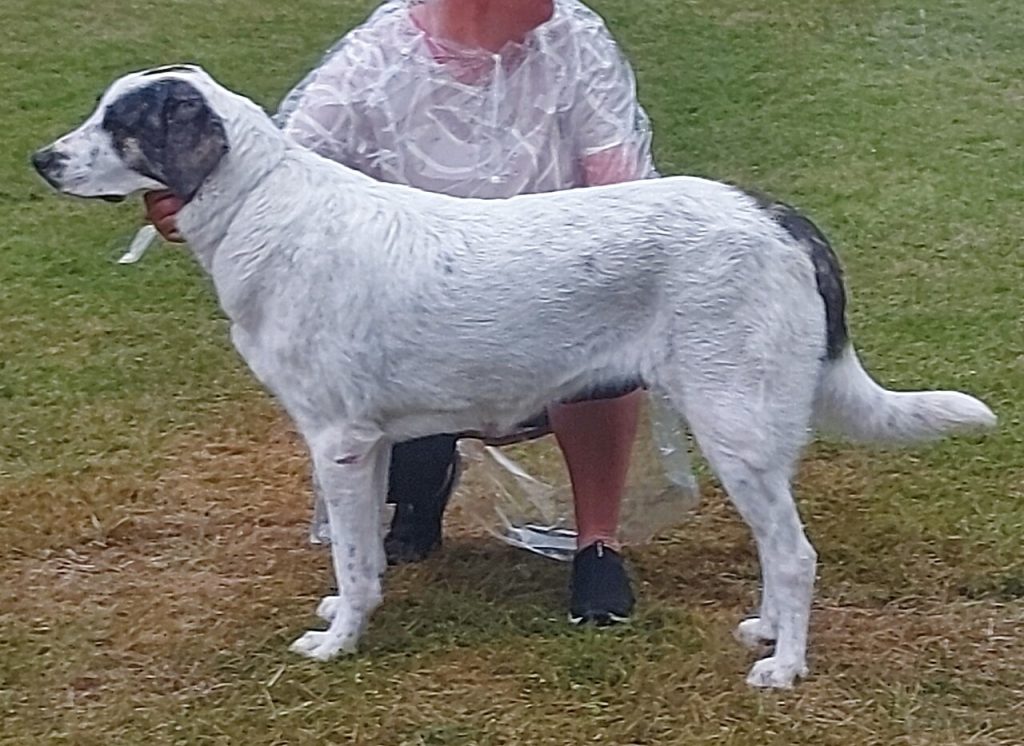
The Rafeiro of the Alentejo is a large, serene and deeply territorial Portuguese Mastiff, bred for centuries on the plains of the Alentejo to guard herds against the wolf. It’s not a companion dog to use: He’s a blood guardian, quiet inside the house but imposing when something comes into his territory. Before you fall in love with his bear-like demeanor, you should understand what it means to live with a dog that is designed to make decisions for itself.

Is the Rafeiro do Alentejo for you?
The Rafeiro do Alentejo is a wonderful dog in the right hands and a serious problem in the wrong. His guarding instinct is untrained: It’s from the factory. That makes it an exceptional keeper of farms and families, but also an animal that needs an experienced owner, space and a clear plan for socialization. It’s not a breed for beginners or anyone looking for a dog who’s sociable with everyone.
It suits you if…
- You live in the country or in a house with a fence.
- You’re looking for a deterrent, quiet, low-maintenance physical guard.
- You have previous experience with large or guard dogs.
- You’ve been willing to socialize him intensely since he was a puppy.
- You value an independent dog who doesn’t live at your feet.
Think about it if…
- You live in a small apartment or in a busy urban area.
- It’s your first dog or you want a docile, complacent companion.
- You get a lot of visitors and strangers every day.
- You can’t guarantee a safe and strong fence.
- You’re looking for a dog for sports, agility or long days of exercise.
Character and temperament
The Rafeiro do Alentejo has the classic temperament of a cattle guard dog: Calm, self-assured and suspicious of others. Within its family nucleus it is a balanced, calm and surprisingly affectionate dog, able to lie down for hours without demanding constant attention. That serenity is transformed as soon as he senses a threat in his territory: Then a determined watchman appears, with a deep bark and a presence that rarely needs to go beyond warning.
He’s a dog who thinks for himself. For generations he was raised to work alone, away from the shepherd, making decisions about what’s dangerous and what’s not. That trait makes it reliable as a guardian but also less “obedient” than a cooperative working breed. He doesn’t seek to please for the sake of pleasing: He cooperates when he understands the meaning of what you ask and trusts the person who asks. Distrust of strangers is innate and should not be confused with unwarranted aggression; it is the working tool of the breed, and that is why early socialization is so crucial.

Coexistence: children, other pets, flat and loneliness
With the children in your family the Rafeiro do Alentejo is usually patient and protective, understanding them as part of the herd he must guard. Nevertheless, their size and strength require supervision: a dog over 40 kilos can pull or displace a small child without bad intention.
In contrast to other pets, if it grows with domestic dogs and cats, it integrates them as part of the group it protects. Coexistence with unfamiliar dogs, especially of the same sex, can be tense due to its territorial nature.
The floor’s not his place.. It is a large dog, bound to the territory and with the vocation of guarding a wide space; locked in an urban apartment it is frustrated and barks excessively. He needs a house with a fenced-in garden. As for the loneliness, it tolerates better than many breeds to stand alone watching – it is its natural job – but it should not spend the day isolated without contact with its family, or it will develop excessive guarding behaviors and anxiety.
Education and training
Educating a Rafeiro do Alentejo is an exercise in patience and consistency, not mechanical repetition. It learns quickly, but decides whether to obey according to its own criteria, so training must be based on respect and a relationship of trust, never on imposition by force, which only generates a resentful and dangerous guard.
The early socialization is top priority. As a puppy, he needs to know people, noises, environments, and other animals in a positive way, so that he learns to distinguish between normal and truly threatening. A well-socialized Rafeiro is a reliable guardian; one who is not can become reactive with any visit. Establish clear boundaries early on, reward calmness, and work on basic obedience – especially yelling and barking – with short, motivational sessions. It is a recommended breed for owners with prior experience with guard dogs.
Exercise and activity
The Rafeiro do Alentejo is a dog of moderate energy, not an athlete. It was not bred to run after the herd like a sheepdog, but to watch over it calmly, so its exercise needs are lower than its size suggests. It only needs one or two good daily walks and space to patrol its territory at its own pace.
Excessive high-impact exercise during growth is also counterproductive in a dog of this size, because it punishes joints that are still forming. Quiet walks, a large garden and the satisfaction of “doing your job” keep it balanced.

Care: fur and hygiene
The coat of the Rafeiro do Alentejo is dense and smooth, of short or medium length, and less abundant than that of other mountain herding dogs. This simplifies its maintenance: a weekly brushing is enough to remove the dead hair and keep it clean, intensifying it during the seasonal mowing, when it loses more hair.
As with all large dogs, ears s should be routinely monitored – checked and cleaned to prevent infection – toenails s, which should be trimmed if they do not wear out on their own, and dental hygiene s with regular brushing.
Foodstuffs
As it is a large and slow-growing dog, the feeding of the Rafeiro do Alentejo should be especially careful during puppy and juvenile stage. A quality feed formulated for large or giant breeds is suitable, which provides the appropriate proportion of calcium and phosphorus and avoids too rapid growth, which would overload their forming joints.
In the adult, the ration should be tailored to their weight, age and activity level, preferably divided into two daily servings rather than one large one, a sensible measure in large deep-chested dogs to reduce the risk of gastric torsion. It is important not to let him eat cravings or do strenuous exercise right after eating, and always keep him at a proper weight: Being overweight is a direct enemy of your joints and your longevity.
Health and life expectancy
The Rafeiro do Alentejo is a rustic and usually robust breed, the result of centuries of functional selection in a demanding environment.
The first is the joint health: Hip and elbow dysplasia is a common concern in breeds of this size, so it is advisable to acquire puppies from breeders who evaluate their breeders and take care of weight and exercise during growth. The second is gastric torsion or dilation, a veterinary emergency typical of large, deep-chested dogs that is prevented by splitting meals and avoiding exercise immediately after eating. Regular veterinary checks, vaccination, deworming and weight control complete the picture of a healthy life.
Physical appearance
The Rafeiro do Alentejo is a big and imposing dog, slightly longer than tall, of robust construction and wide chest. Its head is massive, almost bear-like, with small, dark eyes of serene expression and small, triangular, dropped ears.
The female measures around 66-74 cm at the withers and the females about 64-70 cm, with weights usually ranging from 35 to 50 kg depending on sex and specimen. The coat is dense and smooth, short or medium length. As for colour, it accepts black, lion’s mane, wolf grey or yellow, black or not, but always with white spots; or white with spots of these colours. It is a less thick coat than that of other mountain mastiffs.
Origin and history
The Rafeiro do Alentejo owes its name to its region of origin, the Alentejo, in southern Portugal. It is a traditional herd guard dog, employed to protect cattle during seasonal transhumance: it accompanied herds on their ascent to mountain pastures in summer and on their return to the plains in winter, defending them from wolves and other predators.
At the end of the 19th century it became known as Rafeiro do Alentejo. The first breed standard dates back to 1953 and the Fédération Cynologique Internationale finally accepted it in 1954. The profound social changes in Portugal in the 1970s – with the exodus from the countryside to the cities and the decline of pastoral livestock – left these dogs without their function, and in the early 1980s the breed was on the verge of extinction, with only a few specimens in the hands of a small group of breeders. In 1994 an association of breeders was founded in Monforte, in the district of Portalegre, which, together with the town hall, created a breeding centre to recover the breed. By 2006 there were more than 1,100 females listed in the book of Genesis.
Curiosities
- The name “rafeiro” alludes in Portuguese to a rustic type and guard dog, and the breed is also known in Spanish as mastiff of the Alentejo or Portuguese Mastiff.
- In addition to tending flocks, he historically participated in big game hunting: there are ancient photographs showing him among the hunting herds of King Charles I of Portugal, who had a palace in the Alentejo.
- A specimen of this breed called Bobi came to be recognized by Guinness World Records as the world’s oldest dog, with a declared age over 31 years; later Guinness canceled the record for not finding enough evidence to verify its age.
- From the crossing of the Rafeiro do Alentejo with the American Bulldog (and later the American Staffordshire Terrier) emerged a developing American breed known as Abraxas Bulldogge.
If you’re drawn to the world of big watchdogs and moles, you may want to compare the Rafeiro do Alentejo to other breeds of similar profile: the mighty Cane Corso, the imposing English Mastiff, the rescue giant San Bernardo or the versatile Rottweiler.
Frequently asked questions about Rafeiro do Alentejo
The Rafeiro do Alentejo is an aggressive dog?
It is a territorial guardian and distrustful of strangers by nature, but balanced and affectionate with its family. Well socialized since puppyhood, it distinguishes between normal and threatening.
Does the Rafeiro do Alentejo serve to live in a flat?
It is not ideal. It is a large dog, territorial and bound to a large space to watch. It needs a house with a well-fenced garden. In an urban apartment it tends to get frustrated and bark excessively, and its size complicates coexistence in small spaces.
How long does a Rafeiro do Alentejo live?
Its life expectancy is around 12 to 14 years, a remarkable figure for a dog of its size. Adequate weight, good nutrition during growth and regular veterinary checkups help to reach the high end of that range.
Is it suitable for first-time owners?
Its strong guarding instinct, independence, and size require an owner with experience with large or guard dogs, able to socialize it well and to set boundaries consistently and without force.
How much exercise does the Rafeiro do Alentejo need?
Less than its size suggests. It is a moderately energetic dog that was bred to be a calm watcher, not a runner. One or two walks a day and a patrol area are sufficient. Intense exercise during growth should be avoided to protect its joints.
Do you get along with children and other pets?
With children and animals of his own family he is usually protective and patient, integrating them as part of the group he cares for.
How much does a Rafeiro do Alentejo weigh and measure?
Males measure around 66-74 cm at the withers and females about 64-70 cm, with weights ranging from approximately 35 to 50 kg depending on sex and specimen.
Is it a rare breed or hard to find?
Yes, it is a rare breed even in Portugal. It was on the brink of extinction in the 1980s and recovered thanks to the work of breeders and a breeding center in Monforte. Outside Portugal it is rare, so it is advisable to go to serious and evaluated breeders.