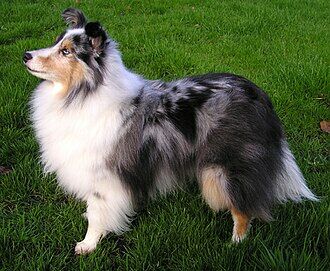
The Shepherd of Shetland, affectionately known as Sheltie, is a small, alert and deeply loyal herding dog born in the rugged Shetland Islands of Scotland. It resembles a miniature long-haired Collie, but it’s a breed with its own personality: Smart as a whip, very barking and sticking to her family. If you’re looking for a brilliant partner to train with, play with and share your day, the Shetland Shepherd is a firm candidate. In this guide, we review their character, care, health and origins in no uncertain terms.
Is the Shetland Shepherd for you?
Before you fall in love with that fox-faced dog, it’s good to know where this breed shines and where it can complicate your life. The Shetland Shepherd is a sensitive and mentally demanding dog.
In favour .
- Very smart and very easy to train.
- Loyal, affectionate and very close to his family.
- Comfortable size: fits well on the floor if you exercise.
- Excellent warning and alert dog.
- Star of agility, obedience and dog sports.
- Good with kids when you grow up with them.
To be taken into account
- He barks a lot: he needs management from a puppy.
- It sheds a lot of hair and requires constant brushing.
- He needs daily exercise and mental stimulation.
- He may be reserved or shy with unsociable strangers.
- Shepherding instinct: tends to chase and “group”.
- He doesn’t like prolonged loneliness.
Character and temperament

If I had to sum up the Shetland Shepherd in one word it would be clever. It’s not a breeder’s exaggeration: In psychologist Stanley Coren’s well-known classification of canine intelligence, the Sheltie ranks sixth among more than 130 evaluated breeds. An average specimen understands a new order in less than five repetitions and obeys the first one 95 percent of the time or more. That privileged head is its greatest virtue and, mismanaged, also its greatest problem.
It’s a cheerful, sensitive and extremely loyal dog. He turns to his family, seeks his companionship, and is aware of what’s going on around him. That constant vigilance makes him a magnificent warning dog: barks at the doorbell, at a passing car, or at anything new. With strangers it is usually reserved and some specimens may be shy, a trait that the standard discourages and that good early socialization largely corrects.
There are also Shelties with a more nervous point and “terrier”, always ready for action. In general, their activity level tends to match that of their owner: they are as happy running in the field as lying next to you, provided they have previously spent energy.
Coexistence: children, other pets, flat and loneliness
- With children: is affectionate and gets along very well with them, especially if raised alongside them from puppyhood.
- With other pets: usually gets along well with dogs and cats, but it has a strong herding instinct: it may try to chase and group other animals (and even children) when they run.
- On the floor: adapts smoothly to an urban floor as long as it goes out for a walk and receives enough stimulation.
- Soledad: is a very affectionate dog who does not like to be left alone for too many hours. Lack of companionship and activity can lead to excessive barking, anxiety and unwanted behavior.
Education and training

Few breeds are as grateful to educate as the Shetland Shepherd. Its intelligence and eagerness to please make basic training simple even for first-time owners. The condition is to always use positive reinforcement: rewards, play and friendly voice. It is a sensitive dog that is blocked or frightened with harsh methods and screams.
The first is the early socialization: exposing the puppy to people, noise, other animals and a variety of environments is the best vaccine against shyness and reactivity. The second is the control of barking: as it barks by instinct, it is advisable to teach it early a “silence” command and, above all, not to reinforce the bark by paying attention to it every time it warns.
Otherwise, his head asks for work: tricks, olfactory games, advanced obedience or canine sports.
Exercise and activity
Shepherding instinct is still very much alive in the breed. The Shetland Shepherd loves to run in open spaces, chase and have a mission. He is not an extreme endurance athlete, but needs at least an hour a day of activity well divided between walks, free running and play.
Where it really enjoys is in dog sports: in its size category, the Sheltie master the agility and also excels in obedience, flyball, tracking, shepherding tests and talent shows. Combining physical exercise with mental challenges is the perfect recipe to avoid boredom, which in this breed translates into barking, phobias and nervousness.
Care: fur and hygiene

The coat is the most demanding of the Shetland Shepherd. It has a two layers: a long, straight, rough-textured outer hair that forms that showy mane on the neck and chest, and a soft, dense inner undercoat that insulates it from cold and heat.
The ideal is to brush it two or three times a week, and daily during the moult periods, paying attention to the areas where knots form (behind the ears, armpits, back of the thighs and buttocks).
The rest of the hygiene is common sense: bathing only when it is really dirty (excess dries the skin), checking and cleaning ears, cutting nails when they hit the ground and regular dental hygiene to prevent tartar.
Foodstuffs
The Shetland Shepherd is a small (6-8 kg) and active dog, so he needs a complete and quality food adjusted to his size, age and activity level.
For reference, the daily ration is usually divided into two portions: keep fresh water available, monitor your weight regularly, and, if you have any questions about diet, rations, or food allergies – to which some Shelties are prone – consult your veterinarian instead of improvising.
Health and life expectancy
Overall, it is a robust and long-lived breed. The life expectancy is around 12 to 15 years; in fact, different studies place its average above that of all breed dogs (a British study puts the figure at around 13.4 years and another Japanese raises it to about 14.3).
- Collie eye abnormality (CEA) and other eye problems: like the Collie, the Sheltie inherits eye malformations with some frequency.
- Mutation of the MDR1 gene: causes sensitivity to certain drugs (such as ivermectin and various anesthetics and antiparasitics).
- If you have von Willebrand disease: is an inherited blood clotting disorder; the Sheltie can carry severe forms.
- Dysplasia of the hip: rare in the breed (of the lowest prevalences recorded), but described; good breeders X-rayed their breeders.
- Otros: hypothyroidism, epilepsy, allergies and skin problems, and a predisposition described for certain tumours and the gallbladder mucosa.
The best guarantee of health is to go to a responsible breeder who does genetic and hip testing, and keep veterinary checks and prevention up to date.
Physical appearance
The Shetland Shepherd gives the impression of a long-haired Collie reduced to scale, harmonious and elegant. It is a small dog: the ideal height at the cross is 37.5 cm in males and 35.5 cm in females, with an approximate weight of 6 to 8 kg. The body is somewhat longer than tall, with deep chest and smooth lines.
The head, refined, draws a long wedge that narrows from the ears to the nose. The ears are small and semipermeable, with the tip falling forward when alert. The eyes, medium-sized and almond shaped, are dark brown, except in blackbirds, which may have one or both eyes blue.
As for color, the standard supports several layers: sword(from gold to mahogany, the most common), tricolor(intense black with fire and white marks), blackbirds(blue merle, silver gray jaspered black), and also black and white or black and fire.
Origin and history
The Shetland Shepherd comes from the shetland Islands, an archipelago in the north of Scotland, of harsh climate and scarce resources. Like the Shetland pony, cow and sheep, the local dog was forged small and tough to thrive in those conditions, helping farmers manage livestock.
Its exact origin is somewhat confused. It’s not just a miniature Collie: the islands’ primitive sheepdogs were of the spitz type, probably similar to today’s Icelandic sheepdog, and were crossed with collies brought from mainland Britain. Folklore even mentions contributions from small spaniels and dogs brought by whalers. Already in the 20th century, breeders such as James Loggie added long-haired Collie blood to fix the modern type.
The breed was introduced as a “Shetland Collie”, a name that angered Collie breeders and forced them to rename it Shetland Sheepdog. Official recognition from the British Kennel Club came in 1909, with a female named Badenock Rose as the first entrant; the first specimen registered by the American Kennel Club, “Lord Scott”, did so in 1911. The islands’ ancient Spitz shepherd dog eventually became extinct, replaced at work by the Border Collie. In the FCI nomenclature, the Shetland Shepherd is classified as Group 1 (herding dogs and boyars), Section 1 (herding dogs), Standard No 88.
Curiosities
- His nickname “Sheltie” is so popular that many people don’t know his official name, Shetland Sheepdog.
- It’s one of the most intelligent dogs in the world: sixth in Stanley Coren’s ranking of obedience and work capacity.
- It shares land with other “miniature” Shetland breeds, such as the famous pony and Shetland sheep.
- The facial markings of some swordfish still show dark remains – the so-called “tinned bumps” – inherited from their black ancestors.
- He is such a master of agility in his category that he is a regular of the podiums in competitions throughout Europe and America.
- Ch. Halstor’s Stallion Peter Pumpkin is a breed legend – father to 160 champions.
If you are attracted to the intelligence and shepherding instinct of the Shetland Shepherd, you may be interested in comparing the breed with its working relatives. Take a look at the Collie, that large relative it looks so much like; the tireless Border Collie, considered the world’s smartest dog; the versatile Pastor Australiano; or the small, energetic Welsh Corgi Pembroke, another short-legged shepherd with a lot of character.
Frequently Asked Questions About the Shetland Shepherd
Does the Shetland Shepherd bark a lot?
Yes, it is one of their hallmarks. The Sheltie is an excellent warning dog and tends to bark at any noise, person at the door or passing car. It is not a defect, but its vigilance instinct: with early socialization, daily exercise and “enough” work since puppy is controlled and significantly reduced.
Is he a good dog to live on?
The Shetland Shepherd adapts to both an urban flat and a farm as long as it receives enough walks and mental stimulation. The key is not the square footage, but to meet its need for activity and companionship; a bored Sheltie or just too many hours does give problems (barking, anxiety).
How much hair does it loosen and how much does it have to be brushed?
The ideal is to brush it 2 or 3 times a week, and daily during mowing, to avoid knots in areas of rubbing (behind the ears, armpits and buttocks) and keep the mantle healthy.
Do you get along with children and other pets?
Yes, especially if he grows up with them. He is affectionate and patient with the children in the family, although his size makes it convenient to supervise play with the younger ones. He usually gets along well with other dogs and cats; however, his herding instinct may cause him to chase or try to “group” children and other animals in motion.
Is it easy to educate?
According to Stanley Coren’s canine intelligence rating, the Sheltie ranks sixth among more than 130 breeds: it learns a new command in less than five repetitions and obeys the first one 95 percent of the time or more. It responds wonderfully to positive reinforcement and hates harsh methods.
How much exercise do you need a day?
At least one hour of daily activity divided into walks, play and some mental work. It is not a hyperactive dog in series (its energy level usually accompanies that of the owner), but it loves to run, chase and have a task.
What health problems are typical of the breed?
The most watched are hereditary eye problems (collie eye abnormality), sensitivity to certain drugs due to the MDR1 gene mutation, von Willebrand disease (clotting disorder) and, to a lesser extent, hip dysplasia, hypothyroidism and skin problems.
How is it different from the long-haired collie?
Especially in size: the Shetland Shepherd looks like a miniature long-haired Collie, but they are two distinct breeds with their own standards. The Sheltie is about 35-37 cm at the withers and weighs 6-8 kg, while the Collie is a large dog.