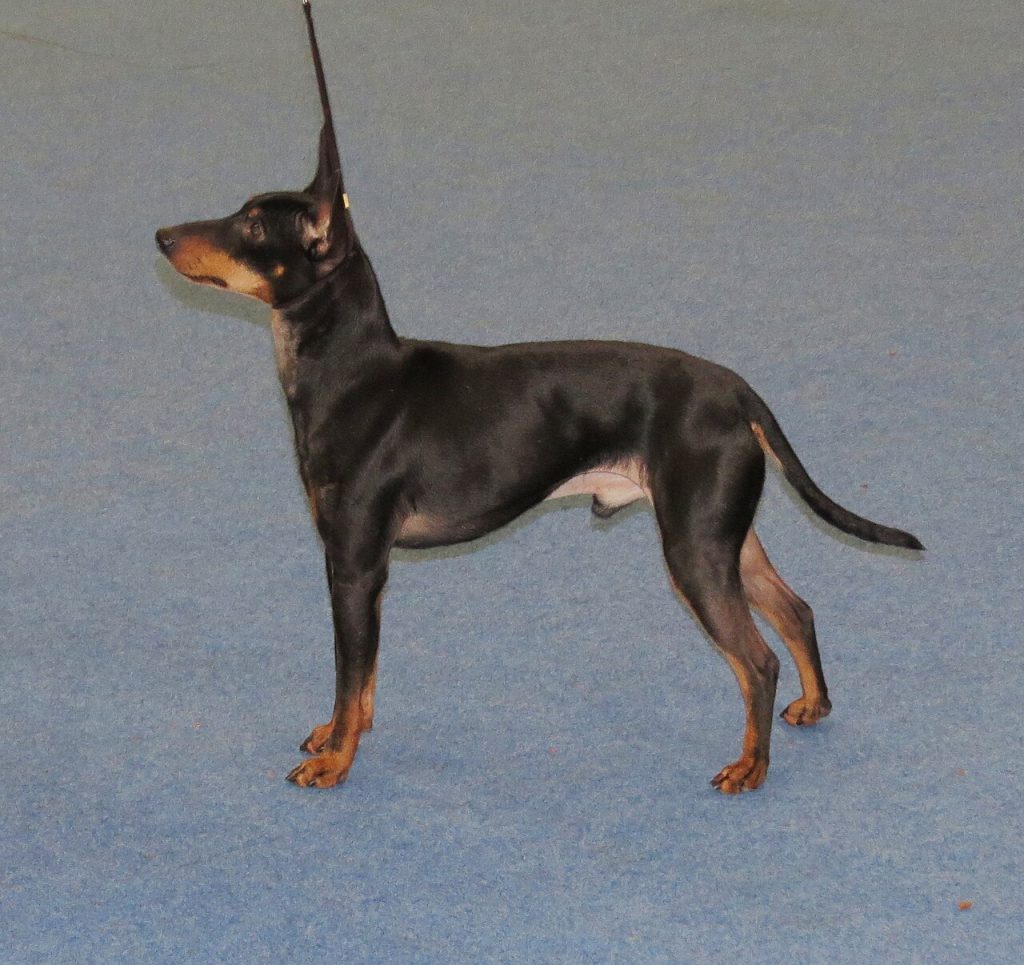
The Toy Terrier Inglés is one of the smallest and most elegant companion dogs Britain has ever produced: a miniature terrier with short, black, fiery hair, a fine, athletic body and upraised “candle flame” ears that are its hallmark. Behind his refined appearance beats the lively heart of a Victorian rat-hunter. If you are looking for a tiny but alert, affectionate and manageable dog on the floor, the English Toy Terrier deserves your attention, although it is good to know his terrier character and physical fragility well before deciding.
Is the English Toy Terrier for you?
It is a perfect dog for those who live in a flat, spend time at home and want a small, clean and devoted companion, but with a spark. It is not a passive “purse” dog: it retains hunting instinct, terrier energy and a clear tendency to watch. It is also not the ideal dog for a house with very small and abrupt children, because its size makes it fragile.
In favour .
- Minimum size: comfortable on floors and to be carried everywhere.
- Short hair: very low grooming maintenance.
- Very close to his family, loving and loyal.
- He’s sharp and smart, he learns fast.
- Good alarm dog for his size.
- It needs less exercise in quantity than a large terrier.
Against
- Fragile: not suitable for households with very young or abrupt children.
- Sensitive to cold; needs a coat in winter.
- Prey instinct for rodents and small animals.
- He can bark at strangers and make noises if he’s not polite.
- He can’t stand prolonged loneliness.
- Very rare breed: hard to find and with few breeders.
Character and temperament

The English Toy Terrier combines two souls: that of the companion dog, deeply attached to its people, and that of the working terrier, alert and determined. At home it is affectionate, seeks lap and warmth, and usually chooses a reference person with whom it creates a very close bond. It is a dog that learns everything, follows your footsteps around the house and enjoys participating in family life.
That tender side comes with a lively and somewhat intense character. He’s curious, brave for his size and quick on reflexes. It doesn’t have the extreme stubbornness of some of the larger terriers, but it does have its liveliness: It reacts to stimuli, watches the door and alerts you to what’s happening. Well socialized he is balanced and sociable; uneducated he may become nervous or barking. He is, in short, a small dog with a big personality.
Coexistence: children, other pets, flat and loneliness
With children: The English Toy Terrier is affectionate, but its thin skeleton and light weight make it vulnerable to falls and abrupt handling. It fits better in homes with older children who understand how to treat a tiny dog.
With other pets: can coexist well with other dogs and, if socialized as a puppy, also with house cats.
On the floor: is one of the best apartment dogs available in terms of size and needs. It takes up little space, dirty little and adapts to urban life. Of course, it needs your walks and attention: the floor does not replace exercise or company.
Soledad: is a dog that is very attached to his family and has difficulty spending many hours alone.
Education and training

It is an intelligent dog that learns quickly when it is well motivated. It responds wonderfully to positive reinforcement (rewards, voice, play) and very poorly to harsh methods: with such a small and sensitive dog, punishment only generates fear and mistrust. Short, cheerful and constant sessions are the key.
Two priorities in his education. The first, the early socialization: exposing him as a puppy to people, noises, other dogs and situations so that he grows up safe and non-reactive. The second, the barking control and guard: as a good watchdog, tends to warn; it is good to teach him from the beginning to calm down to order so that the warning does not become a chronic barking. Learning cleanliness may take a little more patience, as with many toy breeds, so a very regular routine helps.
Exercise and activity
Although it fits in a bag, the English Toy Terrier is an athletic and agile dog that enjoys moving. It doesn’t need the long hours of a working dog, but it does need daily walks and playtime that burn its energy and stimulate its mind. A couple of outings a day plus some play at home are usually enough to keep it balanced.
He loves to run, chase toys and “hunting” games that appeal to his instinct. He is smart and fast enough to shine in activities such as small-scale agility or olfactory games. Two things should be watched: the cold (he is cold, better coat in winter) and his tendency to throw himself after small animals, so in open areas control or leash are prudent.
Care: fur and hygiene

Its short, dense, and shiny coat is one of the easiest to care for. A weekly brushing with a glove or a soft brush is all that is needed to remove the dead hair and maintain the shine, and an occasional bath when it gets dirty.
Where we must be consistent is on other fronts. Being a toy breed, the dental hygiene is important: brushing your teeth regularly to prevent tartar and gum problems Check and trim the toenails, clean the ears upright and attend to their cold sensitivity: In winter, especially in harsh climates, a little coat helps keep it cool on walks because of its fine hair and low body fat.
Foodstuffs
It needs a quality food formulated for small dogs, with croquettes of the right size for its mouth.Because it is so light, the quantities are reduced and it is advisable to divide the ration into two servings to keep its energy stable, especially in puppies, in which possible sugar drops must be monitored.
Control of the weight is key: a few extra grams are very noticeable in a dog that weighs just 3 kilos, and the excess weight overloads its fine joints. Measure rations, moderate rewards and avoid human food scraps. Always have fresh water available and adjust the diet to its age, activity and the indications of your veterinarian.
Health and life expectancy
It is a small dog and, in general, long-lived and rustic within its fragility: its life expectancy is around 12-13 years, and it is not uncommon that it reaches good health at older ages.
- Primary lens dislocation (PLL): hereditary eye disorder described in terriers; genetic proof is available.
- Dislocation of the patella: common in small breeds, can cause limping.
- Xantinuria: metabolic disorder that may favor urinary stones, monitored in the breed lines.
- Dental problems: common in toy dogs; hence the importance of oral hygiene.
- Sensitivity to cold: more a feature than a disease, but important in its management.
Choosing a puppy from a responsible breeder, who tests the health of the parents and socializes the young, is the best guarantee.
Physical appearance
The English Toy Terrier is a small, compact and elegant dog with fine lines reminiscent of a miniature Manchester Terrier. According to the British standard it measures between 25 and 30 cm to the cross and weighs between 2,7 and 3,6 kg. Its silhouette is athletic, narrow-chested, back slightly arched over the back and thin limbs; when moving, its trot is reminiscent of the extended step of a horse.
The only color supported is the black and fire: A black coat with fire-colored markings on the legs, chest and face. The hair is short, dense and shiny, attached to the body. It has small almond-shaped eyes, dark and expressive, and its most characteristic feature: ears erect in the shape of a “candle flame”(candle-flame), thin, pointed and naturally raised, without cuts. That combination of elegance, finesse and distinctive ears makes it unmistakable.
Origin and history
The English Toy Terrier descends from the older Old English Black and Tan Terrier and is closely related to the Manchester Terrier, its larger version. Their origins lie in a very different world from today’s house dog: The “rat pits” of Victorian England, where you put terriers in a rat pit and bet on which one would kill their share in the shortest time. The smaller the dog was able to do it, the more it was valued, and that selection toward the miniature gave rise to the breed.
There is a legend from that time: In 1848 it was recorded that a Black and Tan Terrier called Tiny the Wonder, weighing just 2.5 kg, killed 200 rats in less than an hour. When those shows were banned, coinciding with the founding of the Kennel Club, the elegant black and fire terrier made the leap into the show ring. In 1903 the first Black and Tan Terrier (Miniature) was registered, and the current name, English Toy Terrier (Black and Tan), was adopted in 1960.
Specimens of all sizes were exported to Canada and the United States, where they founded a population that for decades was isolated from the European and resulted in the Toy Manchester Terrier. In North America, the two sizes were unified in 1958 as a single breed, the Manchester Terrier, with two varieties (standard and toy). Today the English Toy Terrier is on the vulnerable native breeds list of the British Kennel Club, with barely a hundred puppies registered a year, and work is underway to expand its genetic base.
Curiosities
- Its distinguishing feature, the “candle flame” ears, must be naturally erect: they are never cut.
- Tiny the Wonder, the terrier that killed 200 rats in less than an hour in 1848, weighed just over 2 kilos.
- It’s a vulnerable native breed in the UK: only about 100 are born a year.
- The Kennel Club opened its book of origins to allow re-registration of North American Toy Manchester Terriers and reinforcement of the genetic stock.
- It is one of the smallest terriers in the world and belongs, at the same time, to the group of FCI terriers.
- In the Victorian era, it was a popular dog among elegant ladies, who appreciated its finesse and clean hair.
If you are attracted to this small black and fire terrier, you may be interested in other breeds that are similar in size, temperament, or appearance: the Yorkshire Terrier, another companion toy terrier; the Chihuahua, the quintessential miniature dog; the Dóberman, which shares the characteristic black and fire pattern with the big one; and the Whippet, with the same fine, athletic, elegant silhouette.
Frequently Asked Questions about the English Toy Terrier
How tall and how much does an English Toy Terrier weigh?
According to British standards it measures between 25 and 30 cm at the withers and weighs between 2.7 and 3.6 kg, making it one of the smallest terriers in existence.
Is he a good dog for the floor?
For its minimal size, short hair and moderate needs it adapts very well to apartment life, provided it receives its daily walks and company.
Do you get along with children?
It is affectionate, but its thin skeleton makes it fragile. It fits better with older, caring children; very young ones require constant supervision to avoid injury.
How long does the English Toy Terrier live?
Their life expectancy is about 12-13 years, and with proper care they are not uncommon to reach older ages, as is often the case with small breeds.
Does he bark a lot?
With socialization and early education, it is well controlled and does not have to become a barking dog.
Do you need a lot of exercise?
Less than a large terrier, but more than a passive saloon dog, a couple of daily walks and moments of play that stimulate body and mind are enough to keep him balanced.
Is this a rare breed?
It’s listed as a vulnerable native breed in the UK, with barely a hundred puppies registered a year, so finding a serious breeder may require patience.
Are you cold?
His short, fine hair and low body fat make him chilly, so in winter, especially in harsh weather, he appreciates a coat for walks.